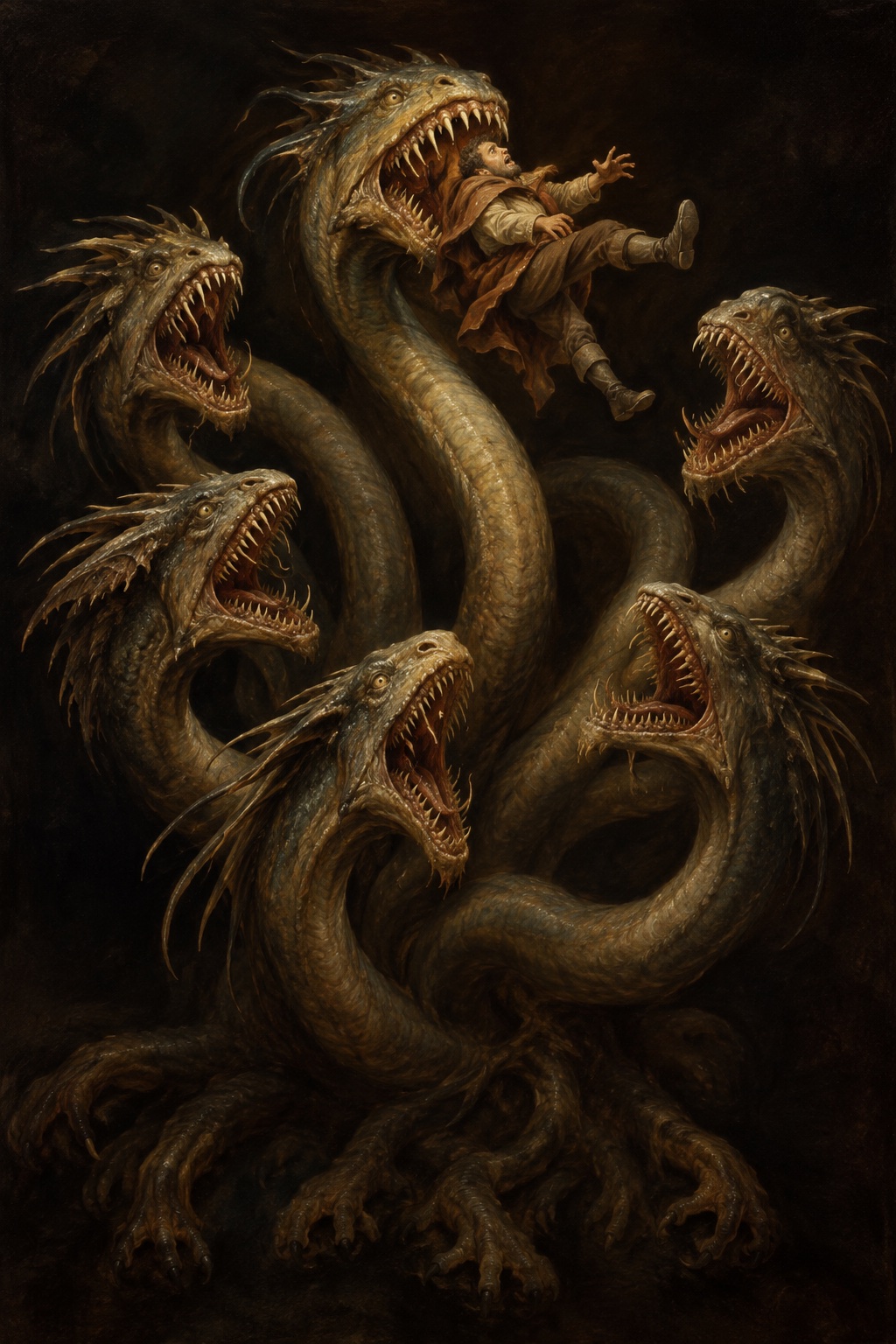
The cave in the cliff
Homer tells of Scylla in the twelfth book of the Odyssey. The goddess Circe warns Odysseus about the sea road ahead of him, and she describes two ways. The second way runs between two cliffs. The higher cliff reaches the broad sky with its sharp peak, and a dark cloud always surrounds it. Its rock is smooth, as if it were polished, and no man could climb it. In the middle of the cliff is a dim cave that faces the west. Not even a strong man could shoot an arrow from a ship into it. Scylla lives in that cave.
ἔνθα δ’ ἐνὶ Σκύλλη ναίει δεινὸν λελακυῖα. τῆς ἦ τοι φωνὴ μὲν ὅση σκύλακος νεογιλλῆς γίνεται, αὐτὴ δ’ αὖτε πέλωρ κακόν· οὐδέ κέ τίς μιν γηθήσειεν ἰδών, οὐδ’ εἰ θεὸς ἀντιάσειε. τῆς ἦ τοι πόδες εἰσὶ δυώδεκα πάντες ἄωροι, ἓξ δέ τέ οἱ δειραὶ περιμήκεες, ἐν δὲ ἑκάστῃ σμερδαλέη κεφαλή, ἐν δὲ τρίστοιχοι ὀδόντες, πυκνοὶ καὶ θαμέες, πλεῖοι μέλανος θανάτοιο. μέσση μέν τε κατὰ σπείους κοίλοιο δέδυκεν, ἔξω δ’ ἐξίσχει κεφαλὰς δεινοῖο βερέθρου· αὐτοῦ δ’ ἰχθυάᾳ, σκόπελον περιμαιμώωσα, δελφῖνάς τε κύνας τε καὶ εἴ ποθι μεῖζον ἕλῃσι κῆτος, ἃ μυρία βόσκει ἀγάστονος Ἀμφιτρίτη. τῇ δ’ οὔ πώ ποτε ναῦται ἀκήριοι εὐχετόωνται παρφυγέειν σὺν νηΐ· φέρει δέ τε κρατὶ ἑκάστῳ φῶτ’ ἐξαρπάξασα νεὸς κυανοπρῴροιο
“Therein dwells Scylla, yelping terribly. Her voice is indeed but as the voice of a new-born whelp, but she herself is an evil monster, nor would anyone be glad at sight of her, no, not though it were a god that met her. Verily she has twelve feet, all misshapen, and six necks, exceeding long, and on each one an awful head, and therein three rows of teeth, thick and close, and full of black death. Up to her middle she is hidden in the hollow cave, but she holds her head out beyond the dread chasm, and fishes there, eagerly searching around the rock for dolphins and sea-dogs and whatever greater beast she may haply catch, such creatures as deep-moaning Amphitrite rears in multitudes past counting. By her no sailors yet may boast that they have fled unscathed in their ship, for with each head she carries off a man, snatching him from the dark-prowed ship” — Homer, Odyssey 12.85–100, tr. Murray
The first thing that Circe gives is a home. ἔνθα δ’ ἐνὶ Σκύλλη ναίει: therein dwells Scylla. The verb ναίει means to live in a place. The cave is Scylla’s home. The second thing is a sound. δεινὸν λελακυῖα: she yelps terribly. Then Circe measures the sound. τῆς ἦ τοι φωνὴ μὲν ὅση σκύλακος νεογιλλῆς γίνεται: her voice is only as great as the voice of a new-born whelp. The next words turn against that. αὐτὴ δ’ αὖτε πέλωρ κακόν: but she herself is an evil monster. The sentence puts the small voice first and the monster second.
The word for the whelp, σκύλακος, is close in sound to her name, Σκύλλη, and the two words stand only a line apart. Circe’s speech does not link them, and this entry does not claim that one word comes from the other.
The last clause of the first sentence tells how Scylla looks to others. οὐδέ κέ τίς μιν γηθήσειεν ἰδών, οὐδ’ εἰ θεὸς ἀντιάσειε: no one would be glad to see her, not though it were a god that met her. The clause does not stop at men. It names a god too among those who would take no joy in the sight of her.
Six necks and twelve feet
Then Circe counts. τῆς ἦ τοι πόδες εἰσὶ δυώδεκα πάντες ἄωροι: Scylla has twelve feet, all of them ἄωροι, which Murray renders misshapen. ἓξ δέ τέ οἱ δειραὶ περιμήκεες: she has six necks, and they are very long. ἐν δὲ ἑκάστῃ σμερδαλέη κεφαλή: on each neck there is a terrible head. ἐν δὲ τρίστοιχοι ὀδόντες: in each head there are teeth in three rows, πυκνοὶ καὶ θαμέες, thick and close, and πλεῖοι μέλανος θανάτοιο, full of black death. The numbers are exact, and one of them comes back later in the book. Six necks carry six heads, and later in the book six heads take six men.
The next sentence places the body in the cave. μέσση μέν τε κατὰ σπείους κοίλοιο δέδυκεν: up to her middle she is sunk in the hollow cave. ἔξω δ’ ἐξίσχει κεφαλὰς δεινοῖο βερέθρου: she holds her heads out of the dread chasm. Murray writes her head, in the singular, but the Greek word κεφαλὰς is plural. The text does not say where the twelve feet are. The part of her that comes out of the cave is the heads.
From that place she hunts. αὐτοῦ δ’ ἰχθυάᾳ, σκόπελον περιμαιμώωσα: she fishes there, eagerly searching around the rock. Her catch is δελφῖνάς τε κύνας τε, dolphins and dogs, which Murray calls sea-dogs, and any greater κῆτος, a sea beast, that she can take. These are the creatures that ἀγάστονος Ἀμφιτρίτη, deep-moaning Amphitrite, rears past counting. The sea goddess comes into the passage as the one who feeds Scylla’s prey. The text does not make her kin to Scylla.
Last comes the danger to men. τῇ δ’ οὔ πώ ποτε ναῦται ἀκήριοι εὐχετόωνται παρφυγέειν σὺν νηΐ: no sailors yet can boast that they got past her with their ship unscathed. φέρει δέ τε κρατὶ ἑκάστῳ φῶτ’ ἐξαρπάξασα: with each head she snatches a man and carries him off. Circe does not describe a fight. She describes a toll, one man for each head.
This is the whole of her body in Homer’s text. It gives her twelve feet, six necks, six heads and three rows of teeth in each head. It gives her no human part, and nothing in these lines makes her a woman above the waist. It gives her no dogs’ heads either. The only dogs in the passage are the whelp that her voice is likened to and the κύνας, the sea-dogs, that she hunts.
Six men from the ship
Under the lower of the two cliffs, Circe says, Charybdis sucks down the black water three times a day, and no one could save him there. So her advice is to keep close to Scylla’s cliff and drive the ship past quickly. It is better far, in Murray’s words, to mourn six comrades in thy ship than all together (12.108–110).
At the strait, Odysseus does not tell his men about Scylla. He calls her a cureless bane, and he fears that his men would stop rowing and huddle together in the hold (12.223–225). Then he forgets Circe’s command not to arm himself. He puts on his armour, takes two long spears in his hand and goes to the fore-deck, where he expects Scylla of the rock to show herself first. He cannot see her anywhere, and his eyes grow weary from looking at the misty rock (12.226–233). On the other side Charybdis boils and sucks down the sea, and the men look at her in fear. While they look, Scylla strikes.
τόφρα δέ μοι Σκύλλη γλαφυρῆς ἐκ νηὸς ἑταίρους ἓξ ἕλεθ’, οἳ χερσίν τε βίηφί τε φέρτατοι ἦσαν. σκεψάμενος δ’ ἐς νῆα θοὴν ἅμα καὶ μεθ’ ἑταίρους ἤδη τῶν ἐνόησα πόδας καὶ χεῖρας ὕπερθεν ὑψόσ’ ἀειρομένων· ἐμὲ δὲ φθέγγοντο καλεῦντες ἐξονομακλήδην, τότε γ’ ὕστατον, ἀχνύμενοι κῆρ. ὡς δ’ ὅτ’ ἐπὶ προβόλῳ ἁλιεὺς περιμήκεϊ ῥάβδῳ ἰχθύσι τοῖς ὀλίγοισι δόλον κατὰ εἴδατα βάλλων ἐς πόντον προΐησι βοὸς κέρας ἀγραύλοιο, ἀσπαίροντα δ’ ἔπειτα λαβὼν ἔῤῥιψε θύραζε, ὣς οἵ γ’ ἀσπαίροντες ἀείροντο προτὶ πέτρας. αὐτοῦ δ’ εἰνὶ θύρῃσι κατήσθιε κεκλήγοντας, χεῖρας ἐμοὶ ὀρέγοντας ἐν αἰνῇ δηϊοτῆτι
“Scylla seized from out the hollow ship six of my comrades who were the best in strength and in might. Turning my eyes to the swift ship and to the company of my men, even then I noted above me their feet and hands as they were raised aloft. To me they cried aloud, calling upon me by name for that last time in anguish of heart. And as a fisher on a jutting rock, when he casts in his baits as a snare to the little fishes, with his long pole lets down into the sea the horn of an ox of the steading, and then as he catches a fish flings it writhing ashore, even so were they drawn writhing up towards the cliffs. Then at her doors she devoured them shrieking and stretching out their hands toward me in their awful death-struggle” — Homer, Odyssey 12.245–257, tr. Murray
The number is the one that Circe gave. ἓξ ἕλεθ’: she took six. And they were not any six. οἳ χερσίν τε βίηφί τε φέρτατοι ἦσαν: they were the best in strength and in might. Odysseus is looking at Charybdis when it happens. He turns to the ship and sees only πόδας καὶ χεῖρας, the feet and hands of his men, above him, ὑψόσ’ ἀειρομένων, as they are lifted high. They call him by name, ἐξονομακλήδην, and the text adds τότε γ’ ὕστατον, for that last time.
Then Homer gives a simile, and it turns the fishing in Circe’s speech against the men. In her speech Scylla fished for dolphins. Here she is like an ἁλιεὺς, a fisher, on a jutting rock, who lets his bait down into the sea on a long pole and flings the small fish ashore. The pole is περιμήκεϊ, very long, and it is the same adjective that Circe used for the six necks, περιμήκεες. The caught fish is ἀσπαίροντα, writhing, and the men are ἀσπαίροντες too. ὣς οἵ γ’ ἀσπαίροντες ἀείροντο προτὶ πέτρας: even so were they drawn writhing up towards the cliffs. The men are the catch.
αὐτοῦ δ’ εἰνὶ θύρῃσι κατήσθιε κεκλήγοντας: there at her doors she ate them as they shrieked. Homer’s word for the mouth of her cave is θύρῃσι, doors, and it goes with Circe’s first verb, ναίει: the cave is the place where Scylla lives. The men die χεῖρας ἐμοὶ ὀρέγοντας, stretching out their hands to Odysseus, ἐν αἰνῇ δηϊοτῆτι, in their awful death-struggle. Odysseus says that of all he suffered on the paths of the sea, this was the most pitiful thing that his eyes saw (12.258–259).
He comes back through the strait once more, later in the book. By then he is alone, and he rows with his hands, sitting on timbers that Charybdis has thrown up. Scylla does not take him. Zeus, the father of gods and men, did not let her catch sight of him again, and Odysseus says that otherwise he would not have escaped utter destruction (12.445–446).
Crataiis, her mother
Before Odysseus sails, he asks Circe whether he could escape Charybdis and still ward off Scylla when she attacks his men. Circe calls him rash. Scylla is not mortal, but an immortal bane, she says. There is no defence against her, and to flee from her is bravest (12.116–120). If he stops by the cliff to arm himself, Scylla may dart out again and take as many men as she has heads. So he must row past with all his strength and call on the one being who can hold Scylla back.
βωστρεῖν δὲ Κράταιϊν, μητέρα τῆς Σκύλλης, ἥ μιν τέκε πῆμα βροτοῖσιν
“and call upon Crataiis, the mother of Scylla, who bore her for a bane to mortals” — Homer, Odyssey 12.124–125, tr. Murray
βωστρεῖν δὲ Κράταιϊν: call upon Crataiis. The line gives Crataiis one role only. She is μητέρα τῆς Σκύλλης, the mother of Scylla, and ἥ μιν τέκε πῆμα βροτοῖσιν, she bore her for a bane to mortals. The phrase names what Scylla is to mortals, and it gives no reason for the birth. The next line gives the reason for the call. Crataiis will then keep her daughter from darting out again (12.126). So the mother is the one power in Circe’s speech that can hold Scylla back. The text does not say how she does it.
Book 12 tells nothing more about Crataiis. It gives her no parents, no home and no shape, and it names no father for Scylla. It also gives no story of how Scylla came to the cliff. In the book she is simply there, immortal, in the cave where she lives.