Three shares, not one
Hesiod interrupts his own catalogue for her. The Theogony is moving through the children of the Titans at speed, a line or two each, when it stops at the daughter of Asteria and Perses and spends forty verses on her — the longest continuous praise of any single deity in the poem.
ὑποκυσαμένη Ἑκάτην τέκε, τὴν περὶ πάντων Ζεὺς Κρονίδης τίμησε· πόρεν δέ οἱ ἀγλαὰ δῶρα, μοῖραν ἔχειν γαίης τε καὶ ἀτρυγέτοιο θαλάσσης. Ἥ δὲ καὶ ἀστερόεντος ἀπ᾽ οὐρανοῦ ἔμμορε τιμῆς ἀθανάτοις τε θεοῖσι τετιμένη ἐστὶ μάλιστα
“And she conceived and bare Hecate whom Zeus the son of Cronos honoured above all. He gave her splendid gifts, to have a share of the earth and the unfruitful sea. She received honour also in starry heaven, and is honoured exceedingly by the deathless gods.” — Theogony 411–415, tr. Hugh G. Evelyn-White
The three shares are the point. Every other Olympian in this wiki holds one province: Poseidon the sea, Hades the underworld, Zeus the sky, and the division that gave them those provinces gave each of them only one. Hecate has a μοῖρα in earth, in the barren sea and in the starry heaven at once, and Hesiod lists no domain she is confined to. What follows in the hymn is a catalogue of situations rather than a jurisdiction: she stands beside kings in the assembly, gives victory in games, brings in the catch with Poseidon, increases the herds with Hermes, and takes any of it away again if she chooses.
What Zeus did not take
The regime change is the hard part of a Greek theogony. The Titans lose, and the poem has to account for what happened to their honours. Hesiod’s answer for Hecate is that nothing happened to them.
Κρονίδης ἐβιήσατο οὐδέ τ᾽ ἀπηύρα, ὅσσ᾽ ἔλαχεν Τιτῆσι μετὰ προτέροισι θεοῖσιν, ἀλλ᾽ ἔχει, ὡς τὸ πρῶτον ἀπ᾽ ἀρχῆς ἔπλετο δασμός, καὶ γέρας ἐν γαίῃ τε καὶ οὐρανῷ ἠδὲ θαλάσσῃ
“The son of Cronos did her no wrong nor took anything away of all that was her portion among the former Titan gods: but she holds, as the division was at the first from the beginning, privilege both in earth, and in heaven, and in sea.” — Theogony 423–426, tr. Hugh G. Evelyn-White
Read against the rest of the poem, that sentence is extraordinary. Cronus is in Tartarus. Iapetus and Menoetius are put down. Atlas is holding up the sky as a sentence. Prometheus is chained. Hecate is Titan stock on both sides and she keeps her original allotment intact, under a new king who is said to honour her above all. Hesiod gives no reason. He does not say she changed sides, and he does not say she was spared for services rendered; he says the division was made at the beginning and she still has what it gave her.
The absence of an explanation is what makes scholars uneasy about this passage and what makes it the most interesting thing in the entry. A poem that spends its whole length explaining who holds what and why simply declines to explain the one figure whose holdings survive the war.
The tenth dawn
The other early text that gives her a scene is the Homeric Hymn to Demeter, and there she does something no one else in the hymn does: she volunteers information.
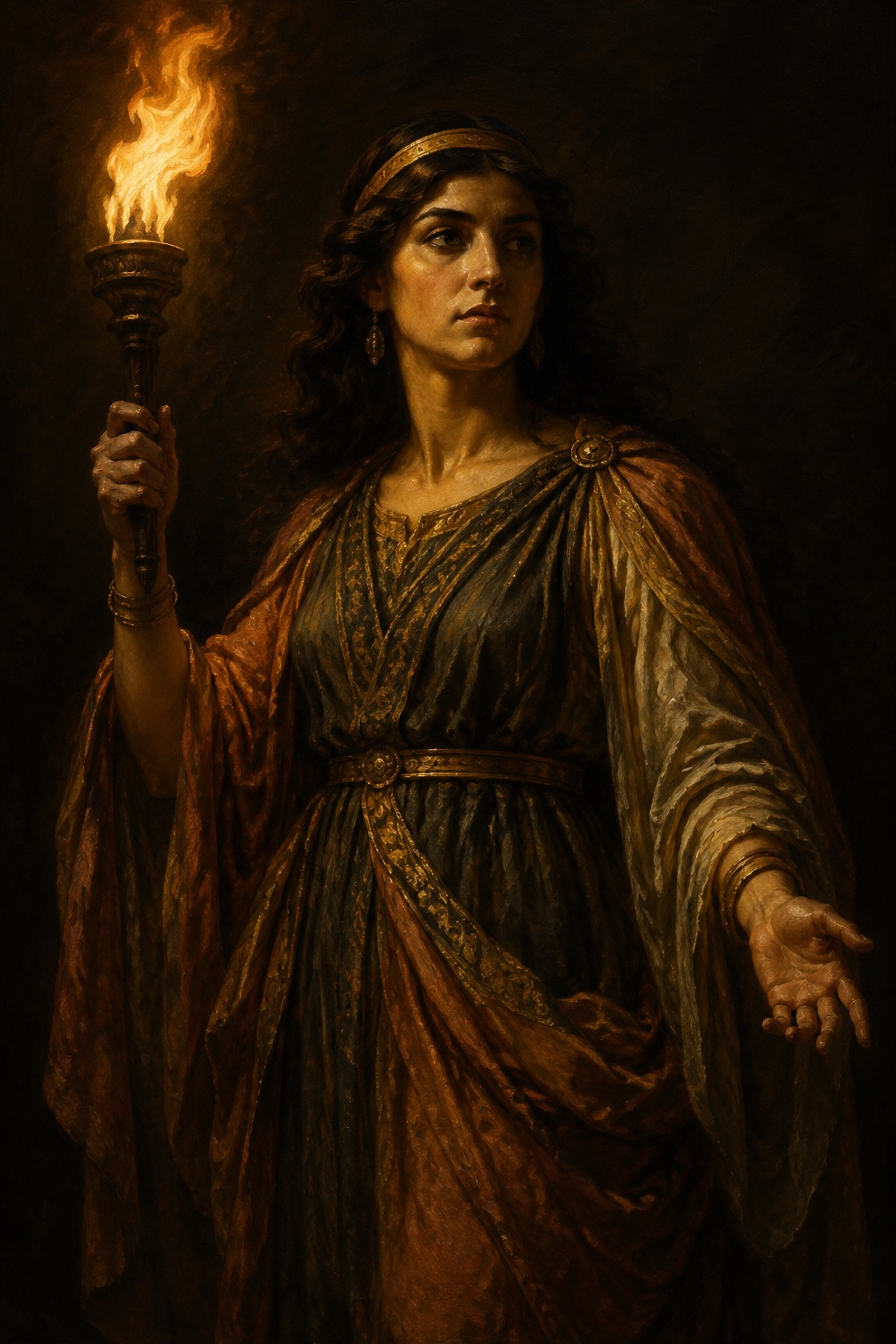
Demeter has been searching for nine days with burning torches, eating nothing, washing in nothing. On the tenth dawn Hecate meets her — “with a torch in her hands”, the hymn says — and tells her the one thing she actually knows, which is that she heard Persephone’s voice and did not see who took her. It is a small piece of evidence honestly bounded, and it is what sends the two goddesses to Helios, who did see. The scene is already told from the sun’s side in this wiki’s Helios entry; from Hecate’s side, what stands out is that she is under no obligation to speak at all.
She is also there at the end, when the daughter comes back.
ἐγγύθεν ἦλθ’ Ἑκάτη λιπαροκρήδεμνος, πολλὰ δ’ ἄρ’ ἀμφαγάπησε κόρην Δημήτερος ἁγνής· ἐκ τοῦ οἱ πρόπολος καὶ ὀπάων ἔπλετ’ ἄνασσα
“Then bright-coiffed Hecate came near to them, and often did she embrace the daughter of holy Demeter: and from that time the lady Hecate was minister and companion to Persephone.” — Homeric Hymn 2.438–440, tr. Hugh G. Evelyn-White
πρόπολος καὶ ὀπάων — attendant and companion. The goddess who answers to nobody in the Theogony attaches herself, permanently and by choice, to the one goddess in the pantheon who spends a third of every year underground. Nothing compels it and nothing in the hymn presents it as a demotion. It is the first text to put Hecate beside the dead, and it does so through an embrace.
What the early texts do not have
Almost everything the name now carries is later than these two poems. The three faces, the crossroads, the dogs, the drawn-down moon, the goddess witches call on — none of it is in Hesiod, and none of it is in the hymn. What is in them is a Titan’s daughter with an undiminished portion of the whole world, and an only child: Hesiod notes that she is her mother’s single offspring and says the honour is greater for it, not smaller.
The later Hecate grew out of the earlier one along a visible seam. A goddess who holds earth, sea and sky at once but rules no province of them is, structurally, a goddess of the places between — and the crossroads is exactly the place between. The magic came afterwards, and the wiki’s other Greek entries reach for her in the dark for the same reason the hymn did: she is the one who is already out there with a light.