Watchman of both gods and men
Helios is the son of the Titans Hyperion and Theia, and brother to Selene, the moon, and Eos, the dawn — the three of them born to their parents in a single sentence of Hesiod’s, the tidiest genealogy in the whole poem. Of the three, Helios is the one who gets a plot of his own. The Homeric Hymn to Demeter addresses him directly as “watchman of both gods and men,” and the phrase is not decoration: in a pantheon where every god has a portfolio, his is simply to look, continuously, at everything the sun’s light reaches.
That job becomes the plot of the hymn’s own crisis. When Persephone is seized and no one on earth can say who took her, it is Helios — not Zeus, not any god with more standing in Olympus’s own affairs — that the searching goddesses have to go and find.
The one who saw
Demeter has spent nine days searching by torchlight, eating nothing and washing nothing, and has learned nothing. Hecate joins her, and together — the hymn’s own verb for their arrival is plural — the two goddesses come to the last god who might actually have seen something, and find him already standing with his horses.
Ἠέλιον δ’ ἵκοντο, θεῶν σκοπὸν ἠδὲ καὶ ἀνδρῶν, στὰν δ’ ἵππων προπάροιθε καὶ εἴρετο δῖα θεάων· Ἠέλι’ αἴδεσσαί με θεὰν σύ περ, εἴ ποτε δή σευ ἢ ἔπει ἢ ἔργῳ κραδίην καὶ θυμὸν ἴηνα. κούρην τὴν ἔτεκον γλυκερὸν θάλος εἴδεϊ κυδρὴν τῆς ἀδινὴν ὄπ’ ἄκουσα δι’ αἰθέρος ἀτρυγέτοιο ὥστε βιαζομένης, ἀτὰρ οὐκ ἴδον ὀφθαλμοῖσιν. ἀλλά, σὺ γὰρ δὴ πᾶσαν ἐπὶ χθόνα καὶ κατὰ πόντον αἰθέρος ἐκ δίης καταδέρκεαι ἀκτίνεσσι, νημερτέως μοι ἔνισπε φίλον τέκος εἴ που ὄπωπας ὅς τις νόσφιν ἐμεῖο λαβὼν ἀέκουσαν ἀνάγκῃ οἴχεται ἠὲ θεῶν ἢ καὶ θνητῶν ἀνθρώπων. Ὢς φάτο, τὴν δ’ Ὑπεριονίδης ἠμείβετο μύθῳ· Ῥείης ἠϋκόμου θυγάτηρ Δήμητερ ἄνασσα εἰδήσεις· δὴ γὰρ μέγα σ’ ἅζομαι ἠδ’ ἐλεαίρω ἀχνυμένην περὶ παιδὶ τανυσφύρῳ· οὐδέ τις ἄλλος αἴτιος ἀθανάτων εἰ μὴ νεφεληγερέτα Ζεύς, ὅς μιν ἔδωκ’ Ἀίδῃ θαλερὴν κεκλῆσθαι ἄκοιτιν αὐτοκασιγνήτῳ· ὅ δ’ ὑπὸ ζόφον ἠερόεντα ἁρπάξας ἵπποισιν ἄγεν μεγάλα ἰάχουσαν. ἀλλά, θεά, κατάπαυε μέγαν γόον· οὐδέ τί σε χρὴ μὰψ αὔτως ἄπλητον ἔχειν χόλον· οὔ τοι ἀεικὴς γαμβρὸς ἐν ἀθανάτοις Πολυσημάντωρ Ἀιδωνεὺς αὐτοκασίγνητος καὶ ὁμόσπορος· ἀμφὶ δὲ τιμὴν ἔλλαχεν ὡς τὰ πρῶτα διάτριχα δασμὸς ἐτύχθη· τοῖς μεταναιετάει τῶν ἔλλαχε κοίρανος εἶναι
“So they came to Helios, who is watchman of both gods and men, and stood in front of his horses: and the bright goddess enquired of him: ‘Helios, do you at least regard me, goddess as I am, if ever by word or deed of mine I have cheered your heart and spirit. Through the fruitless air I heard the thrilling cry of my daughter whom I bare, sweet scion of my body and lovely in form, as of one seized violently; though with my eyes I saw nothing. But you — for with your beams you look down from the bright upper air Over all the earth and sea — tell me truly of my dear child, if you have seen her anywhere, what god or mortal man has violently seized her against her will and mine, and so made off.’ So said she. And the Son of Hyperion answered her: ‘Queen Demeter, daughter of rich-haired Rhea, I will tell you the truth; for I greatly reverence and pity you in your grief for your trim-ankled daughter. None other of the deathless gods is to blame, but only cloud-gathering Zeus who gave her to Hades, her father’s brother, to be called his buxom wife. And Hades seized her and took her loudly crying in his chariot down to his realm of mist and gloom. Yet, goddess, cease your loud lament and keep not vain anger unrelentingly: Aidoneus, the Ruler of Many, is no unfitting husband among the deathless gods for your child, being your own brother and born of the same stock: also, for honour, he has that third share which he received when division was made at the first, and is appointed lord of those among whom he dwells.’” — Homeric Hymn 2, To Demeter 62–87, tr. Evelyn-White
Demeter’s own plea explains why she has come to Helios rather than to any other god. She heard her daughter’s cry carried through the empty air, but with her own eyes she saw nothing; he is the one figure whose sight reaches everywhere hers cannot. Helios does not equivocate, defer to Zeus’s authority, or make her drag the truth out of him. He answers exactly as the question was put: Hades took Persephone, Zeus arranged the marriage beforehand, and — whether or not it is any comfort — the match is not a bad one by the standards the gods themselves keep. It is the only complete, unprompted answer any god gives Demeter anywhere in the hymn, and it is complete because Helios is the only one who was actually watching.
Team, chariot, and the beams that look down
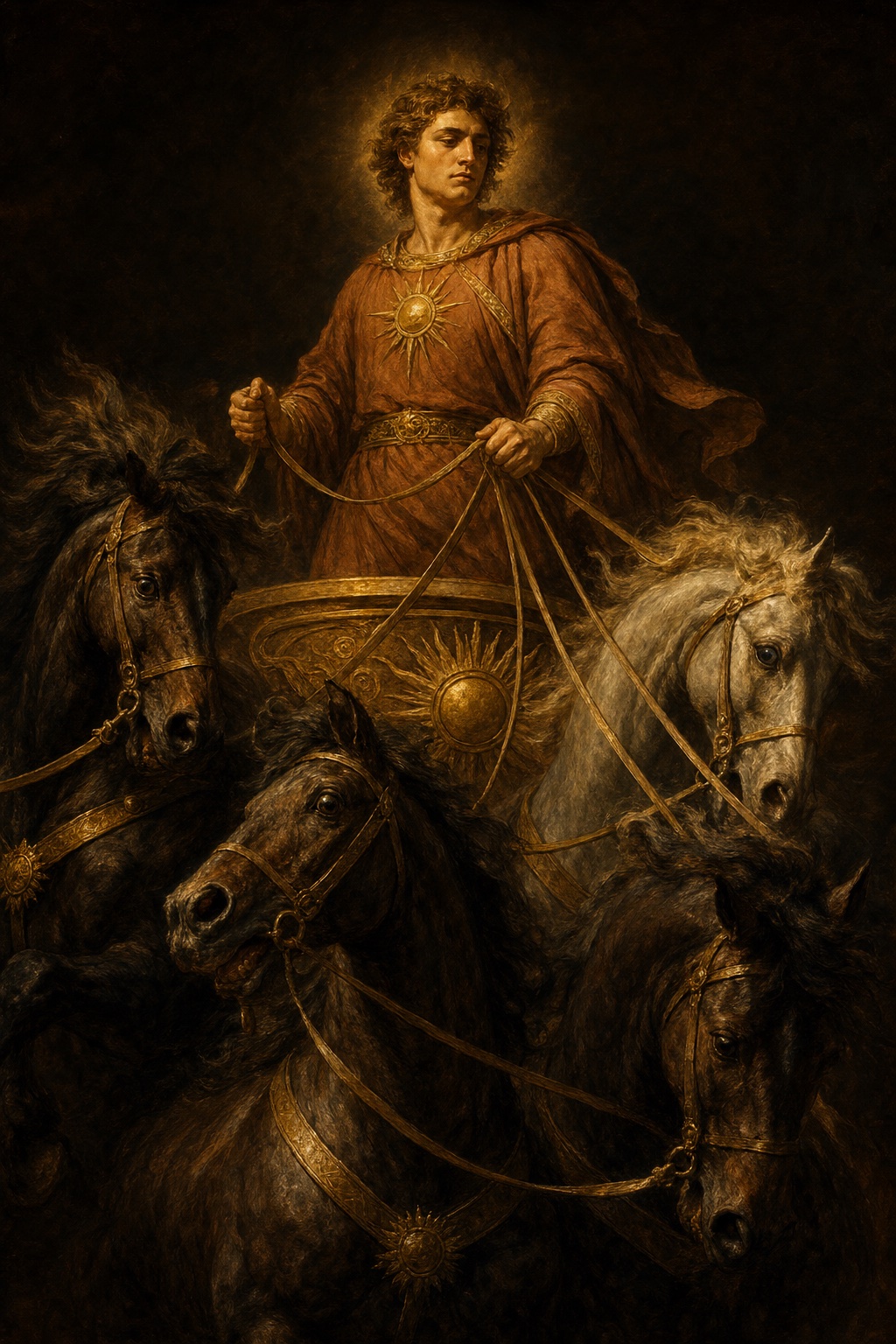
The same scene supplies Helios’s own attributes, distinct from his father’s. Demeter and Hecate find him already at his horses — a team, though the hymn never gives a number, and the four-horse quadriga of later art is a habit of Roman-period imagination, not a Homeric one. Once he has spoken, he calls the team on and the chariot carries him off; horses and chariot are the two concrete objects this passage actually attaches to him, earned in his own scene rather than inherited from Hyperion.
The third attribute is the one Demeter names herself, in the middle of her plea, as the very reason she has come to him at all: he looks down from the bright upper air, over all the earth and sea, by his own beams. For Helios, sight and light are the same mechanism — the beams that make the sun visible from the ground are, from his side, how he sees everything the ground does. That is why a search for a missing witness and a description of sunlight can sit in the same handful of lines without reading as two different subjects.
Later, folded into Apollo
In Homer and Hesiod, Helios and Apollo have nothing to do with each other. Apollo governs prophecy, plague and the lyre, and drives nothing across the sky; Helios belongs to an older generation and does the one job Apollo’s later worshippers eventually wanted a more familiar face for. The identification comes afterward: Apollo picks up the epithet Phoibos, “bright,” and by the fifth century philosophical allegory starts treating the epithet as identity, until by the Roman period “Apollo” and “the sun” can simply mean the same thing. Helios himself does not vanish because of it — Homer and Hesiod simply predate the merger entirely — but a reader who now meets “the Greek sun god” is at least as likely to be handed Apollo’s name as the name of the Titan’s son who actually drove the chariot in the oldest texts, and who answered Demeter when no one else could.