The forge on Olympus
When Thetis needs new armour for her son Achilles, she does not go to a temple or a battlefield ally. She climbs to Olympus and calls at a workshop. Hephaestus is the one Olympian who works for a living, and the Iliad introduces him mid-shift: sweating over his own bellows, inside the bronze house he built for himself.
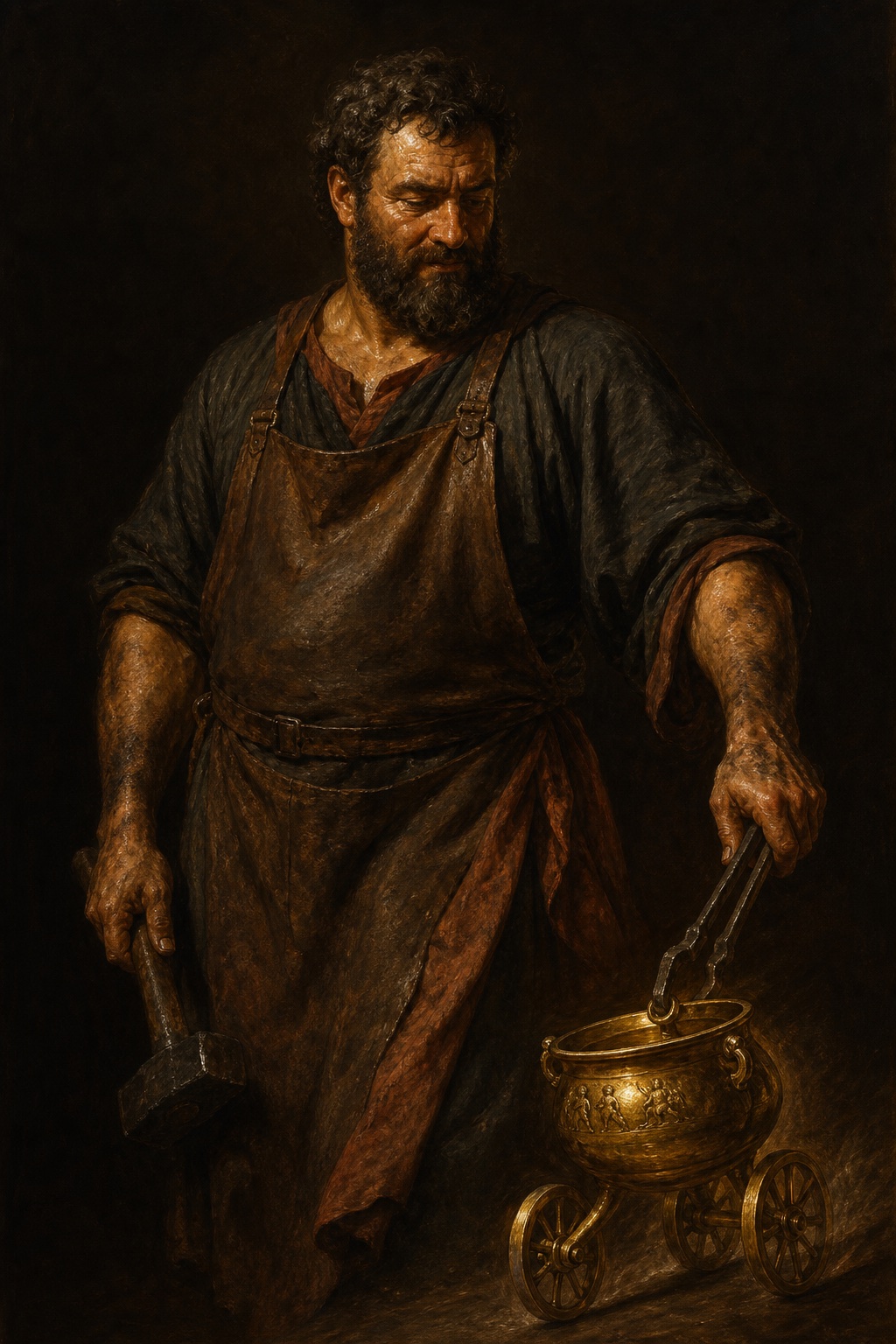
Ἡφαίστου δ’ ἵκανε δόμον Θέτις ἀργυρόπεζα ἄφθιτον ἀστερόεντα, μεταπρεπέ’ ἀθανάτοισι χάλκεον, ὅν ῥ’ αὐτὸς ποιήσατο κυλλοποδίων. τὸν δ’ εὗρ’ ἱδρώοντα ἑλισσόμενον περὶ φύσας σπεύδοντα· τρίποδας γὰρ ἐείκοσι πάντας ἔτευχεν ἑστάμεναι περὶ τοῖχον ἐϋσταθέος μεγάροιο, χρύσεα δέ σφ’ ὑπὸ κύκλα ἑκάστῳ πυθμένι θῆκεν, ὄφρά οἱ αὐτόματοι θεῖον δυσαίατ’ ἀγῶνα ἠδ’ αὖτις πρὸς δῶμα νεοίατο, θαῦμα ἰδέσθαι. οἱ δ’ ἤτοι τόσσον μὲν ἔχον τέλος, οὔατα δ’ οὔ πω δαιδάλεα προσέκειτο· τά ῥ’ ἤρτυε, κόπτε δὲ δεσμούς
“silver-footed Thetis came unto the house of Hephaestus, imperishable, decked with stars, preeminent among the houses of immortals, wrought all of bronze, that the crook-foot god himself had built him. Him she found sweating with toil as he moved to and fro about his bellows in eager haste; for he was fashioning tripods, twenty in all, to stand around the wall of his well-builded hall, and golden wheels had he set beneath the base of each that of themselves they might enter the gathering of the gods at his wish and again return to his house, a wonder to behold. Thus much were they fully wrought, that not yet were the cunningly fashioned ears set thereon; these was he making ready, and was forging the rivets.” — Homer, Iliad 18.369–379, tr. A. T. Murray
Twenty tripods, not one — a production run, not a favor performed on the spot. Golden wheels under each leg let them roll themselves into the gods’ assembly and home again unattended, “a wonder to behold” by the poem’s own account, and still unfinished: the ears not yet fitted, the rivets still going in under the hammer. The scene catches him doing, not ruling, and the poem folds his lameness into the very sentence that credits him with building the house himself, calling him “the crook-foot god” in the same breath.
Servants of gold
His wife meets Thetis first. Charis comes out, seats her, and calls Hephaestus in from the forge. The moment he crosses the room to greet his guest, he does not cross it alone.
ὑπὸ δ’ ἀμφίπολοι ῥώοντο ἄνακτι χρύσειαι ζωῇσι νεήνισιν εἰοικυῖαι. τῇς ἐν μὲν νόος ἐστὶ μετὰ φρεσίν, ἐν δὲ καὶ αὐδὴ καὶ σθένος, ἀθανάτων δὲ θεῶν ἄπο ἔργα ἴσασιν
“there moved swiftly to support their lord handmaidens wrought of gold in the semblance of living maids. In them is understanding in their hearts, and in them speech and strength, and they know cunning handiwork by gift of the immortal gods.” — Homer, Iliad 18.416–419, tr. A. T. Murray
They are not decoration. They are staff built to do the walking his own legs cannot always be trusted to do, and Homer gives them a mind, a voice, and a trade before he gives them anything else. The tripods roll themselves to a meeting; the handmaidens learn their craft, the poem says, “by gift of the immortal gods.” Twice in the same scene the god makes something that can act without him, which is a stranger and more specific kind of power than the thunderbolt or the trident.
Thrown from Olympus, twice
Hephaestus greets Thetis and, before she can even explain her errand, tells Charis what he owes this particular guest.
ἄλγος ἀφίκετο τῆλε πεσόντα μητρὸς ἐμῆς ἰότητι κυνώπιδος, ἥ μ’ ἐθέλησε κρύψαι χωλὸν ἐόντα
“when pain was come upon me after I had fallen afar through the will of my shameless mother, that was fain to hide me away by reason of my lameness.” — Homer, Iliad 18.394–395, tr. A. T. Murray
By his own account, Hera bore a lame son and answered it by throwing him from Olympus; Thetis caught him as he fell and sheltered him for nine years while he learned the craft that now builds Achilles his armour. The rejection is not incidental to the skill — it is the reason he had the time, and the teacher, to acquire it.
Two falls, two accusers, and the poem never reconciles them. What stays constant is the landing: broken on Lemnos or hidden in the sea, Hephaestus keeps ending up somewhere he has to build his own way back from.