The craftsman who carried out Thoth’s command
Popular summaries of Egyptian religion often credit Ptah with a specific philosophical act: conceiving the world in his heart and speaking it into being with his tongue. Budge’s own account, written across two separate books, tells a different story. In his telling the god who speaks the creative command is Thoth. Ptah’s part is to carry that command out, working at the craftsman’s bench beside Khnemu while the universe takes physical shape.
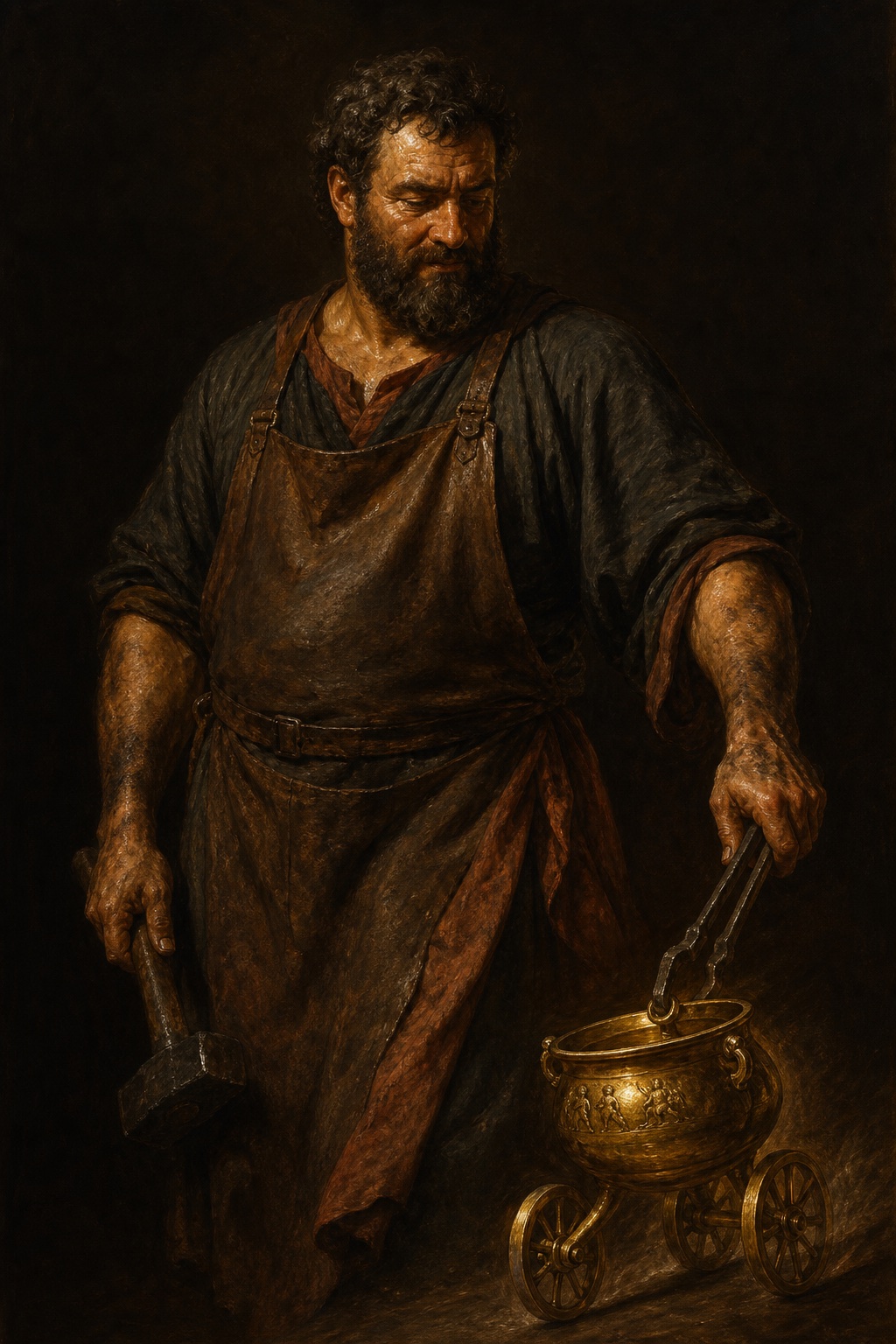
Ptah was the fellow-worker with Khnemu in carrying into effect the commands concerning the creation of the universe which were issued by Thoth, and whilst the latter was engaged in fashioning man and animals, the former was employed in the construction of the heavens and the earth — E. A. Wallis Budge, The Gods of the Egyptians, vol. 1 (1904), p. 501
Thoth speaks; Ptah, alongside Khnemu, builds. The division of labour is exact: one god issues the order in words, the other two turn it into heaven and earth, and into animal and man.
Architect of the universe, beater of the iron firmament
Budge calls Ptah “architect of the universe” and ties his character directly to Thoth’s, the two gods sharing a role even as one speaks and the other builds. The same sentence gives Ptah the most physical image in his whole account: hammering the sky itself into shape.
In the character of architect of the universe he partakes of the nature of Thoth, especially in respect of his title ” lord of Maat ; ” and, as the god who beat out the iron firmament with a hammer and supported it, his attributes resemble those of Shu — E. A. Wallis Budge, The Gods of the Egyptians, vol. 1 (1904), p. 502
The firmament is iron, and someone has to beat it flat and hold it up; Budge gives that labour to Ptah, in the same breath that lets him carry Thoth’s title “lord of Maat” and share Shu’s task of bearing up the sky. Three different gods’ attributes converge on him in one sentence — craftsman, titleholder, and sky-bearer at once. (The spaced punctuation around the quoted title — " lord of Maat ; " — is Budge’s own 1904 typesetting convention for a quoted inscription phrase, reproduced here exactly as printed.)
Self-created, the Opener of the day
In Egyptian Ideas of the Future Life, Budge names Ptah again as one of three gods who executed Thoth’s commands — and this time the sentence’s own grammar draws the line precisely: it is Thoth, not Ptah, who “gave expression in words to the will of the primeval, creative Power.” Ptah’s part is action, not speech.
PTAH was one of the most active of the three great gods who carried out the commands of Thoth, who gave expression in words to the will of the primeval, creative Power; he was self-created, and was a form of the Sun-god R[=a] as the “Opener” of the day. — E. A. Wallis Budge, Egyptian Ideas of the Future Life (1908)
He needed no maker of his own — he was self-created — and he doubled as a form of Ra, greeting each morning as the “Opener” of the day. (R[=a] above is the Gutenberg plain-text edition’s own notation for the macron over the a in Rā, not an error to be silently corrected.) Across all three passages Budge’s Ptah is consistent: never the speaker, always the maker, and made by no one but himself.
Consort of Sekhmet, craftsman in bronze and stone
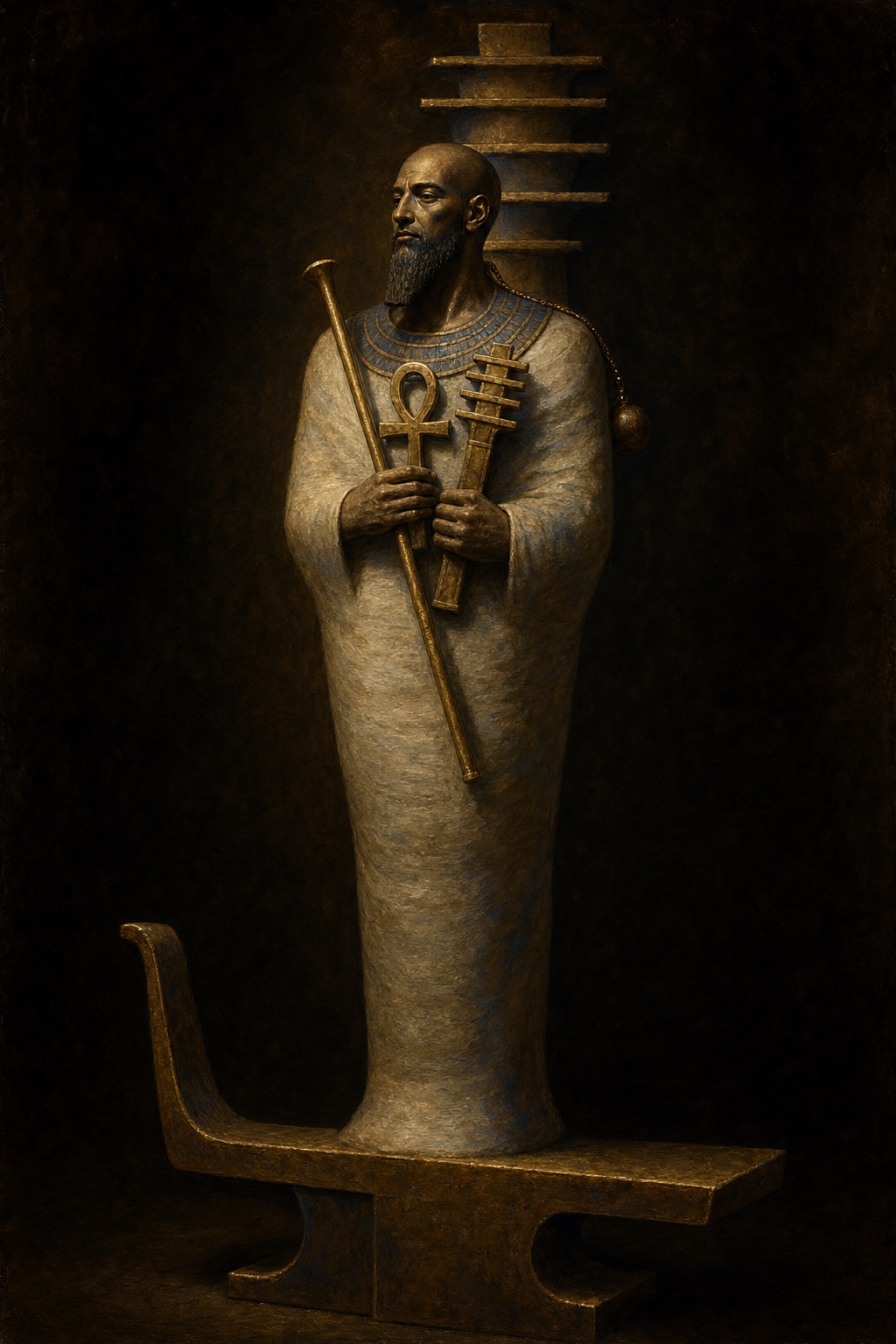
Budge describes Ptah’s image as a bearded man with a bald head, wrapped in a close-fitting garment that leaves only his hands free; from those hands he holds a sceptre and the emblems of life and stability, and the menat hangs from the back of his neck. In the same chapter Budge sums up his trade in one word, metalworker, crediting him as smelter, caster and sculptor together, and as the master designer behind everything that exists in the world.
Later cult tradition — the pairing this wiki’s own Sekhmet entry already carries in the other direction — makes Ptah her consort at Memphis and names Nefertum as their son. Nothing in Budge’s account of Sekhmet’s rampage against rebellious mankind mentions Ptah at all; the bond belongs to the settled Memphite triad, not to that one violent myth, and Sekhmet’s entry is where the myth itself is told. Budge’s own judgement also reaches across cultures: he identifies one form of Ptah with the Greek Hephaestus and the Roman Vulcan, the same craftsman-god pairing this wiki’s Hephaestus entry keeps from the other side.