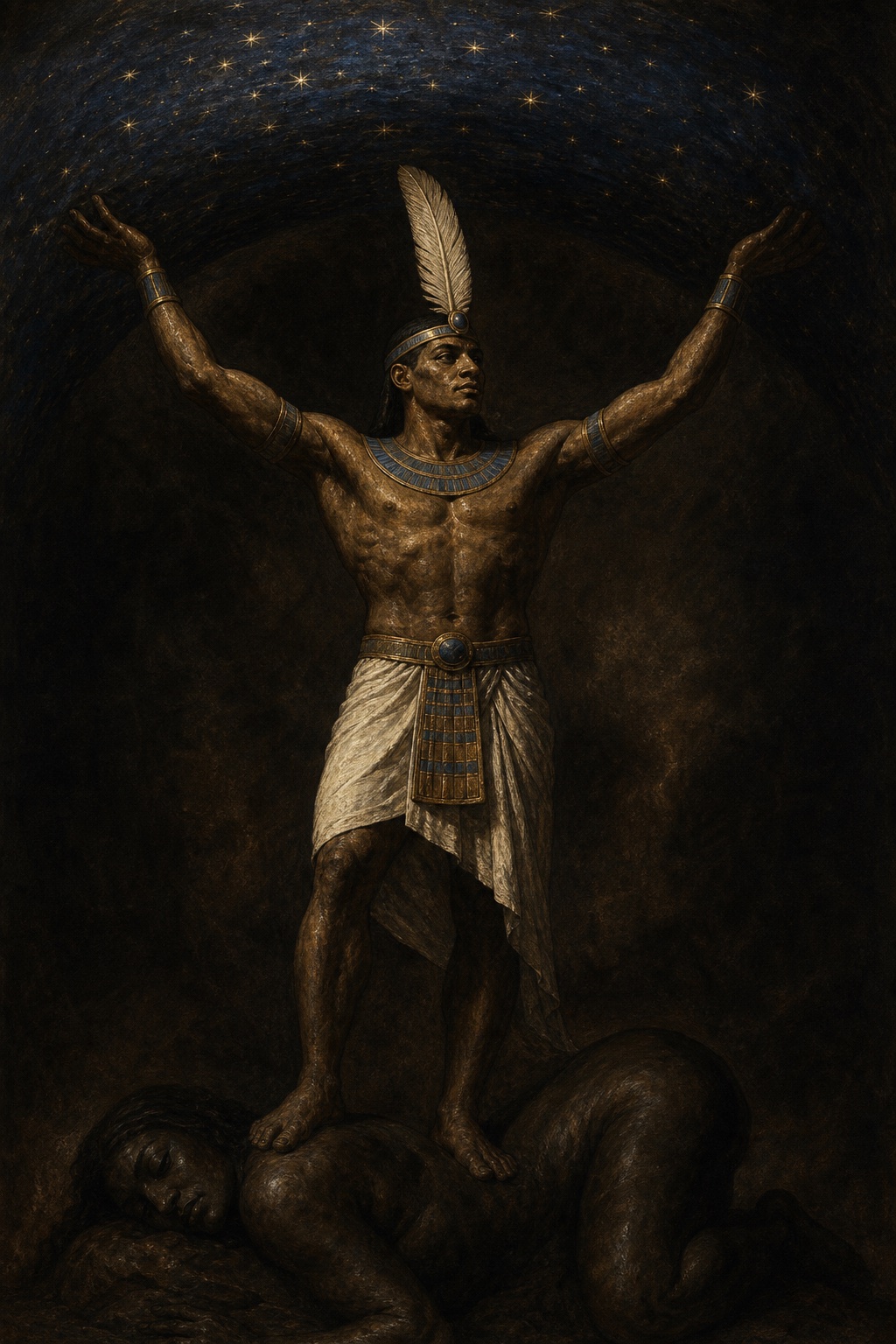
Shu is the first thing the creator made that was not himself. In the Heliopolitan account, Atum — alone on the primeval mound, with no other being to couple with — produces Shu and his sister Tefnut from his own body, and the pair are called in the Pyramid Texts the twin lion-gods, the two gods who made their own bodies. Everything after them is generated in the ordinary way; they are the last of the impossible births.
Budge derives the name from a root meaning dry or empty, and reads him accordingly.
“thus Shu was a god who was connected with the heat and dryness of sunlight and with the dry atmosphere which exists between the earth and the sky” — E. A. Wallis Budge, The Gods of the Egyptians (1904), vol. 2, p. 87
His function is architectural. Geb the earth and Nut the sky are his children, and they are born locked together in an embrace with no gap between them, so that there is no world — no space, no light, nowhere for anything to happen. Shu steps between them and lifts Nut up on his raised arms, and the separation is the creation: the moment the sky comes off the ground is the moment there is a place to live. Egyptian art returns to this image constantly, a man kneeling with both arms above his head, the arched body of the woman above him, the man lying prone below.
That makes him the load-bearing member of the cosmos, and the anxiety in the texts is about what happens if he lets go. He is held up in turn by the four pillars of heaven at the cardinal points, and the coffin texts imagine the disaster of the sky falling as an ever-present possibility rather than a settled matter. Air here is not a soft thing; it is the strut that keeps the ceiling from coming down, and Shu is also the breath in the throat, so the same god who holds up the heavens is the one who provides the dead with something to breathe.
He is a ruler as well as a support. In the sequence of divine kings he takes the throne after Ra withdraws, reigns, and is worn down by war with the followers of Apep before handing on to Geb — a rare case of a cosmic principle also serving a term as pharaoh. Beside the Greeks, the arrangement is inverted twice over: there the sky is male and the earth female, and they are parted by a son with a sickle rather than by a father with his hands.