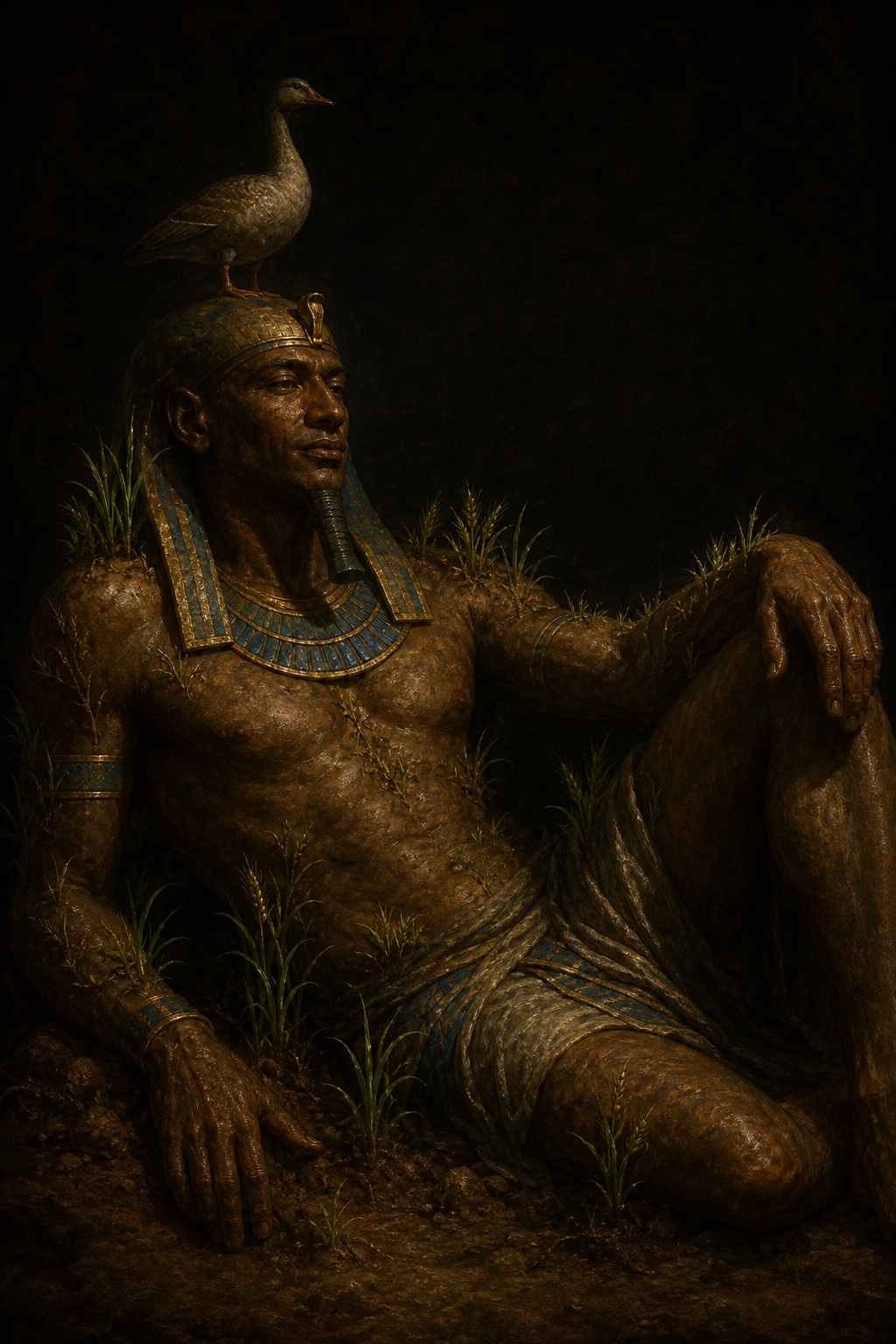
Geb is the ground. Egyptian art draws him as a man stretched out on his back beneath the arched body of his sister Nut, sometimes propped on one elbow, sometimes with barley growing out of his flanks — the land seen as a reclining figure rather than as a place. His name is written with the sign of a goose, the bird sacred to him, and older Egyptological works read it as Seb or Keb before the reading Geb settled.
When Shu had taken up his place beneath the cow and was bearing up her body, the heavens above and the earth beneath came into being, and the four legs of the cow became the four props of heaven at the four cardinal points; and thus it came to pass that the god Seb and his female counterpart Nut began their existence. — E. A. Wallis Budge, The Gods of the Egyptians (1904), vol. 2
The separation is the point. In the Heliopolitan account Geb and Nut are locked together until their father Shu, the air, forces himself between them and holds the sky up — and only in the gap that opens does there begin to be a world with room in it. Geb’s laughter is said to be the earthquake. What he holds down matters as much as what he holds up: the dead lie in him, and the texts speak of the earth’s jaws closing over them, so that the same god who yields grain also keeps the tomb shut.
Politically he is the more important for being the father of Osiris. Geb is reckoned an early king of Egypt, and the throne passes from him to Osiris and then, after Set’s usurpation is overturned, to Horus — which makes the seat of every living pharaoh, by inheritance, Geb’s own. The Egyptians called that seat the iat of Geb, and a king’s right to rule was argued in exactly those genealogical terms.