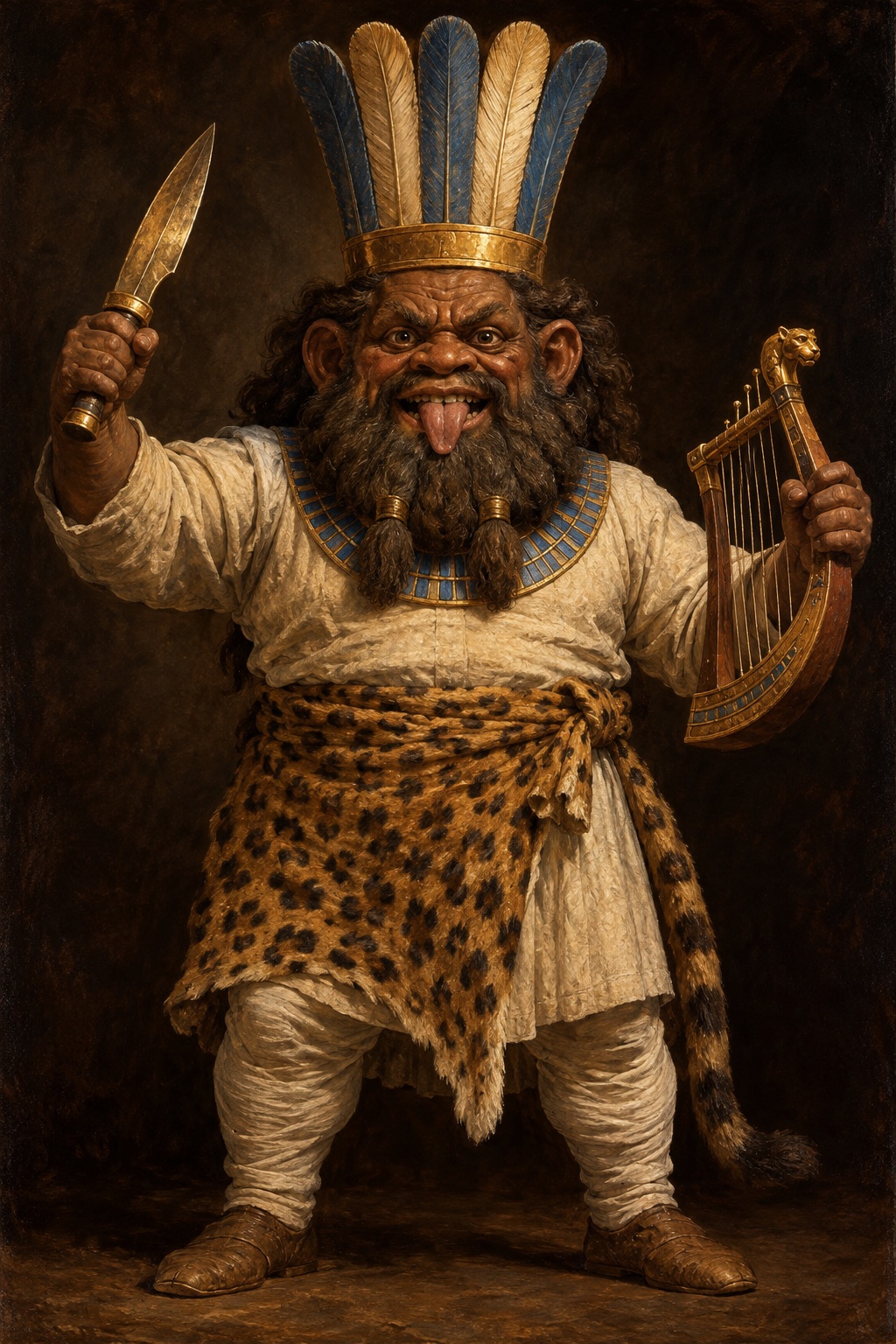
The dwarf in the panther skin
Budge files Bes in a chapter on the foreign gods of Egypt, and his account of him opens on a dispute. Some writers, he reports, held that the god was Semitic, and others that he was African. Budge sets one fact against both views: “the name of the god appears to be Egyptian”. He thinks it was given to the god “in very early times because of the animal’s skin which he wore”, and he adds that the animal itself was called Besa or Basu. On this reading the god takes his name from what he wears.
Budge describes the figure in detail. He says Bes is usually shown in “the form of a dwarf with a huge bearded head”, with a protruding tongue, a flat nose, shaggy eyebrows and hair, large projecting ears, long but thick arms and bowed legs. Then he comes to the clothing.
round his body he wears the skin of an animal of the panther tribe, and its tail hangs down and usually touches the ground behind him; on his head he wears a tiara of feathers — E. A. Wallis Budge, The Gods of the Egyptians (1904), vol. 2, p. 284
The quotation begins halfway through Budge’s sentence. The scan breaks two words of that sentence across line ends, and the quotation starts after them rather than mend them. Budge is exact about the skin: it is not a panther’s but the skin of “an animal of the panther tribe”, and it is the only garment he gives the god in this description. The tail hangs down behind and usually reaches the ground. One more detail sets Bes apart. Egyptian gods are drawn in profile, and Bes sometimes is too, “but usually he appears full face”. He looks straight out of the picture at the viewer.
Budge also had a view on where the god came from, and it is his view as a writer of 1904, not a settled fact. He reads the dwarf’s figure as a sign of a home where “the dwarf and pygmy were held in esteem”, and he compares the tiara with the head-dresses of peoples of Equatorial Africa. From these two things he places the god’s home in a region “a few degrees to the north of the Equator”. The argument moves by hedges: the figure suggests, the head-dress resembles, the two together would lead him to the place. His conclusion, on the next page, drops the hedges: “In his original conception Bes is certainly African”.
Rest, joy and the birth chamber
Budge’s next evidence is a set of objects. Figures of Bes, he writes, are found carved on the handles of mirrors, on kohl vessels and on pillows. These are things of the dressing table and the bed, not of the temple, and Budge draws a careful conclusion from them: “in one aspect at least he was associated with rest, and joy, and pleasure”. Then he turns from the objects to the walls.
From a number of scenes on the walls of the temples and from bas-reliefs we see that Bes was supposed to be present in the chambers and places wherein children were born, and he seems to have been regarded as a protector of children and youths, and a god who studied to find them pleasure and amusement — E. A. Wallis Budge, The Gods of the Egyptians (1904), vol. 2, p. 285
The sentence carries two hedges, “was supposed to be present” and “seems to have been regarded”, because Budge is reading pictures, not a text in which the god speaks. What the pictures give him is presence. Bes is in the room where the child is born. He does not deliver the child, and Budge does not say that he makes the mother fruitful. His work begins after the birth: he guards the child, and he looks for ways to give it “pleasure and amusement”.
Budge then names the scene. One of the oldest pictures of Bes, he says, following Wiedemann, is a relief in the temple of Hatshepset at Der al-Bahari, in the chamber where the birth of the great queen is shown. Meskhent, the goddess of birth, presides there, with the goddesses who act as midwives and the nurses who wait for the child. By the side of the couch stand two figures, Bes and Taweret. Budge admits that what the two of them were to do for the princess is not apparent. But he finds one or both of them in the lying-in rooms of Egyptian queens, and he concludes that their presence was of great importance to the mother and to the child.
Budge is less sure about an older claim. Two figures of the god, he reports, were found at Kahun, and if they belong to the time when that city flourished, Bes was honoured there as early as the Twelfth Dynasty. He gives this evidence little weight, because the figures could have been put into the tombs at Kahun in burials of a much later date.
The harp and the child
Budge gives the god’s music one line: “As a god of music and the dance he is sometimes represented playing upon a harp”. Wiedemann, writing seven years earlier, gives the music an audience. In the scenes he describes, Bes is one of the gods who attend the birth of a king or of the Sun god, and his care goes on after the birth.
He is also shown holding Harpokrates, the young Sun god, upon his left arm while giving him food with his right hand, or bearing the child on his shoulder. But his services to the child were not confined to supplying it with food; he had also to provide for its amusement, and so he is represented as laughing at it, dancing grotesque dances, and playing on the harp before it — Alfred Wiedemann, Religion of the Ancient Egyptians (1897), p. 164
Harpokrates is Wiedemann’s spelling of Harpocrates, the young Horus, whom Budge calls Horus the Child. Wiedemann’s order is the point of the passage. Bes feeds the child first, and only then entertains it. The harp and the dance are part of his service as a nurse, and Wiedemann says that this service, over time, made Bes a patron of dancing, music and merriment, a part for which his odd looks seemed to suit him from the start. In Wiedemann’s account the music grows out of the guardianship, and so, as the next section shows, does the fighting.
Budge reports a later change, and it gives Bes a second form that is not the dwarf of his main description. At some period under the New Empire, he writes, the god took on the character of a solar god and “became identified with Horus the Child, or Harpocrates”. Little by little he was merged in other forms of the Sun-god, until he had absorbed the characteristics of Horus, Ra and Atum, whom Budge calls Temu. As Horus he wore the lock of hair that signifies youth on the right side of his head; as Ra and Atum together he was given the withered cheeks of an old man. Wiedemann places the same merger at the end of the New Kingdom, when Bes was fused with his ward. This is a late composite. The god who stands by the birth couch is the older picture.
Knives against the wicked
The same dwarf goes armed. Budge writes that “as a god of war and slaughter, and as a destroying force of nature he carries two knives in his hands”. As a warrior he wears a short military tunic fastened round his body by a belt, and he holds a shield in his left hand and a short sword in his right. Wiedemann ties the weapons back to the child. Serpents were the chief enemies of the Sun god, so the guardian of the young Sun god was “the foe of serpents”, and he is often shown gripping and strangling them in his hands, or biting them to pieces.
Budge’s evidence for the Underworld comes from the Book of the Dead. The name of Bes does not occur in the Heliopolitan or the Theban Recension, he notes, but in one of the vignettes to the cxlvth Chapter of the Saite Recension “this god is seen guarding one of the pylons of the house of Osiris in the Underworld”. Wiedemann describes what the dead met there. The Bes of the Underworld had a distorted face that inspired terror, and he menaced the wicked with his knife and threatened to tear out their hearts, “and hence he was called the Warrior”. Budge felt the difficulty of the change, and he offered a way to resolve it.
It is difficult to understand the change of view on the part of the Egyptians which turned the god of mirth, and laughter, and pleasure into an avenging deity, but it may be explained by assuming that he only exhibited his terror and ferocity to the wicked, while to the good in the Underworld he was a true friend and merry companion — E. A. Wallis Budge, The Gods of the Egyptians (1904), vol. 2, p. 287
Budge’s solution keeps the god whole. He does not have two natures, one merry and one fierce; he has one nature and two kinds of visitor. Wiedemann tells the same story in the other direction. After the Underworld, he says, people tried to give Bes the same character on earth, but there he was a friend of the good more than an enemy of the wicked, and he was shown with a shield and a sword to defend everyone who was under his protection and wore his image as an amulet. In both accounts the knife and the harp belong to one office. Bes amuses and protects those in his care, and he turns his terror only on what threatens them.