At the birth couch
Taweret is the modern spelling of the name and the headword this wiki files her under. It is not the spelling of either writer quoted below. Budge writes Ta-urt, and Plutarch, who wrote in Greek, calls her Θούηρις, which his translator Babbitt renders Thueris. The reader should take both words, wherever they appear inside a quotation on this page, as the same goddess the heading names. Budge himself makes the link between them: his list of plates captions her figure Ta-urt with Thoueris in brackets after it.
The one place in these sources where she stands beside a birth is a wall. Budge describes a relief in the temple of Hatshepset at Der al-Bahari, in the chamber where the birth of the great queen is shown taking place. Meskhent, the goddess of birth, presides. The goddesses who act as midwives to the queen of Thothmes I are there, with the nurses and the gods of the four quarters of the earth, all waiting to minister to the newborn Hatshepset and to her Ka, the double that was born with her. By the side of the couch stand two figures: Bes, and the hippopotamus goddess.
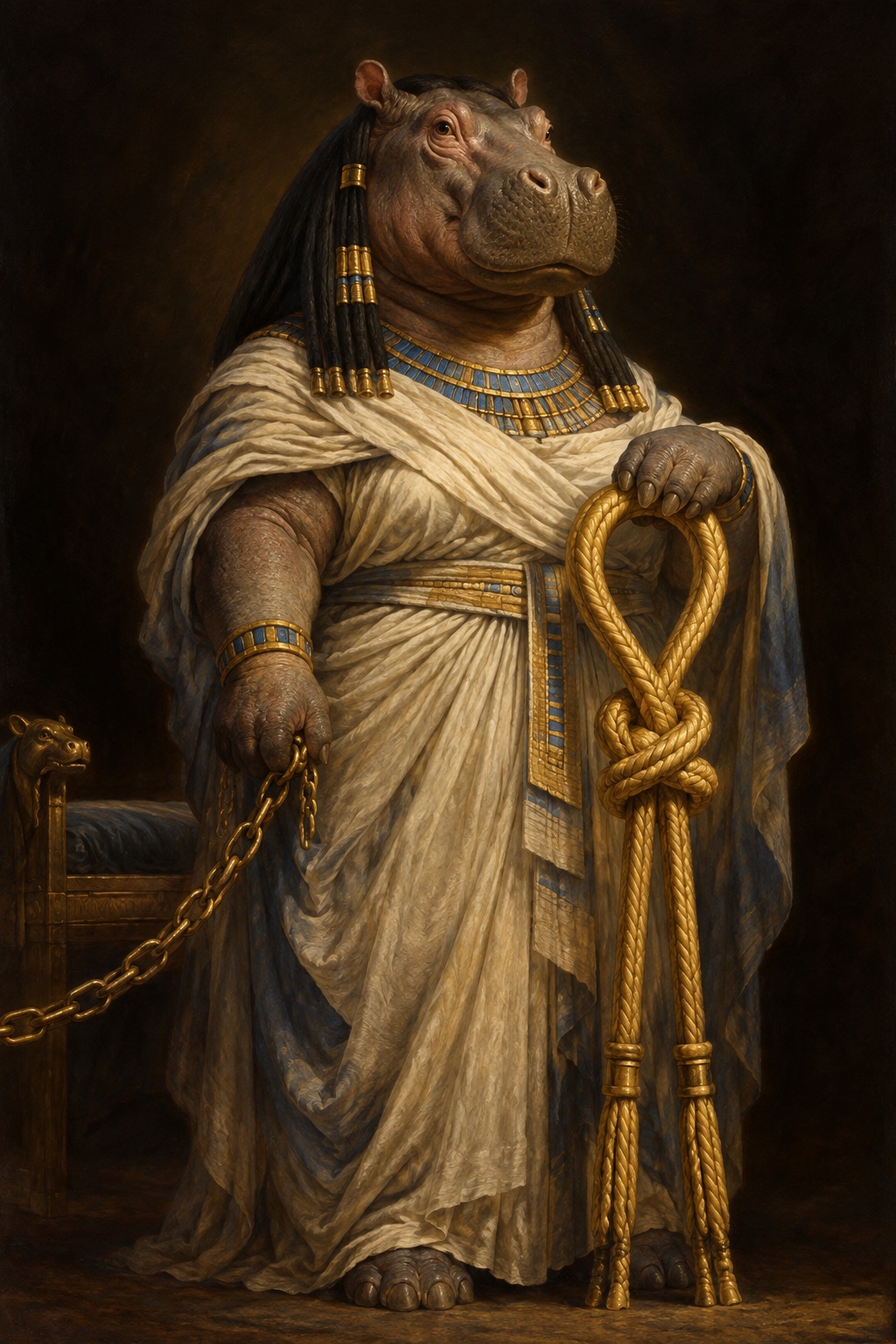
the latter represented in the form of a hippopotamus standing on her hind legs, and leaning with her fore legs upon the emblem of magical protection — E. A. Wallis Budge, The Gods of the Egyptians (1904), vol. 2, p. 285
The quotation begins on the latter because the scan misreads her name in the words just before it, printing Ta-ukt where Budge’s next sentence prints Ta-urt. The misreading is the scan’s, not his, and the quotation starts after it rather than correct it. The latter is the goddess; the former, earlier in the same sentence, is Bes.
Budge is candid about the limits of the picture. What the two of them were meant to do for the princess, he writes, is not apparent. But he finds one or both of them represented in the lying-in rooms of Egyptian queens, and he concludes from this that their presence was held to be of great importance to the mother and to the child. So the pose is the evidence. She does not deliver the child, which is the midwives’ work, and she does not preside, which is Meskhent’s. She stands upright on her hind legs beside the couch and leans her weight on the emblem of magical protection: a guard at a birth, holding the sign of what she guards with.
The birth-house at Ombos
Budge’s own account of her, in the pages he gives to the hippopotamus, opens on a list of names. She was called Ta-urt, Apet and Sheput, among others, and he adds that she was, in practice, identified as a form of every great goddess of Egypt, whether or not the identification was a probable one. He thinks the hippopotamus was probably common in the Delta in predynastic times, and he takes a red and yellow breccia statue of the animal, made in the archaic period and now in the British Museum, as proof that the animal’s cult is as old as Egyptian civilization.
Then he sets out what certain theological systems made of her. In them, Budge writes, she was Set’s female counterpart, and the same sentence goes on to give her a son.
the mother of the Sun-god, or of An-her, whom she brought into the world at Ombos — E. A. Wallis Budge, The Gods of the Egyptians (1904), vol. 2, p. 359
The quotation is the second half of that sentence, and the qualifier at its head governs both halves. This is what some Egyptian systems said, not what all of them said, and Budge does not name the systems he means. Nor does he say whether An-her is another name for the Sun-god or a second candidate for the same birth. His or leaves both readings open, and this entry records the child in the same double form. For this reason, Budge goes on, the city of Ombos was called the birth-house of Apet, one of the names in his list. The one fact that ties her to a single place is a birth, and in this case the birth is her own act. At Der al-Bahari she stands guard over another woman’s child; at Ombos the child is hers.
A kindly guardian of the dead
Budge’s verdict on her comes in the next sentence of the same page, and it rests on a picture from a funerary papyrus.
On the whole, the hippopotamus goddess was a beneficent creature, and she appears in the last vignette of the Theban Recension of the Book of the Dead as a deity of the Underworld, and a kindly guardian of the dead. — E. A. Wallis Budge, The Gods of the Egyptians (1904), vol. 2, p. 359
On the whole is a hedge, and Budge means it, because his paragraph turns next to the other side of the animal. First he describes the picture. In the vignette she holds in her right forepaw an object that has not yet been satisfactorily explained, and her left forepaw rests on the emblem of protective, magical power, which is almost the same name he gives the sign she leans on beside the birth couch. One image places her at the start of a life and the other at its end, and in both she stands with a forepaw on that emblem.
Then the other side. On the other hand, Budge writes, the monster that appears in the Judgment Scene has the hindquarters of a hippopotamus, and that fact reminds him that the Egyptians did not forget the destructive power of the animal. He spells the monster Am-mit; this atlas files the same monster as Ammit. The same animal lends its body to the goddess who guards the dead and to the monster who waits for them at their judgment, and Budge sets the two side by side in consecutive clauses.
Thueris comes over to Horus
The one story in which she acts comes from outside Egypt. Plutarch tells it in his essay on Isis and Osiris, in the part of the war between Horus and Typhon where Osiris has just been pleased to find that Horus is now prepared. Typhon is the Greek name Plutarch uses throughout for the god this atlas files as Set: later in the same essay he says that the Egyptians call Typhon Seth.
λέγεται δʼ ὅτι, πολλῶν μετατιθεμένων ἀεὶ πρὸς τὸν Ὧρον, καὶ ἡ παλλακὴ τοῦ Τυφῶνος ἀφίκετο Θούηρις
“It is said that, as many were continually transferring their allegiance to Horus, Typhon’s concubine, Thueris, also came over to him” — Plutarch, De Iside et Osiride 19 (358C), tr. F. C. Babbitt (Loeb, 1936)
The Greek sentence is short, and its order carries its meaning. It opens on λέγεται, it is said, so Plutarch reports the episode as a story that people tell, not as his own claim. πολλῶν μετατιθεμένων ἀεὶ πρὸς τὸν Ὧρον: many were changing sides to Horus, and ἀεὶ makes it a steady drift rather than a single event. Then καὶ, also: she is one deserter among many, not the first. ἡ παλλακὴ τοῦ Τυφῶνος: Typhon’s concubine, not his wife. Her name comes last in the sentence, after the verb: ἀφίκετο Θούηρις, Thueris came.
Plutarch’s next clause finishes the episode. A serpent pursued her, and Horus’s men cut it to pieces. In memory of this, Plutarch says, the people throw down a rope in their midst and chop it up. The story ends as the explanation of a rite.
Budge knew the story. In the second volume of The Gods of the Egyptians he retells Plutarch’s account of the war, quoting an English version that names Typhon’s concubine Thueris, and a footnote identifies her as Ta-urt. The identification is his, and it is the reason a Greek anecdote belongs on this page. It sits uneasily beside his theological systems in which she is Set’s female counterpart, and this entry records both rather than choose. In some Egyptian systems she belongs with Set as his counterpart. In the Greek story she belongs to him as a concubine, and she leaves him. Plutarch does not say why she left, only that many others were leaving too.
Taken together, the sources give her one steady posture and one story. The posture is on the Der al-Bahari wall and in the last vignette of the papyrus: an upright hippopotamus with a forepaw on the emblem of protection, at a birth and among the dead. The story is Plutarch’s, and it is a single sentence long: in the war between Horus and Typhon, when many were going over to Horus, she went over too.