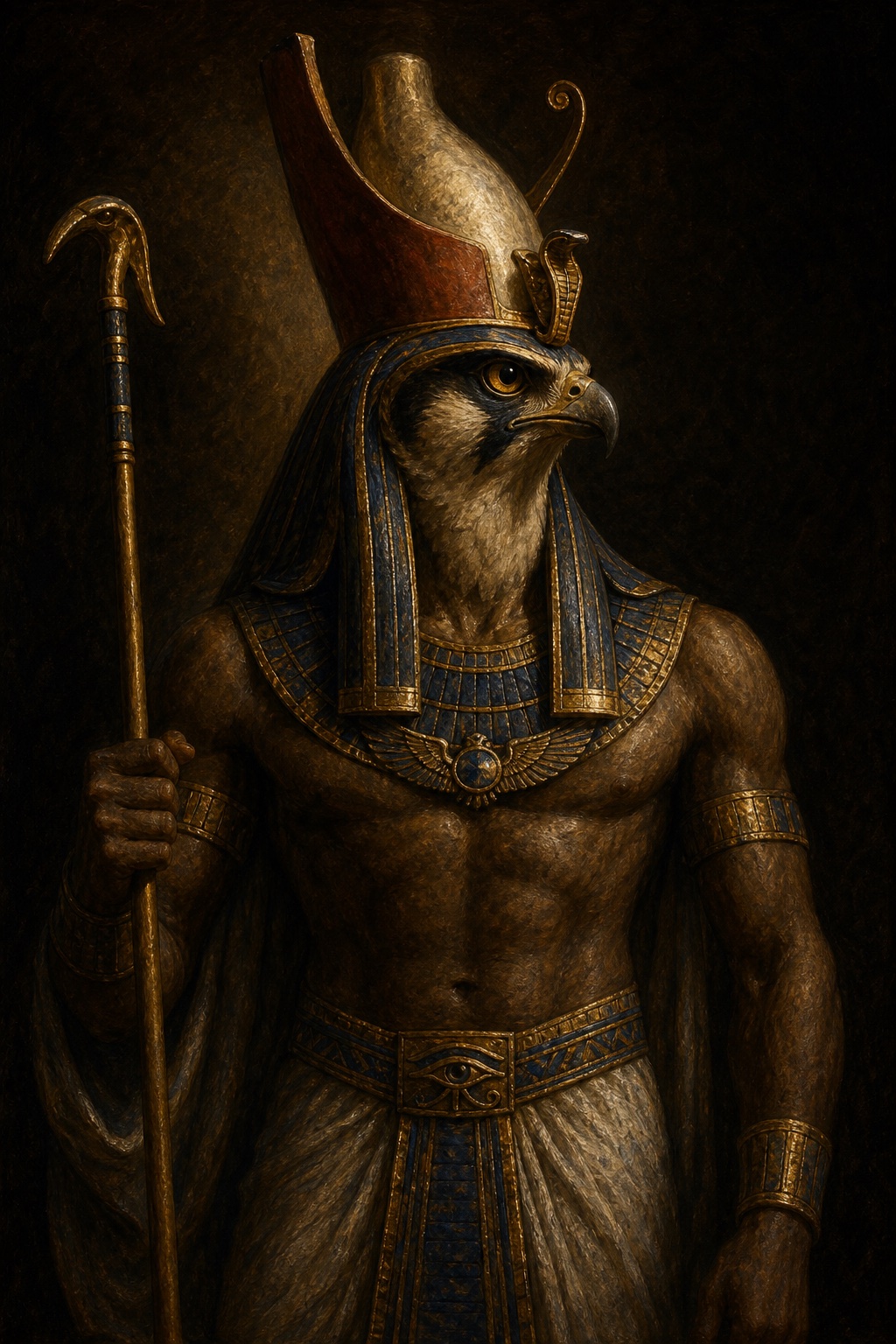
Horus is the sky itself in falcon form: his right eye is the sun, his left the moon, and his wingspan is the heavens. Conceived after his father Osiris’s murder and raised in secret among the papyrus marshes, he grows up to contest the throne of Egypt against his uncle Set in a long cycle of trials — sometimes called the Contendings of Horus and Set — of strength, guile, and endurance, in which both gods are wounded before a divine tribunal finally rules in Horus’s favor and Set is driven from power.
With Osiris avenged, Horus is installed as legitimate king, uniting Upper and Lower Egypt under the double crown. Every reigning pharaoh is his living incarnation, just as every dead pharaoh becomes an Osiris — kingship in Egypt is essentially a passage between the two gods. Horus is not a single fixed figure: as Horus the Child he is the vulnerable infant Isis protects; merged with the sun god as Ra-Horakhty, “Horus of the Two Horizons,” he becomes indistinguishable from Ra at sunrise and sunset. His restored eye, the wedjat, becomes one of Egypt’s most enduring protective symbols, worn as an amulet by the living and the dead alike.
“The late form of the legend goes on to say that Isis fanned the body with her feathers, and produced air, and that at length she caused the inert members of Osiris to move, and drew from him his essence, wherefrom she produced her child Horus.” — E. A. Wallis Budge, Legends of the Gods (1912), introduction