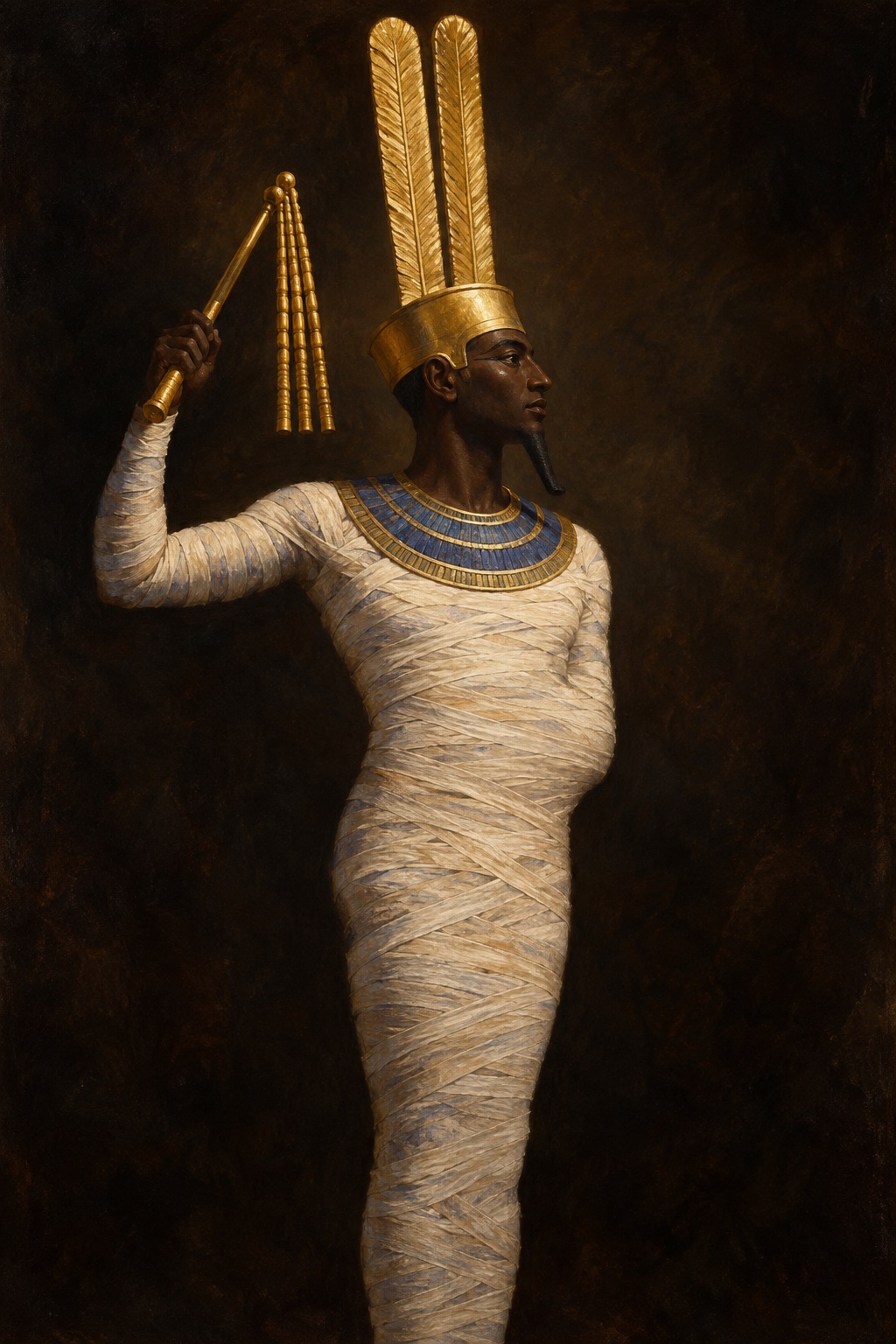
The god in his coming forth
Min is the modern name of this god, and it is the name this atlas files him under. Budge, who translated every Egyptian passage quoted below, calls him Amsu. He gives Min as the other name, and sometimes a third, Khem. Wherever Amsu appears inside a quotation on this page, read it as the god the heading names.
Budge’s Gods of the Egyptians has no chapter on him. What it says about him is scattered through the chapters on other gods, and the clearest statement of what he is comes from a line of the Book of the Dead that Budge quotes in his chapter on Nephthys. In Chapter XVII the dead man speaks in the god’s own voice.
I am the god Amsu (or, Min) in his coming forth ; may his two plumes be set upon my head for me — E. A. Wallis Budge, The Gods of the Egyptians (1904), vol. 2, p. 258, quoting the Book of the Dead, Chapter XVII
Chapter XVII explains itself as it goes. After a statement like this one, the text asks who the god is, and then it answers.
Amsu is Horus, the avenger of his father, and his coming forth is his birth — E. A. Wallis Budge, The Gods of the Egyptians (1904), vol. 2, p. 258, quoting the Book of the Dead, Chapter XVII
The answer does two things. It makes Min a form of Horus, the son who avenged his father, and it reads the god’s coming forth as a birth. A dead man who takes the god’s name is therefore claiming a birth, and he asks for the god’s headdress as the sign of it. The gloss then turns to that headdress. The two plumes, it says, are Isis and Nephthys, who go forth and set themselves on his head as his protectors and supply what his head lacks.
Budge draws his own conclusion from the passage. Nephthys was a goddess of death, but this line ties her to the life that comes out of death, and it makes her, beside Isis, one of Min’s two female counterparts. Min himself, in the same sentence, is the god in whom virility, reproduction and regeneration take one shape.
Amsu-Heru at the twenty-first pylon
Chapter XVII makes the identity with Horus in a gloss. Chapter CXLV, the chapter of the pylons of the House of Osiris, puts it in the dead man’s mouth while he acts. In the Papyrus of Auf-ankh he comes to the twenty-first pylon, which the text calls the pylon of the Still-Heart, and he greets it in the words of Horus. He says that he knows the pylon’s name and the name of the god who guards it. Then he says who he is.
I am Amsu-Heru — The Book of the Dead: Theban Recension (1901), Papyrus of Auf-ankh, Chapter CXLV, tr. E. A. Wallis Budge
Heru is Budge’s form of the name Horus, so this is the compound that Chapter XVII explains: Min who is Horus. The sentence runs on without a break. The scan sets a quotation mark at the start of each line of the speech, and each piece quoted here is a clean run between two of those marks.
the avenger of his father, the heir of his father — The Book of the Dead: Theban Recension (1901), Papyrus of Auf-ankh, Chapter CXLV, tr. E. A. Wallis Budge
The first title is the one that Chapter XVII gives. The second makes him the heir as well as the avenger. The father’s name begins the next piece.
Un-nefer. I have come, and I have caused to be — The Book of the Dead: Theban Recension (1901), Papyrus of Auf-ankh, Chapter CXLV, tr. E. A. Wallis Budge
overthrown all the enemies of my father Osiris — The Book of the Dead: Theban Recension (1901), Papyrus of Auf-ankh, Chapter CXLV, tr. E. A. Wallis Budge
The sentence names the father twice, first as Un-nefer and then as Osiris. Between the two names the pronoun changes from his to my. The sentence opens as a description of Horus and closes as a claim that the speaker makes for himself.
This is the only way these sources give Min a father. Osiris is his father because Min is Horus, not because any text says so of Min alone. This atlas therefore records the identity with Horus and leaves the father out of Min’s relations.
The same compound appears once more in Budge, attached to Osiris himself. His chapter on Osiris gives, after Brugsch, the names under which Osiris was known in different cities. The name at Coptos is Amsu-Heru-ka-nekht, which begins with the Amsu-Heru of Chapter CXLV. At Coptos, then, the name of the local god could also stand for Osiris.
A form of Amun-Ra
Budge’s main description of the god’s figure is not a description of Min alone. It comes in his chapter on Amen-Ra, the god this atlas files as Amun, in a list of the forms that Amun-Ra takes. One of those forms borrows Min’s body.
represented with the body of the ithyphallic god Amsu, or Min, or Khem, i.e., as the personification of the power of generation — E. A. Wallis Budge, The Gods of the Egyptians (1904), vol. 2, p. 17, on a form of Amen-Ra
The subject of the sentence is Amun-Ra, and the body he takes is Min’s. Budge gives all three of Min’s names in a row, and he sums up the god’s nature in one word: generation. The next sentence describes the figure.
In this form he wears either the customary disk and plumes, or the united crowns of the South and North, and has one hand and arm raised to support — E. A. Wallis Budge, The Gods of the Egyptians (1904), vol. 2, p. 17, on a form of Amen-Ra
The quotation stops at support because the object is not a word on the page. Budge prints it as a hieroglyph that the god holds above his shoulder, and the scan cannot read the sign. So this page shows Amun-Ra in the shape of Min. The headdress can be Amun-Ra’s own disk and plumes or the united crowns of the South and the North. The body and the raised arm are what he takes from Min.
The raised arm is Min’s own sign, and Budge uses it that way again a few pages later. The vignette of Chapter CLXV of the Book of the Dead, a petition to Amen-Ra, shows an ithyphallic god with the body of a beetle and the plumes of Amun on its head. Budge says that its right arm is raised like the arm of Min, and in the same sentence he describes Min as the god of nature’s power to reproduce.
Nine pages before the description, a hymn to Amen-Ra that Budge translates joins the two gods in one name. It addresses the god as Amsu-Amen, and Budge gives the other form as Min-Amen. That compound is the identity with Amun that this atlas records.
Coptos, Panopolis and the desert
Budge’s table of the nomes of Egypt puts the god in two of them. In the fifth nome the city is Coptos, and the god is the one the table names Amsu, Min or Khem. The ninth nome carries the god’s own name. Its city is Apu, which Budge gives as Panopolis, and the god is again Min. Elsewhere Budge identifies Panopolis as the modern Akhmim. A papyrus now in the British Museum was written for a priest of Panopolis, of high rank, called Nes-Amsu, or Nes-Min, about 312 BC. His own name contains the god’s.
The Book of the Dead remembers the cult too. In Chapter CXXV the twentieth of the judges of the dead is one who comes forth from the Temple of Min, and to him the dead man declares that he has committed no sin against purity. In Chapter CXXIV of the Papyrus of Nu, the dead man sows seed and ploughs his field, and for this reason, he says, his palm tree is like Min. In his introduction to the Book of the Dead, Budge notes that kings danced before their gods to please them, and his first example is Usertsen, who danced before Min.
The passages above are all Budge’s. For the festival and for the desert, the entry turns to J. H. Breasted’s Ancient Records of Egypt, which spells the name Min. In his summary of the building inscriptions of Ramses III at Medinet Habu, the god’s feast is the occasion for one scene.
During the festival of Min, on the walls of this same (second) court, the king recites to the god — J. H. Breasted, Ancient Records of Egypt (1906), vol. 4, Medinet Habu building inscriptions
What the king recites is the building and equipment of the temple. He tells the god of the house how he built it, so the festival of Min is the occasion for the speech, not its subject.
The second passage comes from the Wadi Hammamat. Ramses IV left stelae on the rocks there, and in the first of them he tells how the god guided him on a visit to the quarries in person. At the end of that stela the king is named as beloved of a list of gods, and Min has a title of his own among them.
Harakhte, Min, lord of the desert — J. H. Breasted, Ancient Records of Egypt (1906), vol. 4, §460, Hammamat stela of Ramses IV
The list opens with Amon-Re, Breasted’s spelling of Amun-Ra, and goes on after Min to Horus, son of Osiris, and to Isis. On this stela Min and Horus are two gods, not one. The identity that the Book of the Dead asserts is one way to read the god, and not every text keeps it. What the stela gives Min instead is the country around it, the desert of the quarries where the stela stands.