A name that means “what is hidden”
Amun and his consort Ament are named in the Pyramid Texts, which puts them among the oldest gods Egypt wrote down, and for that earliest period almost nothing survives about what he was thought to do. What survives is the name, and the name is a common Egyptian word.
if we accept the meaning “hidden” which is usually given to his name, we must conclude that he was the personification of the hidden and unknown creative power which was associated with the primeval abyss gods in the creation of the world and all that is in it. — E. A. Wallis Budge, The Gods of the Egyptians (1904), vol. 2
The root amen means what is hidden, what is not seen, what cannot be seen. Egyptian theology is full of gods who are a visible thing — the sun’s disc, the earth, the sky stretched over it — and this one is defined by the opposite. He is the creative power at work in the abyss before there was anything to see it with.
Budge notes a second etymology that arrives much later, in the centuries approaching the Ptolemaic period, connecting the name instead to men, to abide or be permanent, and yielding the attribute eternal. The two readings do not compete so much as accumulate, which is the usual Egyptian pattern for a god who lasts.
Invisible to gods as well as men
The hiddenness is not modesty and it is not merely a poetic figure. Budge is explicit about how far it reaches.
and that it indicates the god who cannot be seen with mortal eyes, and who is invisible, as well as inscrutable, to gods as well as men. — E. A. Wallis Budge, The Gods of the Egyptians (1904), vol. 2
To gods as well as men is the clause that does the work. Ra is looked at by everyone every day. Amun is not available to the pantheon either. That leaves Egypt with a chief god whose defining property is that nobody, divine or mortal, has the faculty for him — and it is precisely this god who ends up with the largest temple estate in the ancient world.
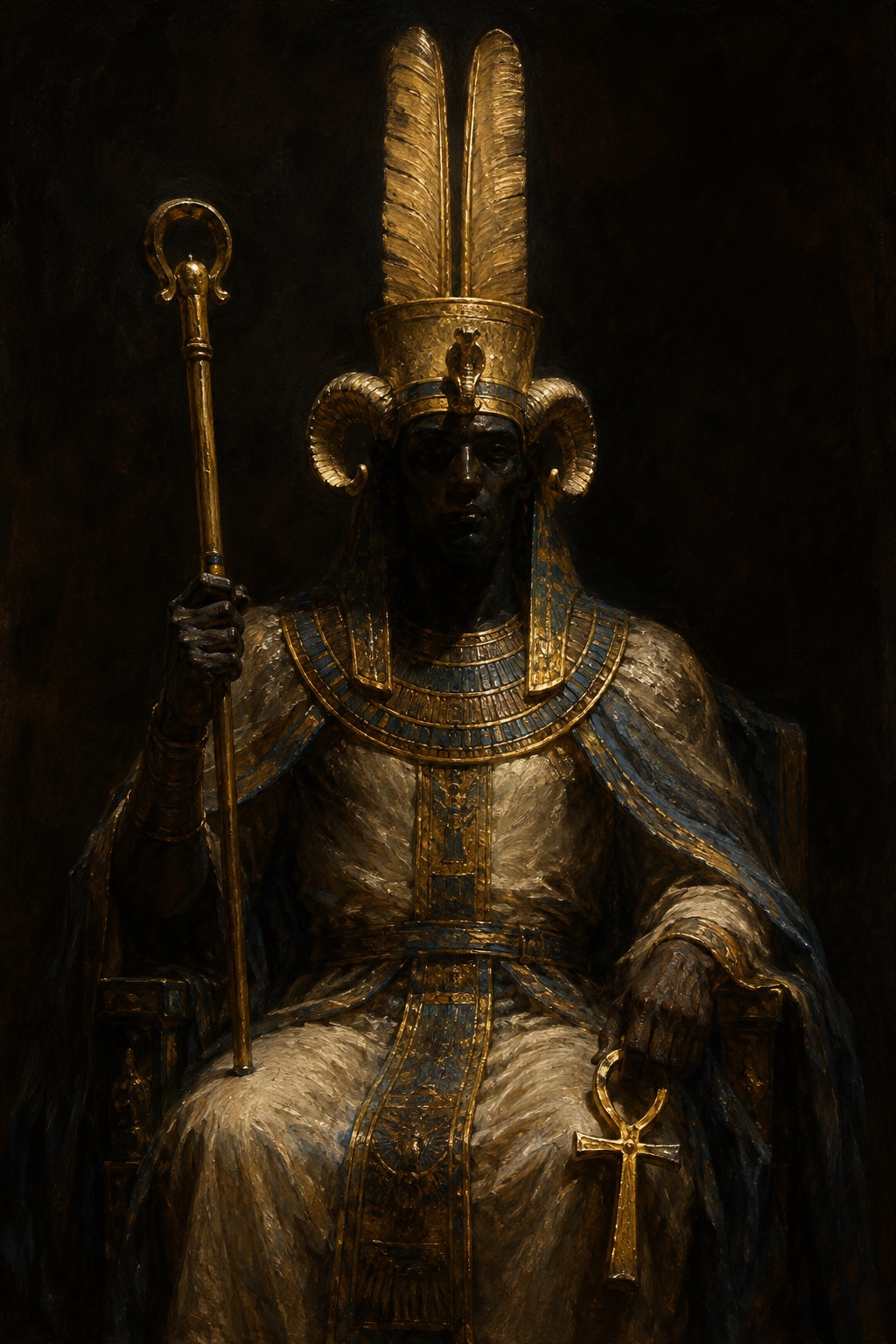
The images fill the gap the way images do. Budge lists five forms in which he is represented, the first of them a man seated on a throne holding the sceptre in one hand and the symbol of life in the other. The hymns pile on regalia: two horns that endure, double plumes that are lofty, the ureret crown, the White Crown, the Atef crown, the amesu sceptre and the flail, with the cobra goddesses of the South and North about his face. All of it is the visible apparatus of a god the same texts insist cannot be seen.
The hymn says it in his own voice
Budge prints a hymn to Amen-Ra, probably of the XXth or XXIst Dynasty, that runs for pages of accumulating titles. Buried in the middle of them is the etymology, stated not as scholarship but as worship — the hymn telling the god what his own name means.
thy name is hidden from thy children in thy name ’ Amen.’ — Hymn to Amen-Ra, in E. A. Wallis Budge, The Gods of the Egyptians (1904), vol. 2
Nine words, and they are the whole theology. What is hidden from the worshipper is not the god’s location or his intentions. It is his name — the thing Egyptian religion treats as the handle by which a being can be known, invoked and compelled. A god called Hidden has published the fact that he is withholding the one item that would give anyone leverage over him, and made the withholding itself the name people call him by.
One god, and the names are past counting
The same hymn’s other move is expansion. Having been unnameable, he becomes innumerable.
Thou king who art One among the gods, thy names are manifold, and how many they are is unknown ; thou shinest in the eastern and western horizons, and overthrowest thy enemies at thy birth daily. — Hymn to Amen-Ra, in E. A. Wallis Budge, The Gods of the Egyptians (1904), vol. 2
By the time this was written he had absorbed the attributes of Ra and of every older form of the sun-god, and Budge’s reading of the hymn is that it documents the takeover: in roughly a hundred years Amun rose from a merely local god to the king of the gods of Egypt, with Thebes as his city and a priesthood whose wealth and social power rivalled the reigning family’s.
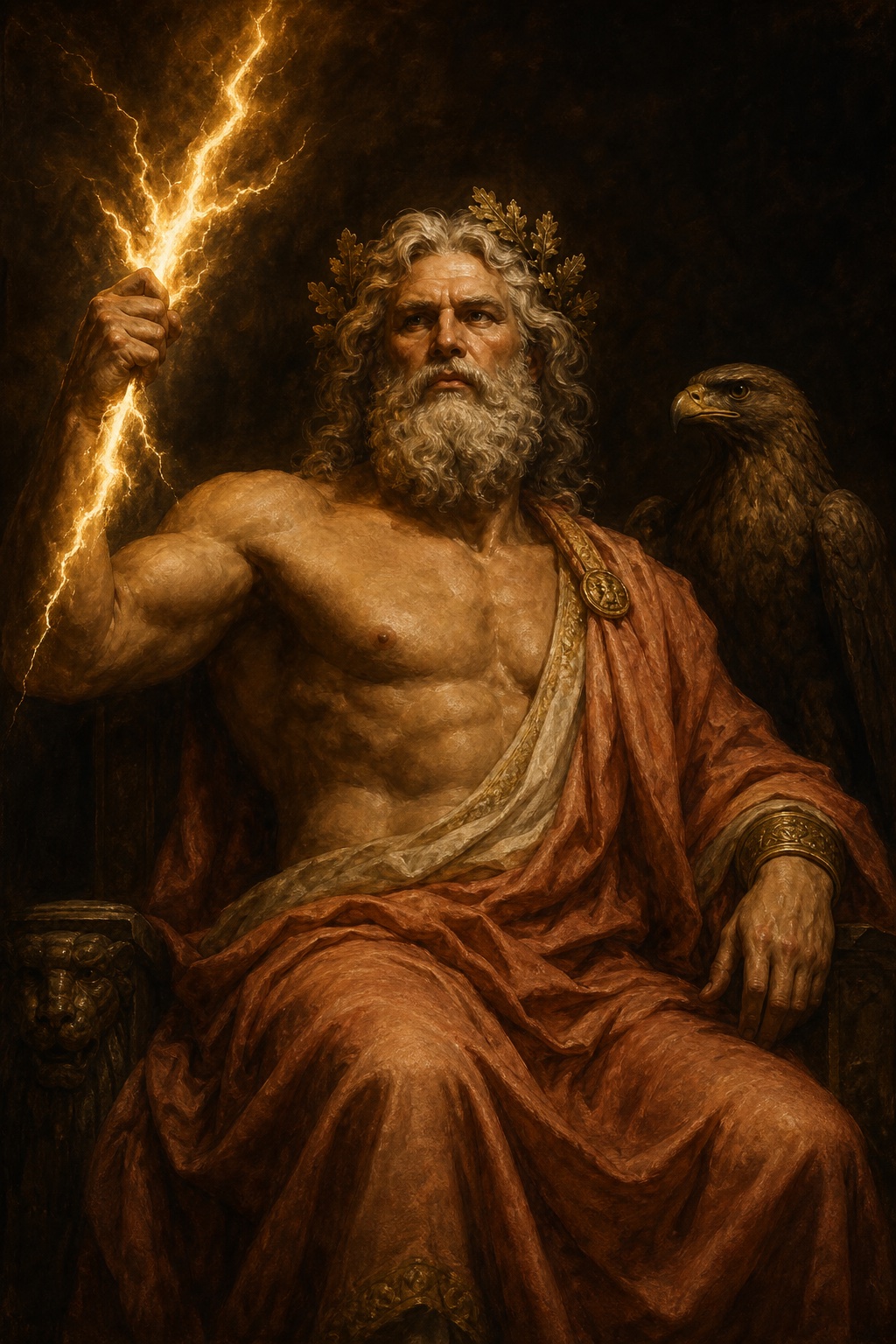
This corpus already records the other side of that merger from Ra’s page, where Amun-Ra is described as hidden power made visible as light, and notes that Greek visitors equated Amun with their own Zeus. Both halves of that are Egyptian orthodoxy rather than compromise. A god’s names were understood to multiply and never to compete, and a god whose own hymn boasts that his names cannot be counted is the least likely of all of them to object.