The whole name is a common noun
Budge introduces her as the principal female counterpart of Amun in the New Empire, and then gives her etymology in four words, because there is nothing else to give.
whose name means Mother, — E. A. Wallis Budge, The Gods of the Egyptians (1904), vol. 2, p. 28
That is the entire derivation. Not a title, not a place, not a compound with a god’s name inside it — the ordinary Egyptian word a child would use, standing alone as the name of the principal goddess of Thebes. Ament’s name is Amun’s with a feminine ending attached, and this atlas records how little that bought her; Mut’s name is not built out of anybody’s. It is also not built out of anything at all. A word that plain can be filled with whatever the theology needs, and the sentence that follows it in Budge fills it immediately.
we see that she was regarded as the great world-mother, — E. A. Wallis Budge, The Gods of the Egyptians (1904), vol. 2, p. 28
The clause runs on past the quoted end to the claim itself: she conceived and brought forth whatsoever exists. One step takes the reader from a domestic noun to the origin of everything there is, and Budge takes it on the strength of her attributes rather than on any myth. There is no birth narrative here, no cosmogony with episodes in it, nothing she is described as doing on a particular occasion. The creation claim rests on the name, and on the pictures.
The strongest form of it is not Budge’s sentence but an inscription found in the ruins of her own temple, where the same idea is stated as a paradox and left standing.
Mut, who giveth birth, but was herself not born of any — E. A. Wallis Budge, The Gods of the Egyptians (1904), vol. 2, p. 29
A mother with no mother is a creator by definition, and the same inscriptions place her with Nun — Budge spells him Nu — in primeval time, before anything was raised out of the water. That is the oldest seat available, claimed for a goddess whose cult centre is the Theban quarter of Asher and whose great temple there was built by Amen-hetep III, about 1450 BC on Budge’s dating. Nun’s own entry records the movement from the other side: later goddesses were identified with the primeval female counterpart of the water and took over her attributes, and it names Mut among them. The temple inscription is that process in its finished state. By the time it was cut, the goddess who was not born of any had been there from the beginning.
The crowns, the sceptre, and the heads at her shoulders
The standard picture is compact enough for Budge to give in one sentence, and every element of it is borrowed regalia.
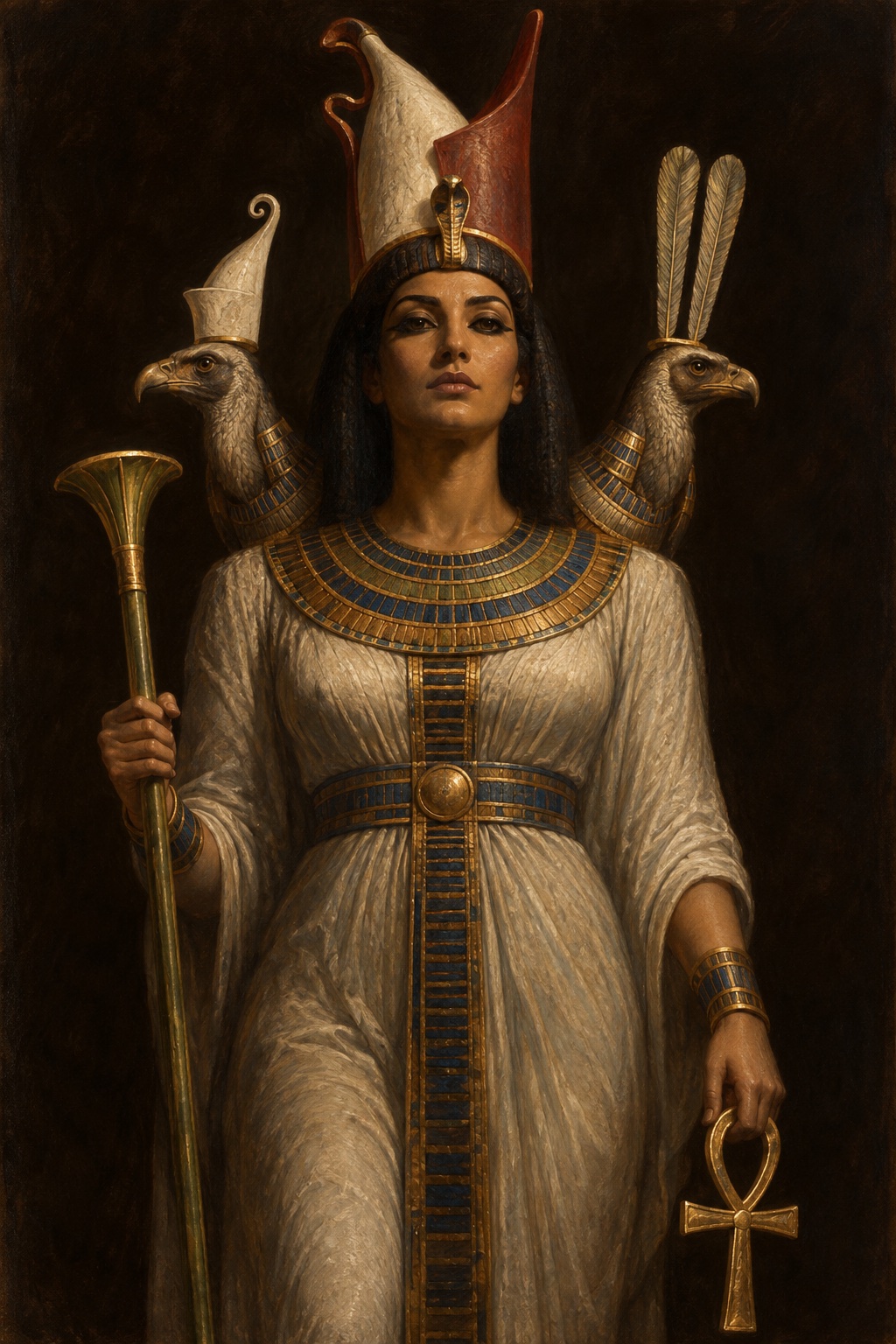
The pictures of the goddess usually represent her in the form of a woman wearing on her head the united crowns of the South and the North, and holding in her hands the papyrus sceptre and the emblem of life. — E. A. Wallis Budge, The Gods of the Egyptians (1904), vol. 2, p. 28
The united crowns are the crowns of the South and the North worn as one, which is the king’s own headgear and the visual statement that the two lands are held by a single power. A goddess wearing it is not being decorated; she is being given the claim. That is what the epithets from her temple say in words — the lady of heaven, the queen of the gods, lady of the life of the two lands — and it is why this entry files her under kingship as well as creation. The papyrus sceptre and the emblem of life are the ordinary pair a goddess holds, one in each hand, and they are the only part of the image that is not an argument.
Then Budge adds a detail that nothing else in this corpus’s Egyptian iconography prepares a reader for.
from each shoulder there projects the head of a vulture; one vulture wears the crown of the North, — E. A. Wallis Budge, The Gods of the Egyptians (1904), vol. 2, p. 28
The sentence continues past the quoted end: the second vulture wears two plumes instead, and sometimes both heads wear plumes, which Budge guesses belong to Shu or to Amen-Ra. What matters is where the heads are. This is not the vulture-skin cap that Egyptological convention puts on the heads of goddesses and royal women, and reading it that way flattens the one description Budge actually gives. The heads project from the shoulders themselves, one at each side, crowned separately from the crowns she is already wearing — a figure carrying three headdresses at once on three different heads, only one of which is hers.
Every head on her is a cult she took over
Budge does not treat this pile-up as decoration either. He reads it as history, and says so in a single sentence that converts each attribute into a cult that was absorbed.
Thus the head of the lioness which projects from one shoulder indicates that she was identified with Sekhet or Bast, and the vulture heads prove that her cult was grafted on to that of Nekhebet, and the double crowns show that she united in herself all the attributes of all the goddesses of the South and North. — E. A. Wallis Budge, The Gods of the Egyptians (1904), vol. 2, p. 29
Sekhet and Bast are the goddesses this atlas files as Sekhmet and Bastet, and Bastet’s entry already carries the identification from her side. Nekhebet is the vulture goddess of the South, who guards the king. The protection this entry credits Mut with arrives through that bird rather than through anything she is recorded as defending. Read the logic backwards and it is an argument from wardrobe: because the image wears a lioness, a vulture and both crowns, the cults behind those three must have been taken in. The conclusion is as wide as it could be — all the attributes of all the goddesses of the South and North — and it rests entirely on what the sculptors put on her.
The same paragraph then names one goddess who lost her place rather than lending it.
Locally she usurped the position of Ament — E. A. Wallis Budge, The Gods of the Egyptians (1904), vol. 2, pp. 29-30
The verb is the point. Usurping a position is succession, not identity: Budge is not saying these are two names for one goddess, he is saying one of them took the other’s post at Thebes, which is why this entry carries no identification with Ament in its relations while carrying two that Budge does state. Ament’s own entry tells the rest of it from underneath, and the shape there is three-cornered rather than two — Mut took the position, while Neith separately came to be worshipped at Thebes under Ament’s name and titles. Two different goddesses walked off with two different parts of her.
The consort who counts as half a god
Budge’s clearest statement of what she is to Amun is not a marriage notice. It is an accounting remark about how many gods a company of gods contains.
Mut, the consort of Amen, might be included in the paut, but Amen and Mut would together only count as one god — E. A. Wallis Budge, The Gods of the Egyptians (1904), vol. 1
A paut is a company of gods, and the Egyptian scheme wanted a fixed number in it. A consort could be admitted, but the pair was then reckoned as a single member — so the world-mother of the last section, who conceived and brought forth whatsoever exists, does not add one to the count. The same arithmetic that made Ament of necessity a deity of little importance is still running here, applied now to the goddess who displaced her, and it is the sharpest limit on her greatness anywhere in reach. Where she is counted in full is the local group of three.
Ptah, Sekhet, and I-em-hetep with Memphis, Amen, Mut, and Khensu with Thebes — E. A. Wallis Budge, The Gods of the Egyptians (1904), vol. 1, Preface
Three gods to a city: Memphis has its three, Thebes has hers, and the Theban three end with Khonsu. That is also the whole basis for the child listed in this entry’s relations. Budge never writes a sentence making Khonsu her son outright; Khonsu’s own entry says so plainly and takes him as her son anyway, on the ordinary inference from a named consort plus a named triad, and this entry claims exactly that much and no more.
One asymmetry on this page is deliberate and should not be read as an error. Amun’s entry gives his consort as Ament, from the oldest layer of the Pyramid Texts; this entry gives Mut’s consort as Amun, from the Theban material that produced the triad. Both are Budge’s own words about the same god in different centuries, he never reconciles them, and neither field is dropped here to rescue the other — the same decision Khonsu’s entry already made, stated once more from the side of the goddess who took the position.