The oldest goddess in the country
This wiki has had Ptah, Atum, Ra and Khnemu since it began, and each of them is somebody’s account of where things started. Neith is the one it did not have, and she is older than any of them: her name is a component of royal names in the First Dynasty, which puts her worship before the theology of Heliopolis that the rest of this pantheon is organised by. When the priests of Heliopolis pushed their Great Company on the other cities, Budge writes, they could not do it at Sais — the cult there was too ancient and too important to displace, and the Heliopolitan system had to accommodate her instead of replacing her.
What Sais said about her is preserved in an unlikely place. Utchat-Heru was her high priest and an admiral under Amasis, and when Cambyses of Persia took Egypt and came to Sais it was Utchat-Heru who received him, walked him through the sanctuaries, and explained whose temple he was standing in.
it was Net, the mighty mother, who had given birth to Ra, and that she was the first to give birth to anything, and that she had done so when nothing else had been born — E. A. Wallis Budge, The Gods of the Egyptians (1904), vol. 1, p. 458, on the shrine-bearing statue of Utchat-Heru
Three claims, in ascending order of scale. She bore Ra. She was the first to bear anything at all. And she did it before there was anything else to be born — which is not a statement about her fertility but about the order of the universe, and it is made to a foreign king standing in her house, by a priest whose job that day was to explain why this particular building should survive the conquest. Budge notes that in another text she is called simply One, and draws the obvious conclusion: at some period she was to goddesses what Ra was to gods.
Note what this does to Ra. Every other account in this corpus has him self-produced, and his own entry tells it that way; Sais quietly makes him a son. That contradiction is not resolved here and was not resolved in antiquity — it is what a genuinely older cult looks like after a younger theology has been laid over it.
The veil
The other thing Sais was famous for, the Greeks carried home.
I am everything which hath been, and which is, and which shall be, and there hath never been any who hath un- covered (or revealed) my veil — Plutarch, De Iside et Osiride ix, as rendered by E. A. Wallis Budge, The Gods of the Egyptians (1904), vol. 1, p. 458
The hyphen in “un- covered” is Budge’s scan breaking the word across a line, and it is left as it stands rather than repaired, on the same principle that keeps “Suten- henen” in Sekhmet’s entry: what is quoted is what the page prints.
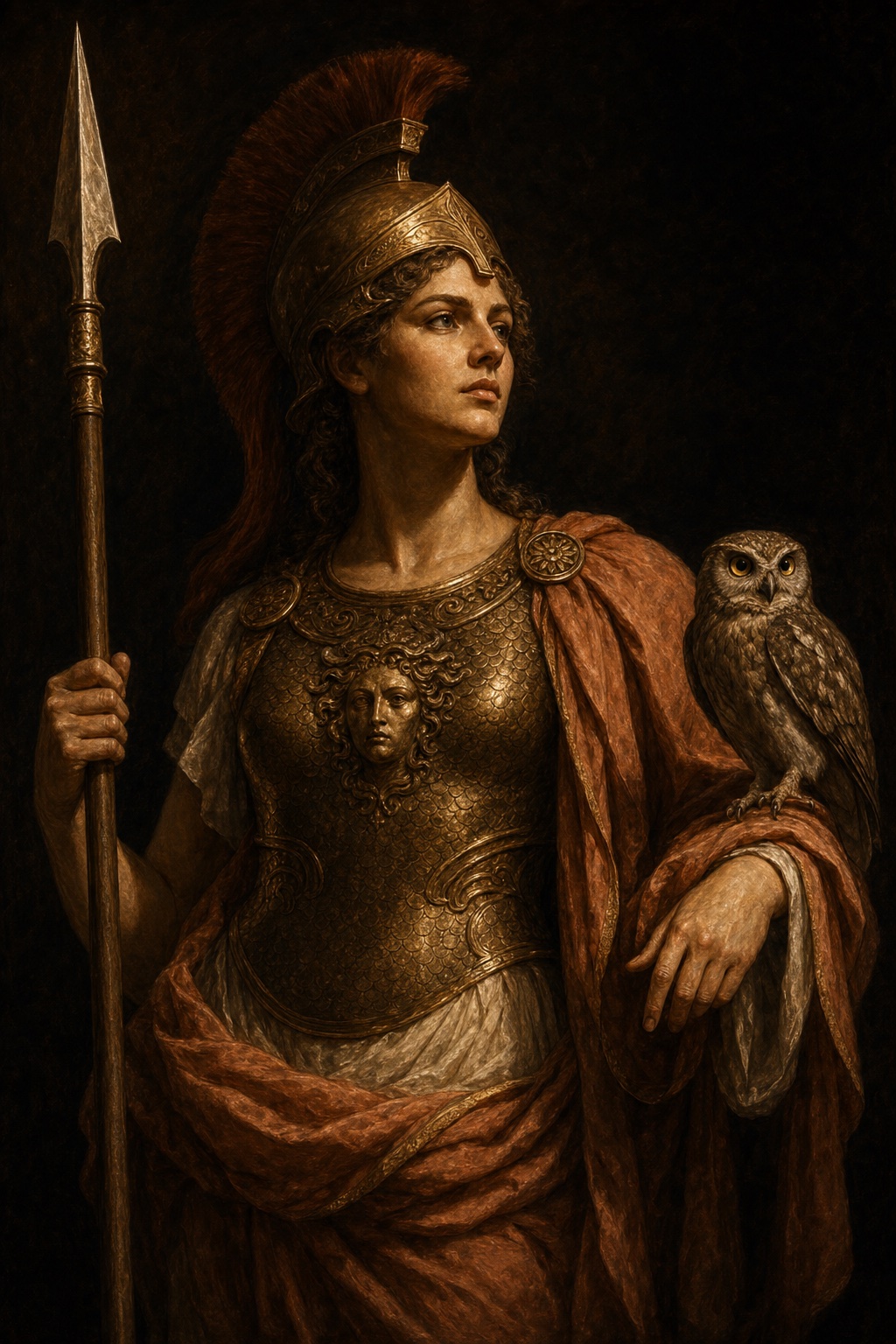
The sentence is the single most quoted line about any Egyptian deity and it is not Egyptian. Plutarch reports it as an inscription on a statue of Pallas — Athena, whom the Greeks identified with the goddess at Sais — and Budge is careful about what that is worth: no hieroglyphic inscription has been found which can be regarded exactly as the original of the Greek words. He does not therefore dismiss it. Proclus, he notes, gives a closely parallel Greek text in which the goddess goes on to say that the fruit she bore became the sun — which Budge takes to reflect, with considerable exactitude, the Egyptian title of Net the mighty mother who gave birth to Ra. So the Greek is not a translation of any surviving Egyptian sentence, and is not an invention either: it is a Greek writer putting into a formula the thing her priests actually said.
The name-play underneath it is Egyptian. Budge follows Mallet here: Net and the word ent, that which is or exists or has being, differ by almost nothing, so the formula is a pun on her name before it is a metaphysics. The Egyptians, he concludes, regarded Net as the Being par excellence — eternal, infinite, and the creative and ruling power of heaven, earth and the underworld alike. They heard her say so every time they wrote her down.
The arrows and the shuttle
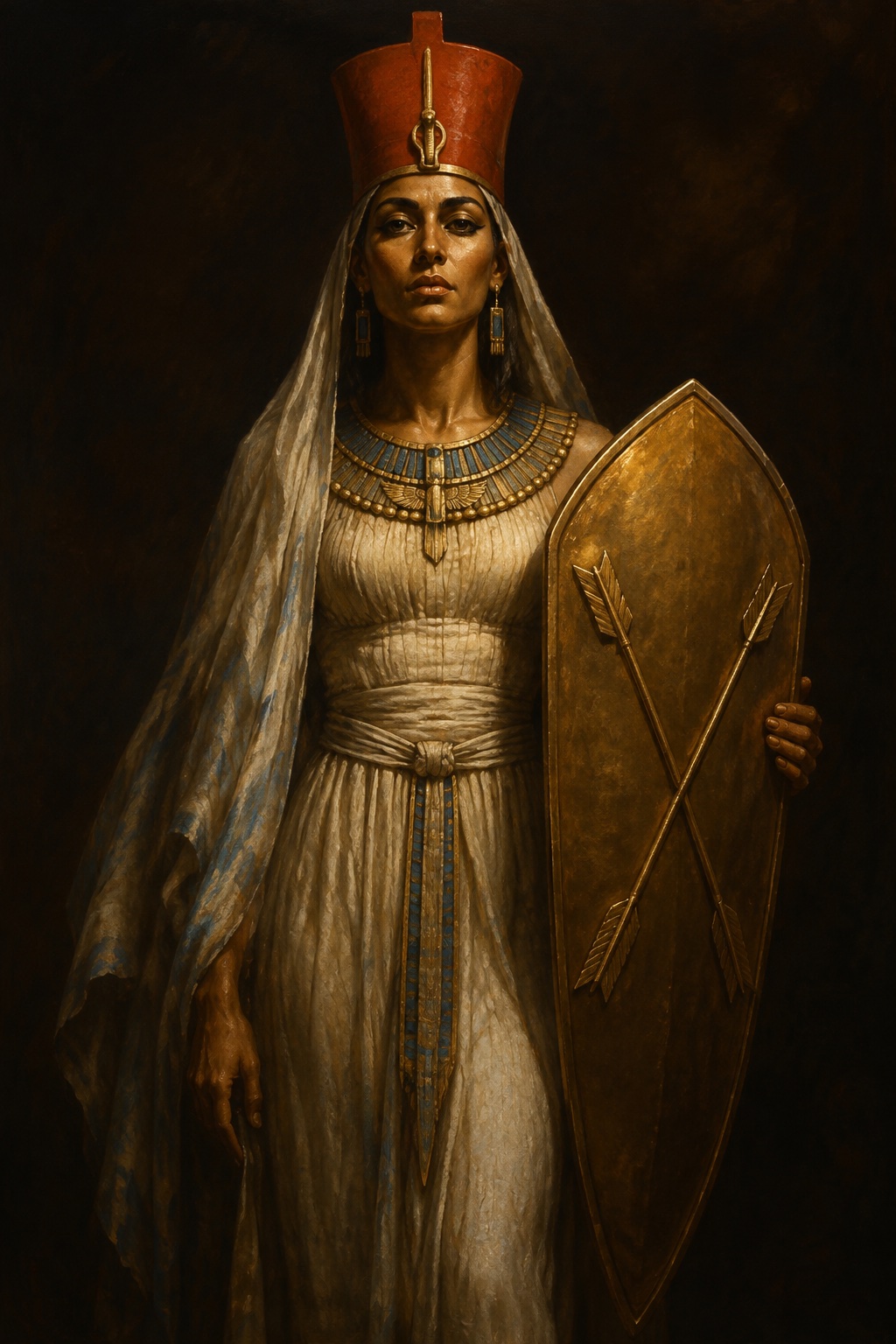
Her sign is two arrows crossed over a shield, and it is the whole of her iconography: it writes her name, it stands on the standard of her nome, and she wears it or carries it in every attitude the monuments give her. The reading is not settled and probably never was. A shield with arrows is a war goddess, and Sais treated her as one; the same group has also been read as a weaver’s shuttle, and it is that reading that made her the goddess of weaving whose linen wraps the dead. Nothing forces a choice — the arrows are for the living and the shuttle is for the mummy, and the same emblem serves both.
The funerary side is where she appears most often in this corpus’s other texts. Budge finds her in the Pyramid Texts of Teta as one of the four goddesses — with Isis, Nephthys and Serqet — who shot forth flame and worked protection for Nu on his throne, the same four who guard the Four Children of Horus and the organs in the canopic jars. That is the shape of her afterlife in the pantheon: not displaced, not forgotten, and no longer the first thing born, but the one holding the corner of the shrine.
Athena at Sais
The equivalence between Neith and Athena is not a modern comparison drawn across cultures. It is in the sources this entry is built from. Plutarch’s inscription is on a statue of Pallas; Budge takes the Greek and the Egyptian titles to be describing the same goddess; and the two agree on more than the identification usually survives — both are war goddesses who are not war gods, both are patrons of a craft (weaving, and the crafts a city is founded on), both are virgin, and both give a city its name and hold it. This wiki records the equivalence on both entries.
Where they part is at the beginning, and it is the more interesting half. Athena has a father and no mother, and the whole point of her birth is that Zeus produced her alone. Neith has no parent at all, produced the sun, and is the reason anything else could be produced — the two most self-sufficient goddesses in this atlas, arriving at self-sufficiency from opposite ends.