The builder of gods and men
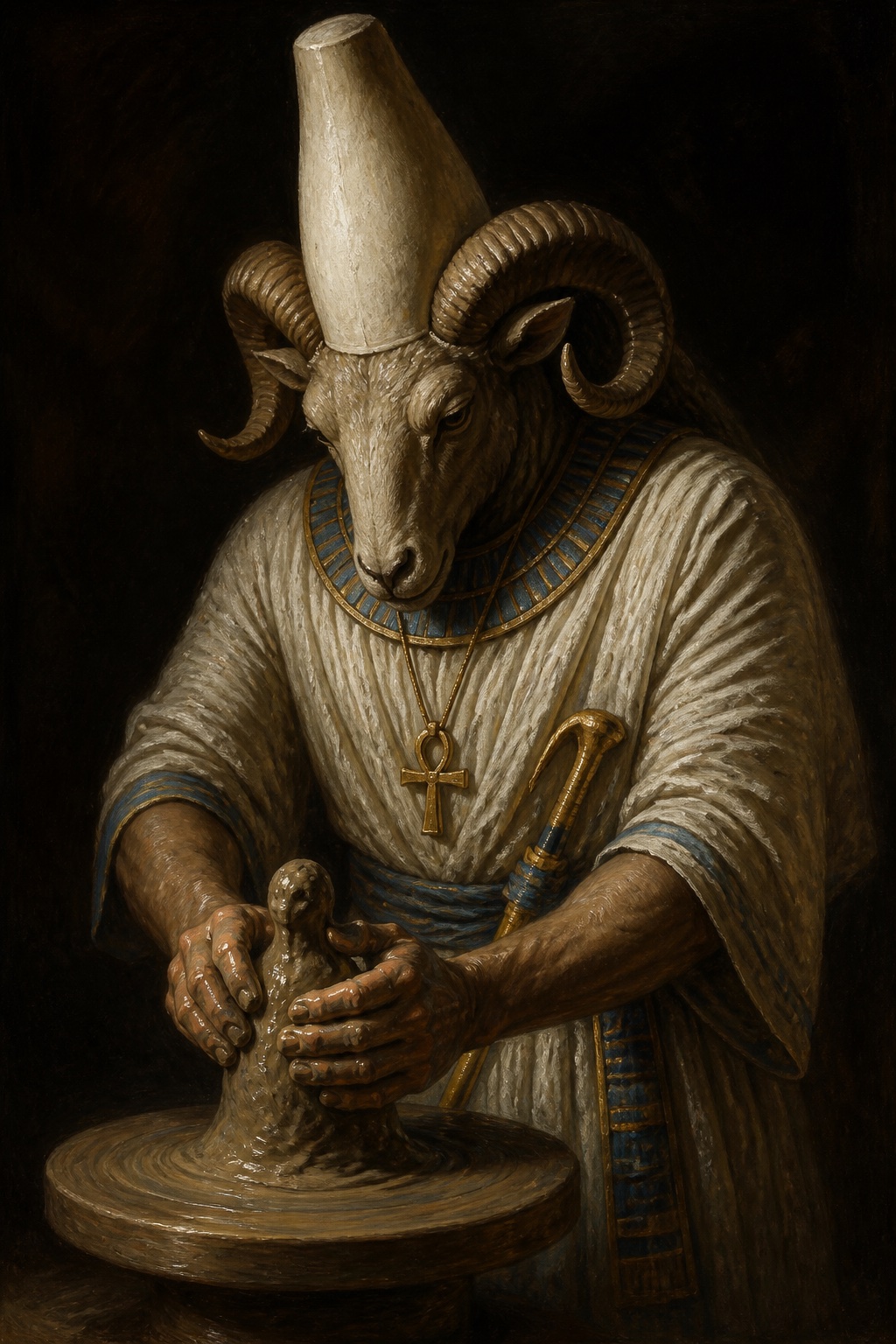
Budge opens his dedicated chapter on Khnemu by naming him the maker of nearly everything else that exists, and doing it from every angle at once: an egg, a company of gods, and a man, each one shaped by the god’s own hand rather than merely presided over.
we know from the texts of all periods that Khnemu was the ” builder” of gods and men. He it was who, according to the statements which were made by his priests at Elephantine, the chief seat of his worship, made the first egg from which sprang the sun, and he made the gods, and fashioned the first man upon a potter’s wheel, and he continued to ” build up ” their bodies and maintain their life. — E. A. Wallis Budge, The Gods of the Egyptians, vol. 2 (1904), p. 50
The sun itself begins here, hatching from an egg Khnemu made before he made anything else; the gods come next, and only then the first man, worked up like clay on the turning wheel. Even finished, the labour does not stop — Budge’s priests at Elephantine credited him with continuing to “build up” the bodies he had shaped and with keeping them alive. Modern Egyptology usually spells this god’s name Khnum; this entry keeps Budge’s own spelling, the one his book uses throughout and the one this wiki’s Ptah and Seshat entries already carry.
A hymn from Esna confirms it
A second witness, from a different cult centre entirely, repeats the same claim in far fewer words. Later in the same chapter Budge quotes it from a hymn inscribed on the walls of the temple of Esna:
he formed the company of the gods, and he made man upon his potter’s wheel. — E. A. Wallis Budge, The Gods of the Egyptians, vol. 2 (1904), p. 66, section “KHNEMU-SHU,” quoting a hymn inscribed at the temple of Esna
Two cult centres, two texts, and the same two objects: the gods and mankind, both turned out on the wheel. Nowhere in Budge’s chapter, in any passage where Khnemu himself is the one doing the making, does a third category ever join them.
Ram-headed, sceptre in hand, lord of Elephantine
Budge also fixes Khnemu’s visual form, apart from the act itself. On the monuments he is shown as a ram-headed man, usually holding a sceptre in one hand and the emblem of life, the ankh, in the other. On his head sits the White Crown of Upper Egypt — though its further ornament is not constant: Budge notes that plumes, uraei, and a disk are only sometimes attached to it, never claimed as a fixed part of the crown itself.
Elephantine, already named above as the chief seat of his worship, is also where Budge gives him his most explicit title: “the lord of the Island of Elephantine” — the god whose favour a soul needed merely to drink from the waters of the celestial Nile, because the earthly river’s own sources were believed to lie close beside his island.
Fellow-worker with Ptah
Khnemu did not work alone. This wiki’s own Ptah entry already quotes Budge’s account of the division of labour between them: Ptah and Khnemu carried out commands that Thoth had spoken, Ptah “employed in the construction of the heavens and the earth” while Khnemu was “engaged in fashioning man and animals.” That sentence describes the act from Ptah’s side of the workshop, and it is the only place in either of Budge’s volumes that gives Khnemu’s own product a third category beyond gods and men. Every passage in which Khnemu is himself the one doing the making — the two quoted above among them — names only the first egg, the gods, and the first man. Animals belong to Ptah’s sentence about Khnemu, not to any sentence Khnemu earns on his own account.
Her-shef at Herakleopolis, Osiris at Mendes
Budge’s chapter also follows Khnemu out of Elephantine and into two more cities under two more names. At Herakleopolis Magna he was worshipped as Her-shef; at Mendes, as a form of Osiris. Each is a local identity layered onto the same ram-headed maker, the same way Elephantine’s own priests already gave him the whole of creation under his own name.