The lady of the house of books
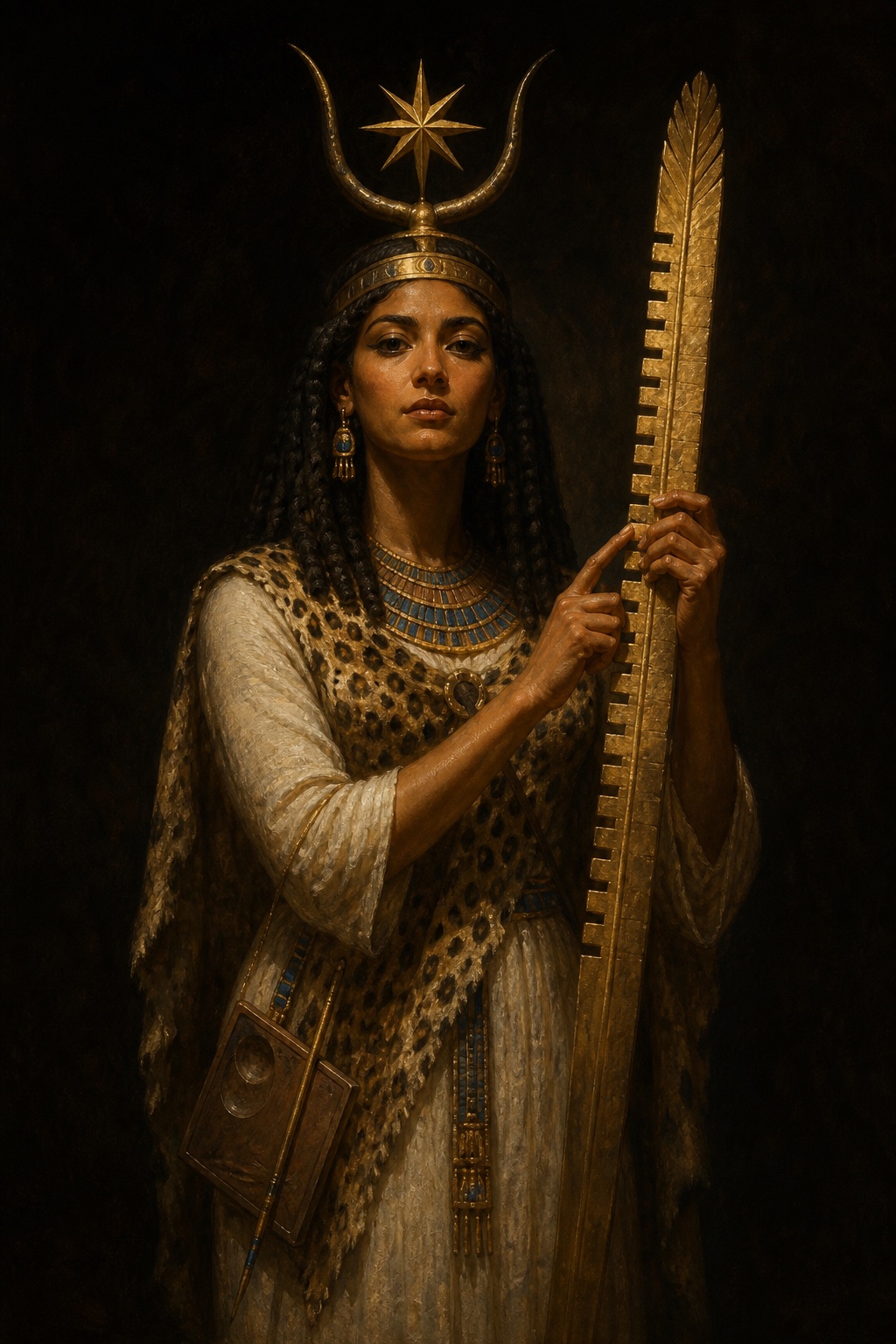
Budge introduces Seshat as a colleague of Thoth rather than a subordinate to him, working the same trade in his own province of writing and learning. He describes her holding the tools of a working scribe, not the regalia of a queen:
in her hands she holds a scribe’s palette and writing reed; in this form she is called the great one, the lady of the house of books — E. A. Wallis Budge, The Gods of the Egyptians, vol. 1 (1904), p. 424
The title names an institution, not a rank: a house of books she keeps, rather than a throne she occupies. In the same picture she also carries the cartouche, which Budge describes as the sign for a name — fitting equipment for a goddess whose business is committing names and words to a lasting record. Above her head he places a stranger mark still, one he reads as a pair of horns turned downward over a seven-rayed star or a seven-petalled flower, and he is unusually candid about what it means: neither the sign’s sound nor its identity, he says, has ever actually been settled. This entry keeps that same honesty rather than assigning the emblem a certainty Budge himself refused it.
Counting the notches, inscribing the years
Elsewhere Budge describes Seshat trading her writing tools for a different kind of record, kept in cuts along a branch rather than in ink:
she holds a notched palm branch in her hand, and she appears to be counting the notches; the lower end of the branch rests on the back of a frog — E. A. Wallis Budge, The Gods of the Egyptians, vol. 1 (1904), pp. 424-425
Each notch marks a year, and the branch itself becomes the instrument of the count, carried rather than merely read. Budge follows this image directly with the use such a count is put to: fixing how long a reign will last, long before the reign itself could prove it.
she declares to a king that she has inscribed on her register on his behalf “a period of life which shall be hundreds of thousands of thirty-year periods,” and has ordained that his years shall be upon the earth like the years of Ra, i.e., that he shall live for ever. — E. A. Wallis Budge, The Gods of the Egyptians, vol. 1 (1904), p. 425
A king’s years, in this telling, are not simply lived; Seshat’s own hand writes them into her register first, and the reign follows what she has already set down. This is close in spirit to the temple-founding ceremony Egyptology elsewhere calls the stretching of the cord, in which a building’s ground-plan is measured out with a cord before construction begins, and which popular tradition credits to Seshat above every other god. That specific ceremony does not appear anywhere in the pages behind this entry, however, and nothing above should be mistaken for a description of it; the gap is recorded here rather than papered over.
Her brother, not her husband
The same volume gives Seshat her fullest single portrait, naming an action and a relationship in one breath:
In a text quoted by Brugsch she declares to Seti that her words concerning him shall never be gainsaid, that her hand shall set down in writing his fame after the manner of her brother Thoth, and all according to the decree of Tem — E. A. Wallis Budge, The Gods of the Egyptians, vol. 1 (1904), p. 426
Later tradition often makes Seshat the wife of Thoth — this wiki’s own Thoth entry records the pairing itself, hedged as something only some traditions hold. Budge’s own account never reaches that far. Here he names Thoth outright as her brother, and elsewhere in the same discussion he describes her as fit to carry out Thoth’s own commands in the work of Creation: a colleague matched to his office, not a bride joined to him at an altar. Nothing in the pages this entry draws from ever calls her his consort. The popular pairing is a real tradition, but it is one this particular source does not support, and this entry follows what Budge actually wrote rather than the tradition built up around him.
Sefkhet-aabut, called Sesheta, and a mother no cult center agrees on
Budge never once writes the name “Seshat.” His heading for this whole discussion reads “Sefkhet-aabut,” sometimes spelled “Sefekh-aabut,” and he treats even that spelling as unsettled — he offers “Sesheta” only as a second, unconfirmed guess at how her name-sign should be read aloud. That second reading is the one he reaches for in his own quotation of a line from the Book of the Dead:
it was built for me by the goddess Sefekh-aabut (or Sesheta), and the god Khnemu set it up for me upon its walls — E. A. Wallis Budge, The Gods of the Egyptians, vol. 1 (1904), p. 425 (quoting Book of the Dead, ch. lvii.6)
This entry calls her Seshat, the modern rendering already fixed elsewhere in this wiki by Thoth’s own entry. No spelling this close to it ever appears in Budge himself, and a quotation of Budge has to keep his own spelling rather than borrow this entry’s — the same split this wiki already keeps between Sekhet and Sekhmet, one name for the page and another wherever the source itself is speaking.
Her family is no better settled than her name. Budge lists three different cult centers in a single sentence, each with its own answer for who she belongs to: she is identified outright with two other goddesses, Renenet and Isis; at Dendera she is instead called a daughter of Nut; and at Lycopolis she is a sister of Osiris and the mother of a local figure Budge calls Heru-nub, whom this entry does not equate with the wiki’s own Horus. Budge records all three claims without choosing among them — the disagreement is his, sitting inside one sentence, not a conflict between separate scholars — and this entry leaves the question exactly where he leaves it, a set of local claims rather than one family tree.