The scorpion venerated in Egypt
Egypt gave a god to most of the things that could kill a person quickly, and the scorpion got one of the oldest.
The Scorpion was venerated in Egypt at a very early period, and the scorpion-goddess Serqet or Selqet was in some of her aspects associated with the powers of evil, and in others with the goddess Isis — E. A. Wallis Budge, The Gods of the Egyptians (1904), vol. 2, p. 377
Two spellings of her name inside one sentence, and that is the least of it. Budge writes her Serqet through both volumes of The Gods of the Egyptians, Selqet here, Serq throughout Legends of the Gods, and Serqet-Hetu in the Pyramid Texts of Teta. It is the same unsettled hand that makes him write Neith as Net and Khonsu as Khensu, and this entry keeps Serqet, the form that dominates, while quoting each text in whatever spelling that text uses.
The two aspects are the more interesting half. She is grouped with the powers of evil and she is grouped with Isis, and nothing in Budge reconciles the two, because there is nothing to reconcile: the goddess who owns the venom is the goddess you address when you want it taken back. Every text below has her on the healing side of that arrangement — which is a choice the texts make about her, not a fact about scorpions.
What hath happened to the child Horus?
The one scene in this corpus where Serqet opens her mouth is a scorpion sting, and the sting is not hers. The child of Isis lies poisoned in the marshes; the boy’s aunt reaches the swamps first, and Serqet arrives behind her.
Then came Nephthys shedding tears, and she went about the Papyrus Swamps uttering cries of grief, and the goddess Serqet said, ’ What is it ? What is it ? What hath happened to the child Horus ?’ — E. A. Wallis Budge, The Gods of the Egyptians (1904), vol. 2, p. 210, on the Metternich Stela
The spaced question marks and the single opening quote are how Budge’s scanned page prints the line, and they are left as they stand. What the line does is smaller than a rescue and stranger than one. Nephthys weeps and walks in circles; Serqet asks a question, asks it again, and gets no answer inside the sentence. In a corpus where gods mostly act, hers is the reaction of somebody arriving at an accident.
What comes next in the volume 2 rendering is a plea: that heaven be prayed to, that the sailors of Ra stop rowing, and that the Boat of Ra not leave the place where the child is. Budge prints it as a fresh speech and names nobody as its speaker. The obvious reading is that Serqet is still talking. The next section is why that reading cannot simply be assumed.
Serq, and Budge’s square brackets
Budge translated these Metternich Stela lines twice, in two different books, and the two renderings do not agree about who speaks. In Legends of the Gods he spells her Serq and makes the whole thing one speech with two mouths.
Then came Nephthys shedding tears and uttering cries of lamentation, and going round about through the papyrus swamps. And Serq [came also and they said]: “Behold, behold, what hath happened to Horus, son of Isis, and who [hath done it]? Pray then to heaven, and let the mariners of Ra cease their labours for a space, for the Boat of Ra cannot travel onwards” — E. A. Wallis Budge, Legends of the Gods (1912), “The Legend of the Death of Horus through the Sting of a Scorpion”
The square brackets are Budge’s own supply — his standing mark for words he has added to make an Egyptian sentence run in English — and it is exactly the supplied words that settle the question. Strike them out and the passage has Nephthys arriving, Serq arriving, and a speech with no owner. Leave them in and the question and the plea together belong to the two goddesses jointly. Neither version gives the plea to Serqet alone, and the volume 2 version gives it to nobody.
So the honest summary is a split one: on both witnesses she asks what has happened to the child, and on no witness does she pray to heaven by herself. It is worth being exact about this, because the sentence is very close to a much better story than the sources support. Nothing here says that Serqet stopped the Boat of Ra. In the fuller Legends telling it is Isis who sends her voice up into heaven and makes supplication, and it is the Disk that stands still in its journey.
The spell that drives back the poison
The Metternich Stela is a healing monument before it is a story, and the narrative sits inside a set of spells meant to be recited over somebody who has actually been stung. Serqet is in those spells, and the way she is in them is worth noticing.
The spell of the Scorpion-goddess Serq driveth back thy might. Stand still, stand still, and retreat through her spell — E. A. Wallis Budge, Legends of the Gods (1912), “The Legend of the Death of Horus through the Sting of a Scorpion”
The second person there is the poison. The words are spoken at the venom by whoever is working the cure, and they are not Serqet’s words: what acts is her spell, and she is the power the reciter draws on rather than the voice in the room. That is a real distinction, and it holds for almost everything she does in Budge — she is the force applied to a dangerous thing, not usually the one who speaks.
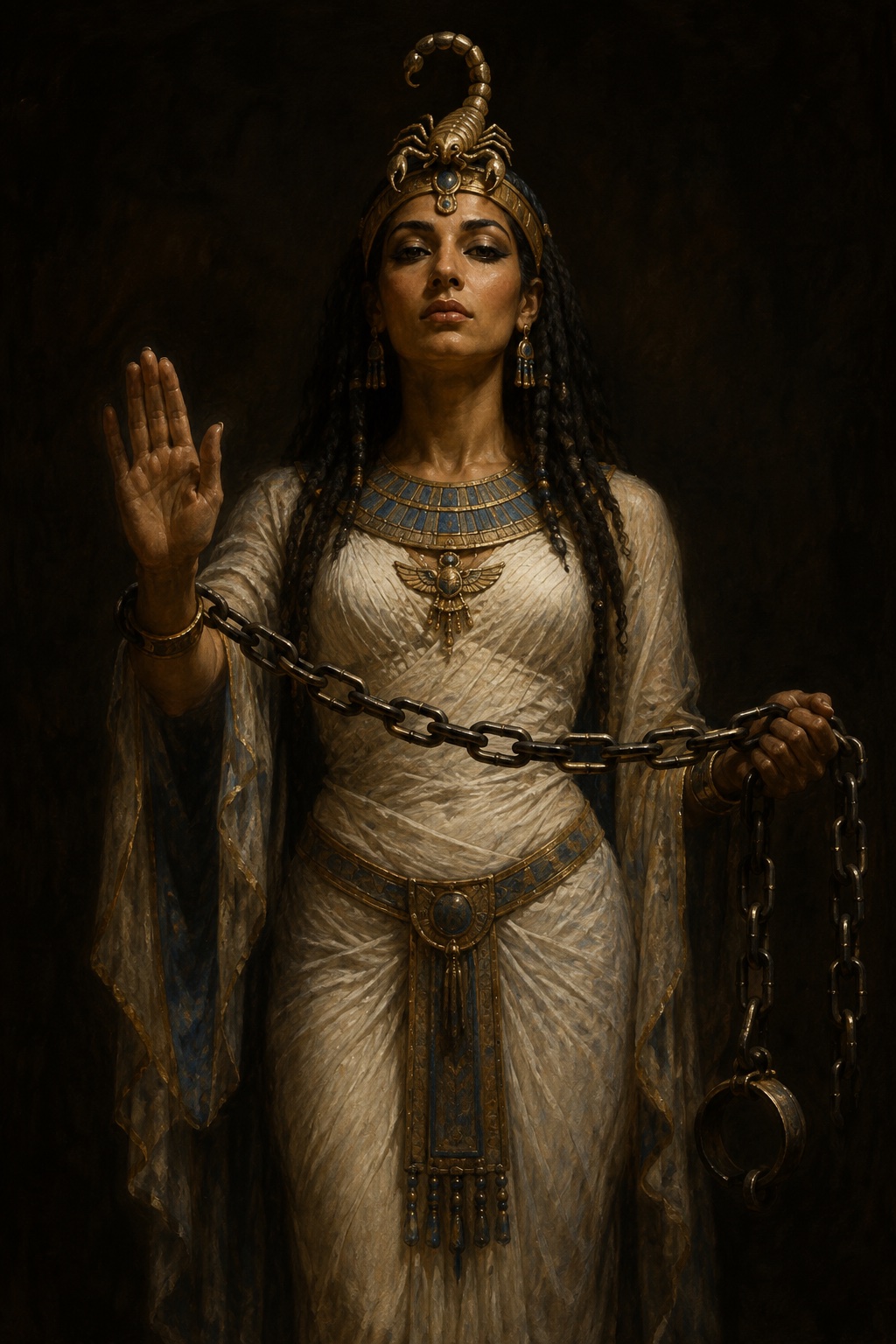
The rest of her acts are all of that kind, and all of them are binding. In the tenth division of the Tuat, Budge describes Apep held down by a chain that four beings and twelve gods pull taut, with Serqet stretched out along the chain at the serpent’s head. In Egyptian Ideas of the Future Life the deceased looks forward to his enemies being handed over to destruction and to her shackles. Budge’s own summary of the first Metternich spell even makes her the executor of the doom that spell pronounces on Apep. None of that is a killing. A spell that dooms a serpent is not a serpent’s death, and this wiki gives Apep no permanent killer because the texts give him none — what Serqet supplies is the chain.
One scene puts the binding and the halted boat side by side. In the seventh hour of the night the Boat of Ra runs into shallow water and the serpent Neha-hra blocks its way; Isis speaks the words that move the boat, Serqet and a companion god seize the serpent and hold him in bonds, and Ra goes on without hindrance. Put that against the papyrus swamps, where the same boat is begged to stop, and the pair reads almost as one idea twice: Serqet is present both times the solar journey is interrupted, once when it is asked to halt for a poisoned child and once when it is freed by tying something up.
Protection for Qebhsennuf
Her permanent office is funerary, and she states it herself, in the first person, in a single line Budge quotes from the canopic material.
Serqet says, I employ each day in making protection for Qebh- sennuf who is in me — E. A. Wallis Budge, The Gods of the Egyptians (1904), vol. 1, p. 456
The hyphen in “Qebh- sennuf” is Budge’s scan breaking the name across a line, and it is left as it stands rather than repaired, on the same principle that keeps “un- covered” in Neith’s entry: what is quoted is what the page prints. Qebhsennuf is one of the Four Children of Horus, the four gods who belong to the four canopic jars and the organs kept in them, and each of the four has a goddess of his own.
The four goddesses are Isis, Nephthys, Neith and Serqet, and Budge finds them together twice on these pages: in the Pyramid Texts of Teta they shoot forth flame and work protection for Nu on his throne, and the same four guard the Four Children of Horus and the organs in the jars. Neith’s entry already records the grouping from Neith’s side. This is the fourth member of it, saying her part of the arrangement out loud — and note the wording she uses, which is not that she guards Qebhsennuf but that he is in her, the goddess and the jar being one thing seen twice. The Teta text is where the fourth spelling named at the top of this entry comes from, Serqet-Hetu, which is also the one furthest from the form the entry settles on.
What she looks like, Budge hardly says. His list of the figures on one monument records her simply as a woman, with no hybrid body and no note of what she wears. A vignette in the Papyrus of Ani shows her holding the emblems of life and eternity, and Budge describes that picture in one clause without naming the individual signs. The scorpion worn on the head — the detail that leads every modern description of her — is in neither volume of The Gods of the Egyptians and in none of the texts this entry is built from. It belongs with the crook and flail that museum labels hang on Khonsu: later convention, probably correct, and not something Budge wrote.