The princess of Bekhten
Of every Egyptian moon-god episode preserved in this corpus’s Budge scans, only one shows Khonsu doing something rather than being described — and it happens far from Thebes, in a country the king of Egypt had no cult reason to visit. Budge’s telling opens with a foreign land called Bekhten, a journey of “seventeen months” from Egypt, where the prince’s young sister-in-law, Bent-reshet, has fallen under an evil spirit. A scribe is sent first and fails to cure her. Only then is the power of Thebes’s own great statue — enshrined there as Khensu Nefer-hetep — sent abroad in a travelling image Budge calls “Khensu, who worketh [his] plans in Thebes,” and it is this second, travelling Khonsu who makes the crossing.
he found that Bent-reshet was possessed of an evil spirit; but as soon as he had made use of his magical power the demon left her and she was healed straightway. Then that demon spoke to Khensu, and acknowledged his power, and having tendered to him his unqualified submission he offered to return to his own place — E. A. Wallis Budge, The Gods of the Egyptians (1904), vol. 2, on the Bentresh stela
What is notable is what the demon does next: not flight, not a rout, but negotiation. It speaks to the god, submits to him, and asks leave to withdraw. The prince of Bekhten is grateful enough, once his sister-in-law is well, that when the travelling god eventually decides to leave, the prince does not want to let him go — and keeps him.
The hawk of gold
The prince keeps the god for “three years, four months, and five days” before Khonsu, unprompted, leaves the shrine that had been built to hold him.
at length he departed from his shrine and returned to Egypt in the form of a hawk of gold — E. A. Wallis Budge, The Gods of the Egyptians (1904), vol. 2, on the Bentresh stela
No fleet, no formal leave-taking, no farewell audience: the healer simply changes shape and flies home. It is the only physical description Budge gives of Khonsu anywhere in the episode — no face, no throne, no regalia while the cure itself is worked, only this one transformation at the very end, gold-coloured and airborne, covering in an instant the distance a human embassy needed “seventeen months” to cross.
The moon-god’s form
Outside the Bekhten narrative, Budge’s account of what Khonsu looks like reads closer to a catalogue than a portrait.
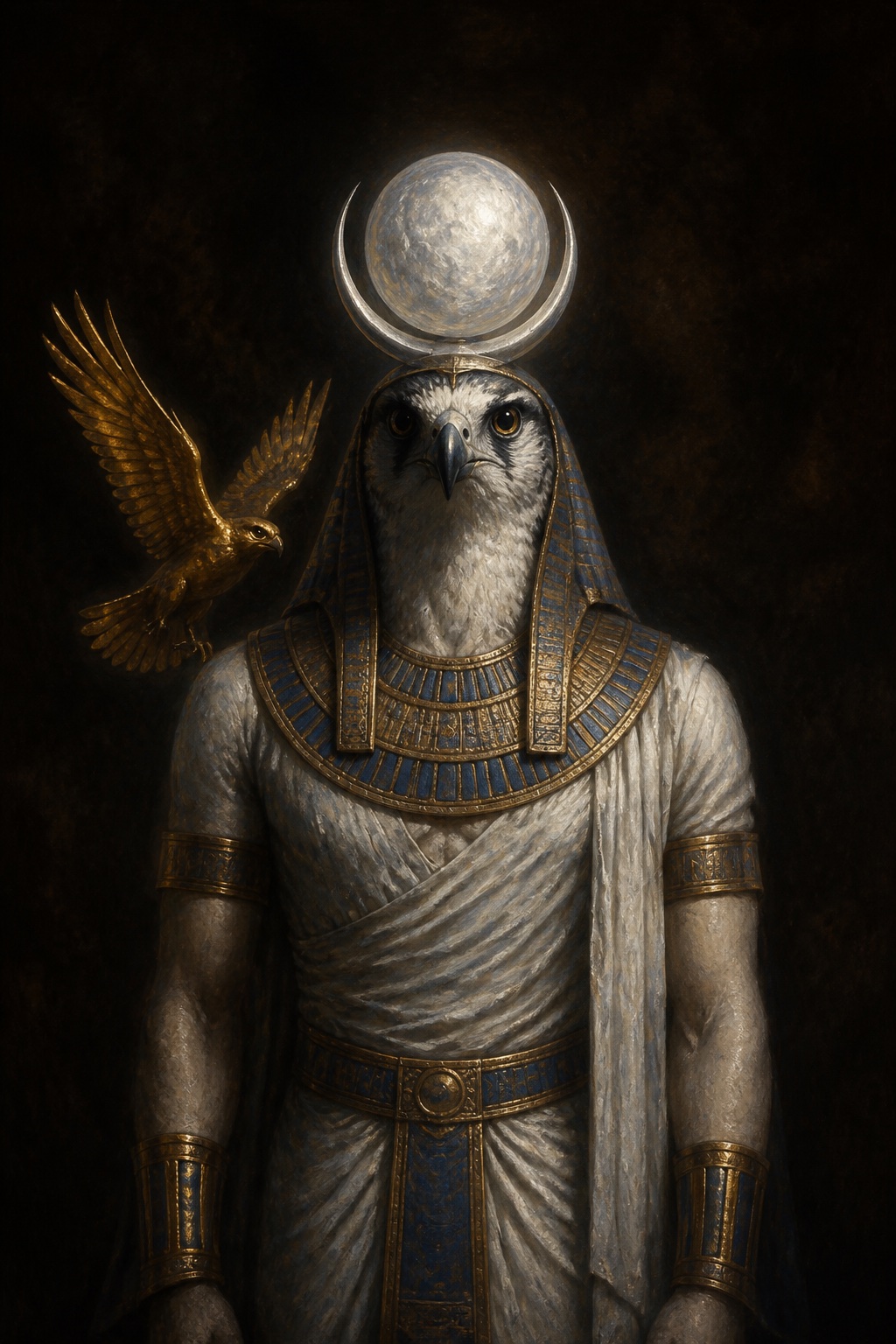
The forms in which Khensu is depicted on the monuments are of considerable interest, and may be thus described. Whether standing or seated on a throne he has usually the body of a man with the head of a hawk; sometimes, however, his head also is that of a man. He wears on his head the lunar disk in a crescent, O, or the solar disk with a uraeus, or the solar disk with the plumes and a uraeus — E. A. Wallis Budge, The Gods of the Egyptians (1904), vol. 2
Three headdresses are offered as alternatives, not fused onto one figure — Budge is listing variant images, not describing a single costume. The crook and flail, a mummiform wrapping, a sceptre, a youth’s side-lock of hair: none of that is in this description, and nothing here should be read as though it were; those are the conventional attributes of later museum reliefs, not Budge’s own. What Budge does add, elsewhere in the same chapter, is that some of the god’s forms are explicitly a child’s rather than a man’s: Khensu-pa-khart, “Khensu the Babe,” and Khensu-Hunnu, “Khensu the Child,” standing to the grown Khonsu the way Harpocrates stands to Horus. That is a claim about youth, not about a hairstyle Budge never mentions — and it belongs with the epithet the next section quotes, not against it.
Son of Amun, beautiful youth of Thebes
Budge’s description of Khonsu’s cosmic rank and his parentage arrive in the same sentence.
He was the second great light in the heavens, and was the “first great [son] of Amen, the beautiful youth, who maketh himself young in Thebes” — E. A. Wallis Budge, The Gods of the Egyptians (1904), vol. 2
The first great light is the sun; call Khonsu the second and Egyptian cosmology has already set him just under Ra. The same clause makes him Amen’s son without further ceremony. Budge spells the god’s own name Khensu and the father’s name Amen throughout; this entry uses the modern Khonsu and Amun instead, in step with this wiki’s own Amun page, which now lists Khonsu among his children. The mother’s side is quieter. Budge never writes a single sentence naming Khonsu as Mut’s son; what he does write is that Mut is “the consort of Amen,” and that the three belong together as one unit, “Amen, Mut, and Khensu with Thebes.” That is how this entry reads Mut as his mother — the ordinary inference from a named consort plus a named triad, not a clause Budge commits to outright. It also sits against a fact already recorded on this wiki: Amun’s own entry gives Ament, his partner from the oldest layer of the Pyramid Texts, as his consort, while the Theban material that produces Khonsu speaks only of Mut. Both claims are Budge’s; neither is dropped here to save the other.
Power over the evil spirits
Bekhten dramatizes one demon’s submission to Khonsu. Budge states the doctrine behind it in general terms.
This god not only ruled the month, but he was also supposed to possess absolute power over the evil spirits which infested earth, air, sea, and sky, and which made themselves hostile to man and attacked his body under the forms of pains, sicknesses, and diseases, and produced decay, and madness, and death — E. A. Wallis Budge, The Gods of the Egyptians (1904), vol. 2
The power the Bekhten stela narrates as a single case is, on this account, general and standing — not a rout achieved by force so much as an authority evil spirits are made to recognize wherever they operate, on earth, in the air, at sea, in the sky. Rameses III later built Khonsu a large temple at Thebes in the Moon-god’s honour, and Budge finds the god named under the epithet “Nefer-hetep” again, on a separate stele. The healer sent abroad to cure a foreign princess and the youth worshipped at home are, in Budge’s telling, the same god under the same name.