The name is his with a t on the end
Amun’s name means what is hidden. Hers is that name with the Egyptian feminine ending added, and that is the whole of her derivation: where he is the hidden one, she is the hidden one, feminine. Budge, who spells the pair Amen and Ament throughout, finds them together in the Pyramid Texts — his second volume cites Unas line 558, while his first volume’s list of the principal gods of those texts files them both under 557 — and notes that they stand there beside a second pair built the same way, Temt being the female counterpart of Tem, the god this atlas files as Atum.
It is evident that even in the remote period of the Vth Dynasty Amen and Ament were numbered among the primeval gods, if not as gods in chief certainly as subsidiary forms of some of them — E. A. Wallis Budge, The Gods of the Egyptians (1904), vol. 2, p. 2
Subsidiary forms of some of them is the qualification that governs everything after it. She stands in the oldest layer of Egyptian writing, which is more than most gods manage, and she stands in it as an accessory. Budge states the consequence flatly, in the other volume and in the middle of a discussion of somebody else.
the female counterpart of the local god Amen, and of necessity a deity of little importance — E. A. Wallis Budge, The Gods of the Egyptians (1904), vol. 1, p. 465
Of necessity is the phrase doing the work. This is not a verdict on her cult or her worshippers; it is a deduction from the way the name was made. A goddess produced by inflecting a god’s name has whatever importance that god’s name has left over, and Amen’s importance in the earliest period was local and small. When his grew, hers did not come with it.
Her head is whichever one he is not wearing
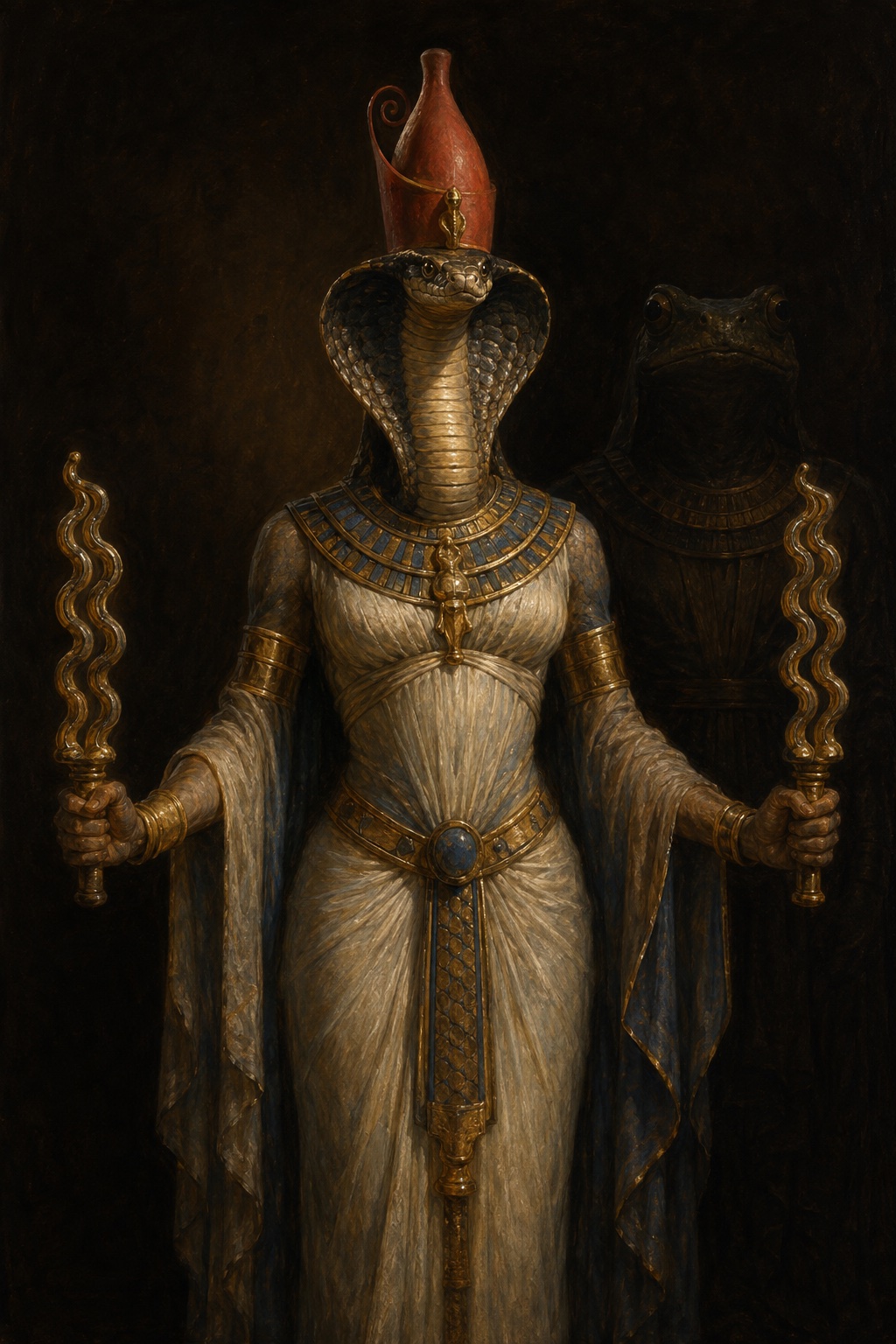
Budge lists five forms in which Amun is represented on the monuments. Two of them arrive with Ament attached, and in both she is described only as the complement of whatever he is in that image.
As a man with the head of a frog, whilst his female counterpart Ament has the head of a uraeus — E. A. Wallis Budge, The Gods of the Egyptians (1904), vol. 2, p. 2
As a man with the head of a uraeus, whilst his female counterpart has the head of a cat — E. A. Wallis Budge, The Gods of the Egyptians (1904), vol. 2, p. 2
Read the two together and the rule is mechanical. The uraeus — the rearing cobra — is his head in the one picture and hers in the other; when he takes it, she is given the cat instead. These are alternative images rather than a single fused figure, but the alternation is not between forms of her own. It tracks his. Nothing else is said anywhere about how she looks: no body, no throne, no sceptre, no crown, only a head chosen so as not to repeat the head standing beside it. The frog belongs to him in both descriptions, and reversing the two is the easiest mistake available on this page.
One of the four goddesses of Hermopolis
The one place Ament holds a function rather than a position is Hermopolis, whose theology counted eight primeval gods arranged as four male-and-female pairs. She is one of the four goddesses, and a god with a built-in feminine counterpart is exactly the raw material that system was assembled from, so it takes the pair in without adjustment.
In some lists of the gods Amen and Ament are made to take the places of Nu and Nut — E. A. Wallis Budge, The Gods of the Egyptians (1904), vol. 1, p. 113
The Eight were never a fixed roster. Different authorities named different gods to the same slots, and in some of the lists Amun and Ament simply occupy the places that Nu, the primeval water, and Nut hold in others. Budge records the substitution and does not resolve it, which is honest reporting of a scheme that was never standardised.
with the primeval goddess Ament, who formed one of the four goddesses of the company of the gods of Hermo- polis, which was adopted in its entirety by the priests of Amen for their gods — E. A. Wallis Budge, The Gods of the Egyptians (1904), vol. 2, p. 30
The hyphen in “Hermo- polis” is Budge’s scan breaking the word across a line, and it is left as it stands on the same principle that keeps “un- covered” in Neith’s entry: what is quoted is what the page prints. The clause after it is the one that matters. The priests of Amun took the Hermopolitan company over entire and applied it to their own gods, which is how a goddess who is grammatically the feminine of Amen ends up classed among the creators. That is the whole basis for filing her under creation, and it is a basis of position rather than of act: nothing in either volume has her make anything.
The goddesses who took her place
The Hermopolis sentence above is not from a chapter about Ament. It sits in Budge’s account of Mut, the great goddess of Thebes, and its subject is what Mut absorbed. Of Mut, Budge writes that “Locally she usurped the position of Ament”, and supplies the reason in the same breath: Mut also took over Apet, the personification of the ancient settlement Apt from which the name Thebes derives. Ament was the consort a name required. Mut was the consort a city produced. This atlas records the collision from the other side already — the entry on Khonsu sets Amun’s oldest consort against the Mut of the Theban triad and declines to drop either — and this clause of Budge’s is the join between them: locally, at Thebes, one goddess took the position, and the other kept only the name.
She did not keep it for long either. At Thebes the goddess of Sais came to be worshipped under it outright — Neith, whom Budge spells Net.
in Thebes Net, as the mother and wife of Amen-Ra, was known under the form and name of the ancient goddess Ament. She is represented as a young woman who wears upon her head the crown of the North, and holds in each hand the emblem of water — E. A. Wallis Budge, The Gods of the Egyptians (1904), vol. 1, p. 465
Every attribute in that sentence is Neith’s, and Budge says so himself in the next one, where he records that all of Net’s attributes were ascribed to Ament — and then, in the same breath, delivers the verdict quoted at the top of this entry about the deity of little importance underneath them. What comes after is the grandest thing ever said under Ament’s name, and none of it was ever hers.
Thus Ament is styled, the Cow, the great lady, who fashioned the company of the gods, the mother of Ra, who gave birth to Horus — E. A. Wallis Budge, The Gods of the Egyptians (1904), vol. 1, p. 465
Mother of Ra, maker of the company of the gods, the Cow: that is the goddess of Sais, wearing a Theban name. The title Budge attaches to the same composite figure, “Ament, the dweller in Apt”, is a Theban title of the merged goddess and not one Ament earned on her own — which is why this entry lists the crown of the North and the water emblems among her symbols while saying, here, whose they were. The name surfaces a third time in Budge’s chapter on Isis, who as lady of the Underworld is called Ament, the hidden goddess, and is declared under that name to be the mother of Ra; he adds that Isis had by then absorbed the attributes of all the great primitive goddesses, which is the same movement again with a larger goddess doing it. Three appropriations, and no sign that the original ever resisted any of them. There is no episode in either volume in which she does anything at all.