The serpent of the North
Budge opens his section on her with the plainest description he has: Uatchet, or Uatchit, is a goddess who was worshipped under the form of a serpent. Both spellings are his, and the second is the one his summary of the Winged Disk legend uses below. Modern writing calls her Wadjet. The oldest seat of her cult was Per-Uatchet, the city the Greeks called Buto, in the Delta. Her temple and its precincts, he says, are known in texts of all periods by a double name, Pe-Tep, and the name occurs so often in the Pyramid Texts that the shrine was clearly both very famous and very old.
She had a counterpart as far back as Budge can trace her. The vulture goddess of Nekheb in the South is Nekhebet, and Budge calls Uatchet her twin sister. The twinship is a matter of geography, not of birth: one goddess is the South and the other is the North. Early in the dynastic period, he says, a king who wanted to proclaim his sovereignty over all Egypt gave himself a title that Budge renders freely as Lord of the shrines of the Vulture and Uraeus. The equivalents of those signs are already on the plaque of Aha, and Budge concludes from them that the cities of Nekhebet and Per-Uatchet were important religious and administrative centres in predynastic times.
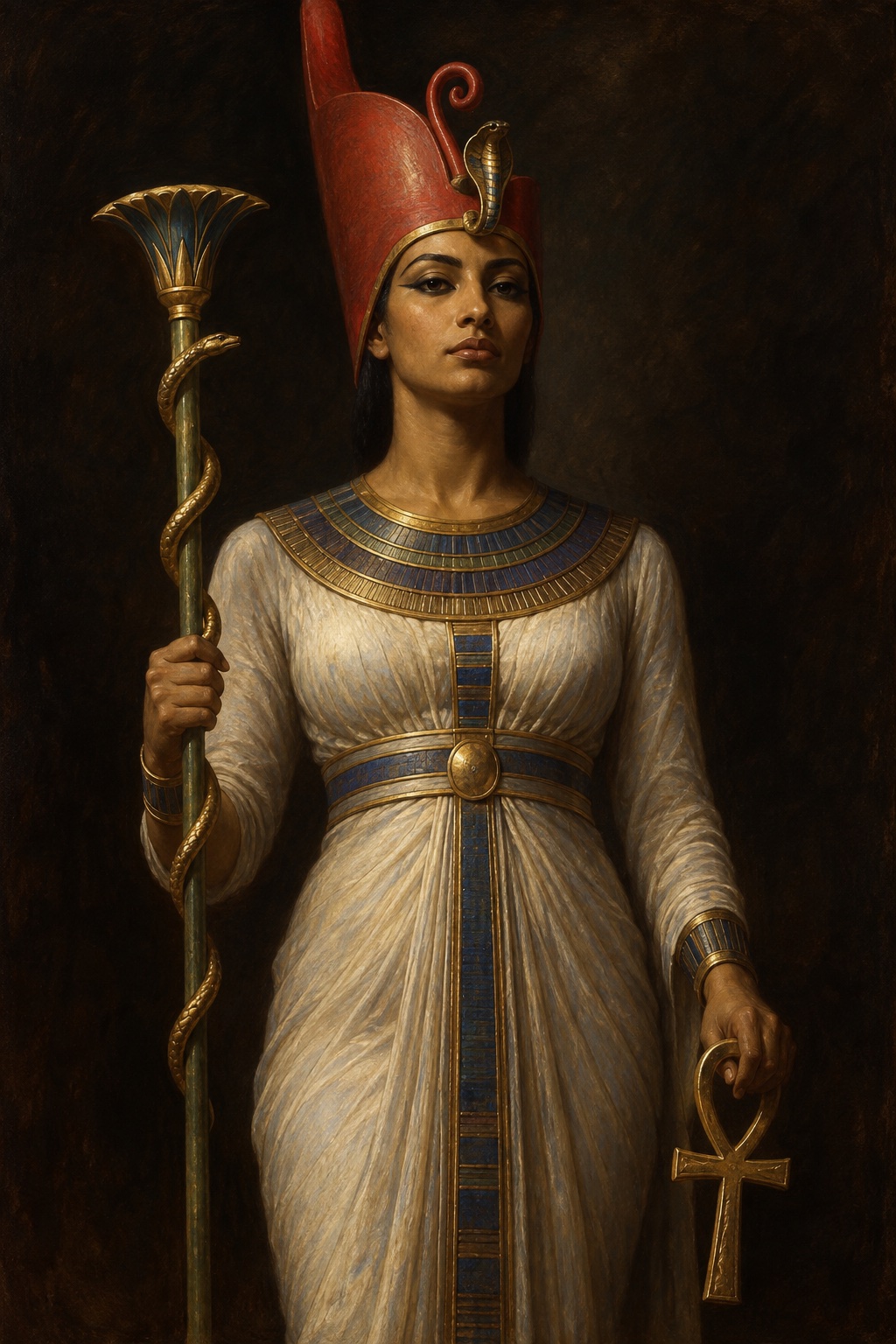
The two goddesses stayed at the king’s side. In the bas-reliefs of the temples, Budge says, Nekhebet is usually shown with her twin, and both appear in coronation scenes, because it was most important for a king to be crowned with the double crown by these two deities. Each of them answers for one half of that crown. Budge’s description of Uatchet’s own image puts the northern half in her hand. In pictures and reliefs she is a woman wearing the crown of the North. In one hand she holds the papyrus sceptre, and sometimes a long snake is twined round it. In some examples she holds the crown of the North in her right hand and is about to place it on the head of a king. Occasionally she is not a woman at all but a large winged serpent, with the crown of the North on her head.
Her titles in Budge are short: lady of heaven; lady of Pe, mistress of Tep, the august one, the mighty one; mistress of all the gods. In late dynastic times she was also called Ap-taui, which Budge renders opener of lands, and he admits that the exact meaning of the title is not quite certain.
Isis hidden in the swamps
Budge narrates one legend in his section on her, and it is not hers. It belongs to Isis. Near the city of the goddess, he says, lay the Island of Khebit, which plays a prominent part in the legends of Isis and Horus, and he retells the part of those legends that happened there.
Isis retreated to the papyrus swamps after she had conceived her child, and she remained hidden in them until her months were fulfilled, when she brought forth Horus, who afterwards became the “avenger of his father;” Set never succeeded in finding her hiding place, because the great goddess had found some means whereby she caused the papyrus and other plants — E. A. Wallis Budge, The Gods of the Egyptians (1904), vol. 1, p. 442
The quoted span stops in the middle of the sentence. In Budge the plants are made to hide Isis from Set, and the same sentence then closes on the goddess this entry is about.
screen her from his view, and the goddess Uatchet visited her and helped her in her retreat. — E. A. Wallis Budge, The Gods of the Egyptians (1904), vol. 1, p. 442
That is the whole of her part. She visits and she helps. The hiding is done by Isis herself, through the plants she causes to screen her, and Budge does not say what form the help took. The help also comes to the mother, not to the child. Isis stays in the swamps from conception until her months are fulfilled, and the retreat is the thing Uatchet helps with. Budge does not show Uatchet nursing the infant Horus there, and this entry does not either.
The legend and the city fit together. Horus, the son of Isis, was worshipped with Isis at Per-Uatchet, and Budge says there is abundant proof of it. From that he concludes that Pe-Tep was a city with two distinct divisions: Horus dwelt in Pe, and in Tep dwelt the goddess he calls Uatchet-Isis. So the goddess of the city helps the mother in the swamps nearby, and the son she bears is afterwards worshipped in the city’s other half. The same name, Uatchet-Isis, also shows the difficulty. In the legend Uatchet is a second goddess who comes to Isis’s aid. In the city, on Budge’s reading, the two are worshipped as one. He states both and does not reconcile them, and the last section of this entry comes back to the question.
The living uraeus
The uraeus is the serpent worn on the brow, and Budge’s clearest witness to what it meant is not a myth but a line of ritual. During the ceremonies of embalming, he says, the operator or priest addressed the mummy, and the address begins with her.
The goddess Uatchet cometh unto thee in the form of the living Uraeus — E. A. Wallis Budge, The Gods of the Egyptians (1904), vol. 1, p. 443
The address goes on past the quoted end. She comes to anoint the head of the dead with their flames, and Budge’s footnote says that the pronoun means Uatchet and Nekhebet together. She rises up on the left side of the head, and she
shineth from the right side of thy temples without speech ; they rise up on thy head during each and every hour of the day, even as they do for their father Ra, and through them the terror which thou inspirest in the holy spirits is increased, and because Uatchet and Nekhebet rise up on thy head — E. A. Wallis Budge, The Gods of the Egyptians (1904), vol. 1, p. 444
The sentence runs on again. The brow of the dead becomes the part of the head on which the two goddesses establish themselves, as they do on the brow of Ra, and because they never leave the dead, awe of him strikes into the souls which are made perfect. The comparison with Ra is the point of the address: the embalmed body receives what the sun god wears, and with it the fear the sun god inspires. The quoted words call Ra their father in passing. It is one phrase in a ritual, and this entry records no parent for her.
The same pair of serpents was carved in stone for the living to see. Budge describes the winged disk sculptured over the doors of Egyptian temples with a serpent on each side: on the right, or south side, Nekhebet, and on the left, or north side, Uatchet. Astronomically, he adds, Nekhebet was the western or right eye of the sun during his journey in the Underworld, and Uatchet was his eastern or left eye. The Book of the Dead keeps the eye. In its seventeenth chapter she appears as a serpent twined round the stalk of a papyrus plant and is called the eye of Ra. In the sixty-sixth the deceased says that he is Uatchet who came forth from Horus, and that he flies up and perches on the forehead of Ra in the bows of his boat in heaven. To become her is to take the place she holds.
Budge’s sides do not stay fixed. Over the temple doors and in the sky she is on the left. The embalming address has her rise on the left side of the head, although in the same breath she shines from the right side of the temples. And the chamber that, following Brugsch, he says was set apart for her near the sanctuary lay on the west, which he calls the right side of the sanctuary, while Nekhebet’s lay on the east, the left. Her chamber was called the house of fire. Nekhebet’s entry observes that in this arrangement the fire belongs to the other goddess, which is to say to Uatchet. The embalming address shares the flames between the two of them.
Destroyer of the foes of the dead
A serpent on the brow is a weapon as well as a crown, and Budge sums up her part among the dead in a single clause.
In the Book of the Dead Uatchet generally plays the part of destroyer of the foes of the deceased — E. A. Wallis Budge, The Gods of the Egyptians (1904), vol. 1, p. 444
The sentence does not stop there. It goes on to say that her connexion with Ma’at shows she was identified with one of the female counterparts of Thoth. The chapters Budge cites bear out both halves. In one the shoulder of the deceased is said to be the shoulder of Uatchet. In the two versions of another chapter he is called the lord of Ma’at, and Ma’at is tied there to the work of the goddess Uatchet. In another the Enemy has come to an end beneath him in the presence of the Assessors, and he eats the Enemy in the great field on the altar of Uatchet. In yet another, certain bones in his head are identified with those of the Uatchti goddesses, which Budge explains as Nekhebet and Uatchet. She is in his body, in his order and at the altar where his enemy ends.
The destroyer is not only a figure of the funerary books. Nekhebet’s entry tells the legend of Horus of Behutet, the god of Edfu, in full. Budge’s own summary of that legend gives the two serpents their work in one sentence, and it spells her name Uatchit.
When this was done Horus changed himself once more into the form of the winged sun-disk with uraei, and took with him the goddesses Nekhebet and Uatchit in the form of two serpents, that they might consume with fire any rebels who still remained. — E. A. Wallis Budge, The Gods of the Egyptians (1904), vol. 1, p. 483
That is why her relations record Horus, as Heru-Behutet, the Winged Disk, as an ally and not as family. She is the serpent he takes with him, and the victory is his. Nekhebet’s entry sets this summary beside Budge’s full translation of the same legend, where the serpents do not burn anyone and the enemies die of their own fear. In the summary the serpents burn, and the fire is hers again, shared as always with her twin: the house of fire near the sanctuary, the flames with which she anoints the head of the dead, and the fire with which the two serpents consume the rebels.
Isis, Nephthys and Hathor
Budge ties her to three other goddesses, and he weighs the three ties very differently.
Isis comes first, and Budge dates it early. In her own section Budge says that Uatchet was identified with Isis at a very early period, and the double city of Pe-Tep is his evidence: Horus in Pe, Uatchet-Isis in Tep. That is the identification this entry records first in its relations.
Nephthys comes from the other side of the pair. In his section on Nekhebet, Budge says that from one aspect Nekhebet was identified with Isis, the fertile goddess of nature, just as Uatchet was identified with Nephthys, who was supposed to act the part of nurse to the offspring Isis brought forth. In other words, he says, Nekhebet was the mother of the Sun-god, and so also of the king of Egypt, his son, and Uatchet was his nurse. This is the only sentence in which Budge makes her a nurse. It is a statement about aspects, not an episode, and it does not put her beside the child in the swamps. Nekhebet’s entry records the same arrangement from the vulture’s side: the goddess of the South bears the king, and the goddess of the North rears him.
Hathor is the identification Budge distrusts. As the goddess of the Underworld, he says, Hathor was identified with four great and ancient goddesses: Nekhebet of Eileithyiaspolis, Uatchet of Per-Uatchet, Bastet of Bubastis and Neith of Sais, the four typical goddesses of the four quarters of the world. He adds at once that this identification is quite evidently the product of a late period, when the earliest attributes of Uatchet and Nekhebet had been forgotten. He describes them under the head of Hathor for convenience, and because there is something to be said for it, not because he regards the Ptolemaic identification as the correct one. This entry therefore narrates Hathor and records only Isis and Nephthys in its relations.