The Eye of Ra
Ra has grown old, and men and women mock him for it. He calls a council of the elder gods and asks what should be done, and their advice is to send out his Eye against the rebels — a weapon so absolute that no other eye can withstand it once it goes forth in the form of Hathor.
Thereupon this goddess went forth and slew the men and the women who were on the mountain (or, desert land). And the Majesty of this god said, “Come, come in peace, O Hathor, for the work is accomplished.” Then this goddess said, “Thou hast made me to live, for when I gained the mastery over men and women it was sweet to my heart” — E. A. Wallis Budge, Legends of the Gods (1912), “The Destruction of Mankind”
Nothing in the surviving line softens it. Hathor answers Ra’s recall by telling him plainly that the killing pleased her, and it is this sentence — one of the most quoted in Egyptology for her dual nature — that scholars reach for whenever they need to show how far her gentler reputation sits from the whole truth of her.
Merged with Sekhmet, tamed with beer
Three sentences later, the text stops calling her Hathor. Without explanation it switches to calling her Sekhet, wading through blood by night on the killing-ground — the spelling Budge gives for the goddess more commonly known as Sekhmet, and the clearest evidence in the whole episode that the two were, in this telling at least, one and the same violence wearing two faces.
Ra has to stop her by trickery rather than force. Mandrakes are ground up by the goddess of Heliopolis, mixed with human blood, and brewed into seven thousand jars of beer, which Ra has carried downriver and poured across the meadows of the Four Heavens overnight. Hathor arrives, sees the blood-red flood, drinks, and gets so thoroughly drunk that she forgets mankind entirely. Ra welcomes her back with a new name, Amit, the beautiful one, and decrees that vessels of the same sleep-producing beer be brewed at every one of his festivals from then on — a hangover written permanently into the liturgical calendar.
Golden goddess of love, music, and joy
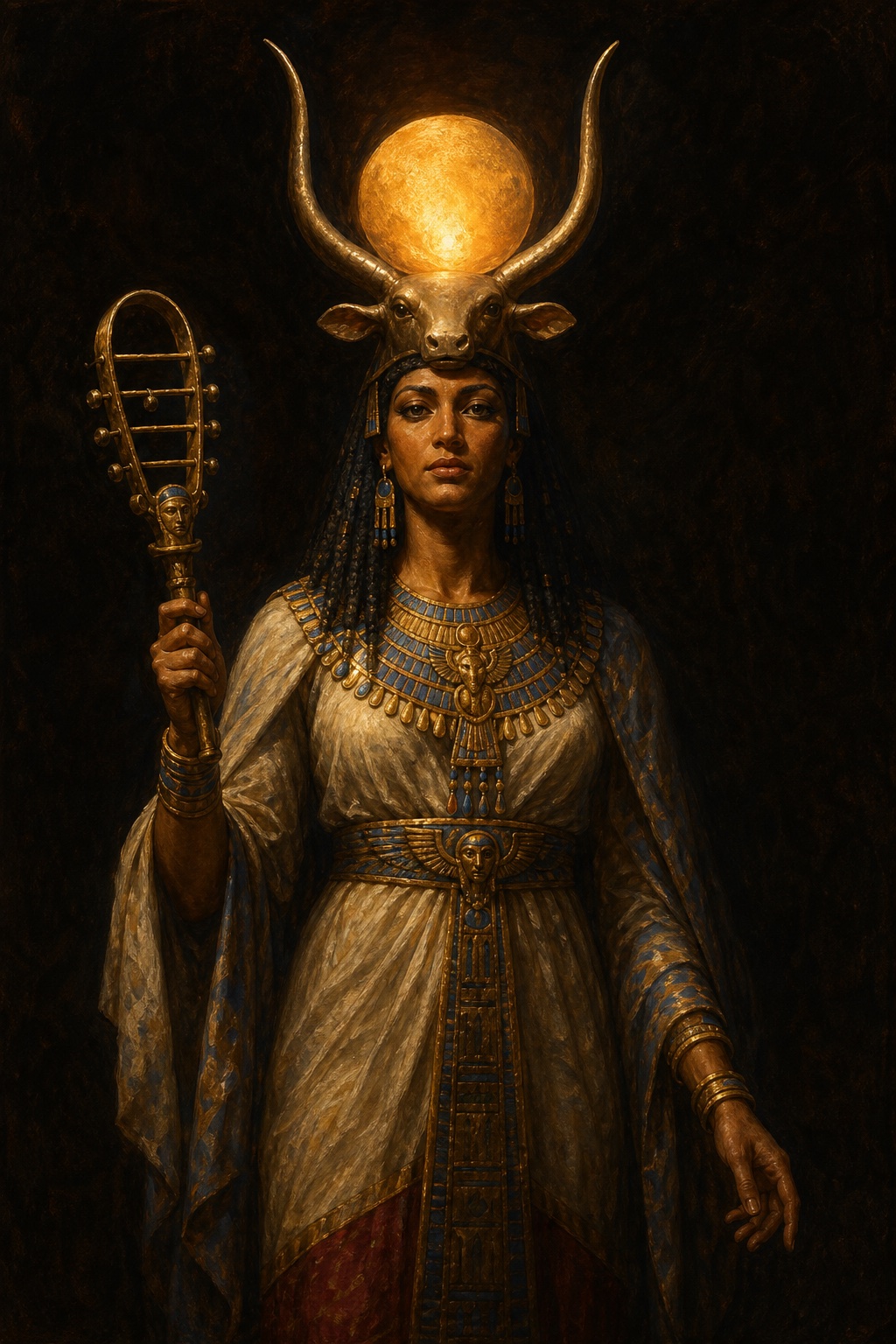
None of this is the Hathor most Egyptians worshipped day to day. Budge describes her wearing cow horns that cradle the solar disk, carrying the sistrum whose rattle was thought to drive off sorrow, and decked in the menat necklace — heavy enough to double as a counterweight, and read as a token of joy and physical pleasure rather than mourning. He calls her a cosmic goddess in her own right, Ra’s female counterpart in the created world, and titled in later texts as ruler of heaven and mistress of the gods. None of that vocabulary — music, ornament, delight — has anything to do with a mountain of slain rebels.
Lady of the West
She is also a goddess of the dead, though in a gentler register than judgment or punishment. As mistress of the necropolis, called Amentet, whose name means the West, she is pictured walking out from the funeral mountain in the form of a cow to greet the newly dead, the way a host might welcome a traveler home rather than judge them. Budge also places her, like Nut, among the goddesses of the sacred sycamore, offering shade and sustenance to souls making the crossing. It is a strange span for one deity: the same figure loosed as a nearly unstoppable weapon of the sun god is, day to day, the one who meets mortals at both ends of life.