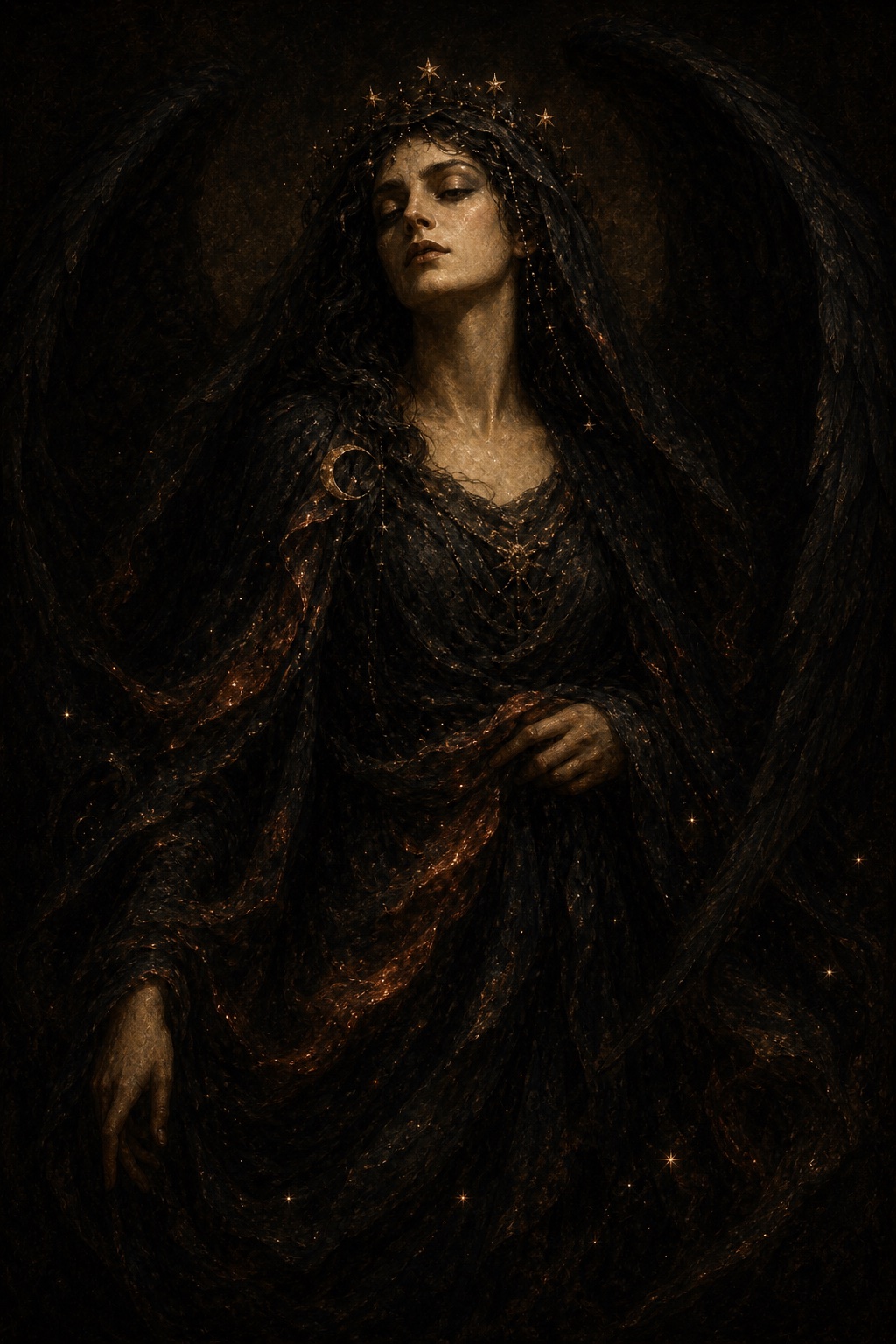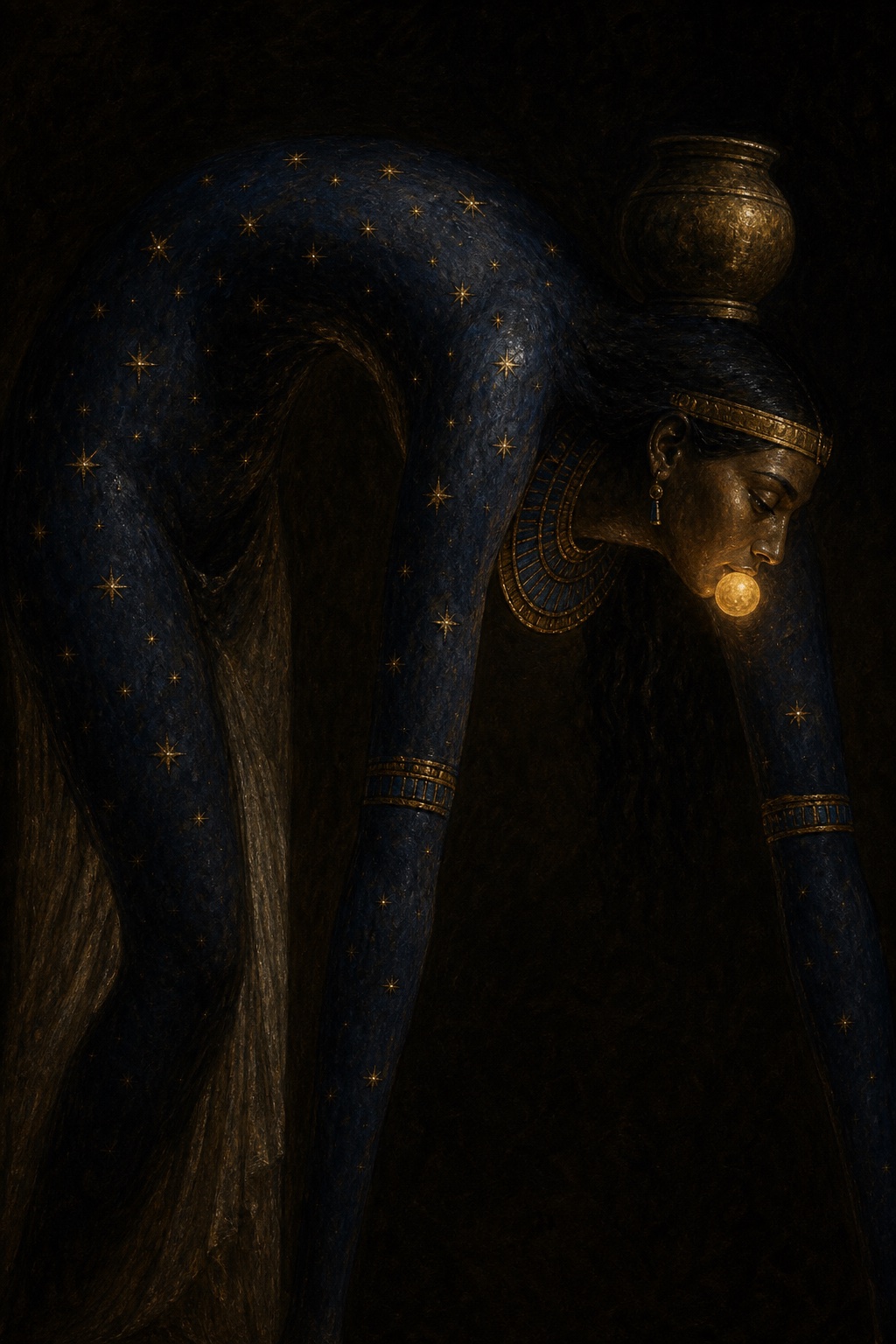
Nut is drawn as a woman arched over the whole width of a tomb ceiling, fingertips at one horizon and toes at the other, her body dark and scattered with stars, her brother Geb lying beneath her. The posture is the cosmology: sky and earth were pressed together until Shu, the air, stood up between them and has been holding her there ever since. Her name is written with a pot of water, and she is sometimes shown instead as an enormous cow, held up at the belly by Shu and at each leg by a supporting god.
The sun’s day is a circuit through her. Ra is born from her each morning, crosses the length of her body, and is swallowed at evening, travelling the night inside her to be delivered again at dawn — which is why coffin lids so often carry her figure facing downward, so that the dead lie in the same position as the sun and can expect the same outcome. She is the mother of Osiris, Isis, Set and Nephthys, borne on the five extra days Thoth won from the moon so that she could give birth outside the year she had been forbidden to bear in.
Hail, thou sycamore of the goddess Nut! Grant thou to me of the water and of the air which dwell in thee. — Book of the Dead, Chapter lix, tr. E. A. Wallis Budge
She reaches the living, too, as a tree. The sycamore fig standing at the desert edge was taken for her, and vignettes show a goddess leaning out of its branches to pour water for the dead and their souls — shade, drink and breath offered at the boundary between the cultivated land and what lies past it. The chapter quoted above exists to let the deceased ask her for exactly that.