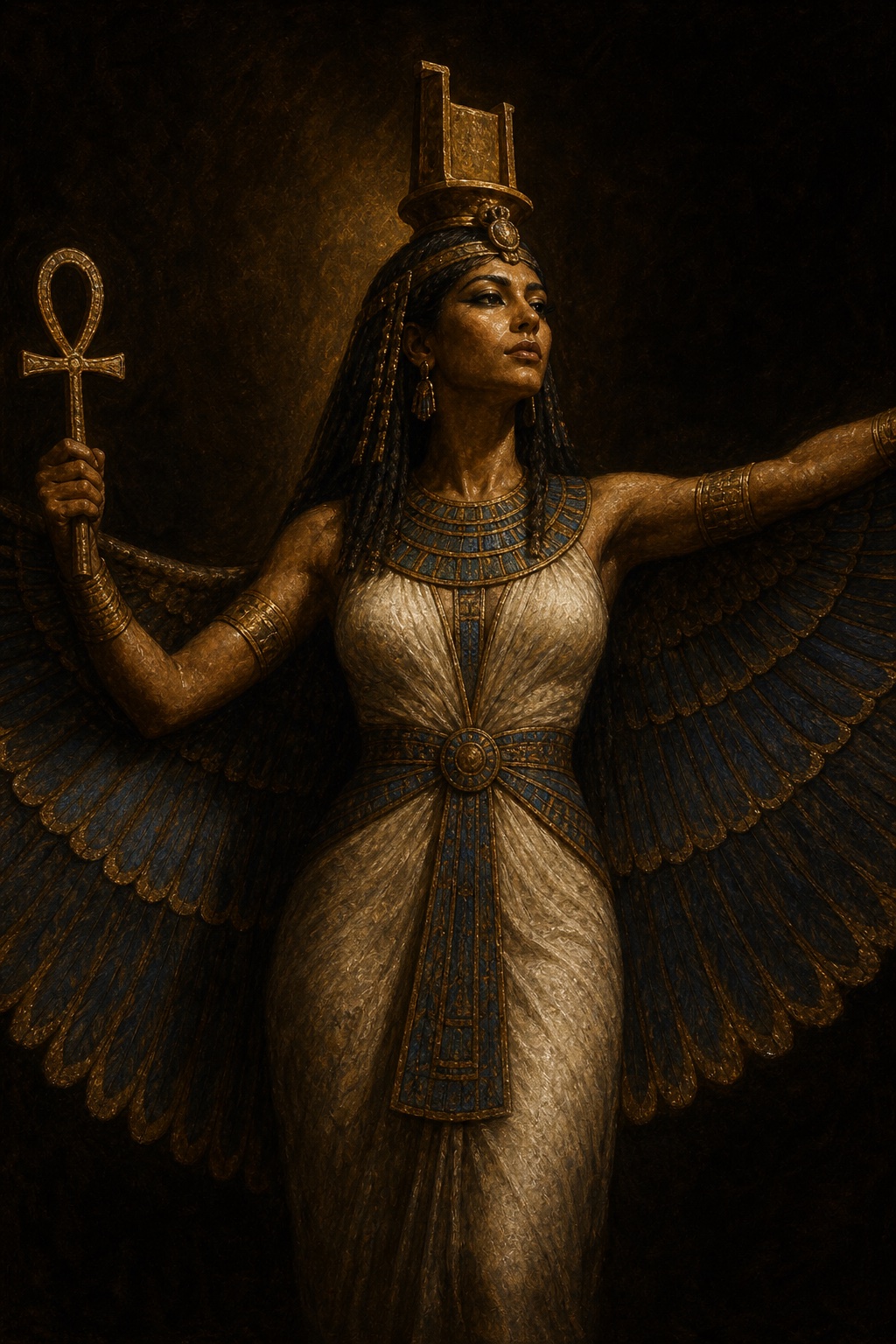
Isis’s name is written with the hieroglyph for a throne, and she personifies royal authority as much as magic or motherhood — the pharaoh sits, mythically, in her lap. When Set murders her husband Osiris, she searches out his scattered body with her sister Nephthys, restores him through spellcraft long enough to conceive Horus, and then raises her son in hiding among the marshes of the Nile Delta, shielding him from Set’s continuing hostility until he is strong enough to claim the throne.
Her magic is famously acquisitive. In one well-known episode she fashions a serpent from Ra’s own spittle mixed with earth, uses it to poison the aging sun god, and withholds the cure until he tells her his true, secret name — the hidden source of his power — which she then wields herself. The story captures her character: patient, resourceful, and willing to outmaneuver even the king of the gods to protect her family. Her cult eventually spread far beyond Egypt, absorbed into Greek and Roman religion until she became one of the ancient Mediterranean’s most widely worshipped goddesses, her worship enduring for centuries after most of the native Egyptian pantheon had faded.
“Flow, poison, come out of Ra. Eye of Horus, come out of Ra, and shine outside his mouth. It is I, Isis, who work, and I have made the poison to fall on the ground.” — E. A. Wallis Budge, Legends of the Gods (1912), introduction