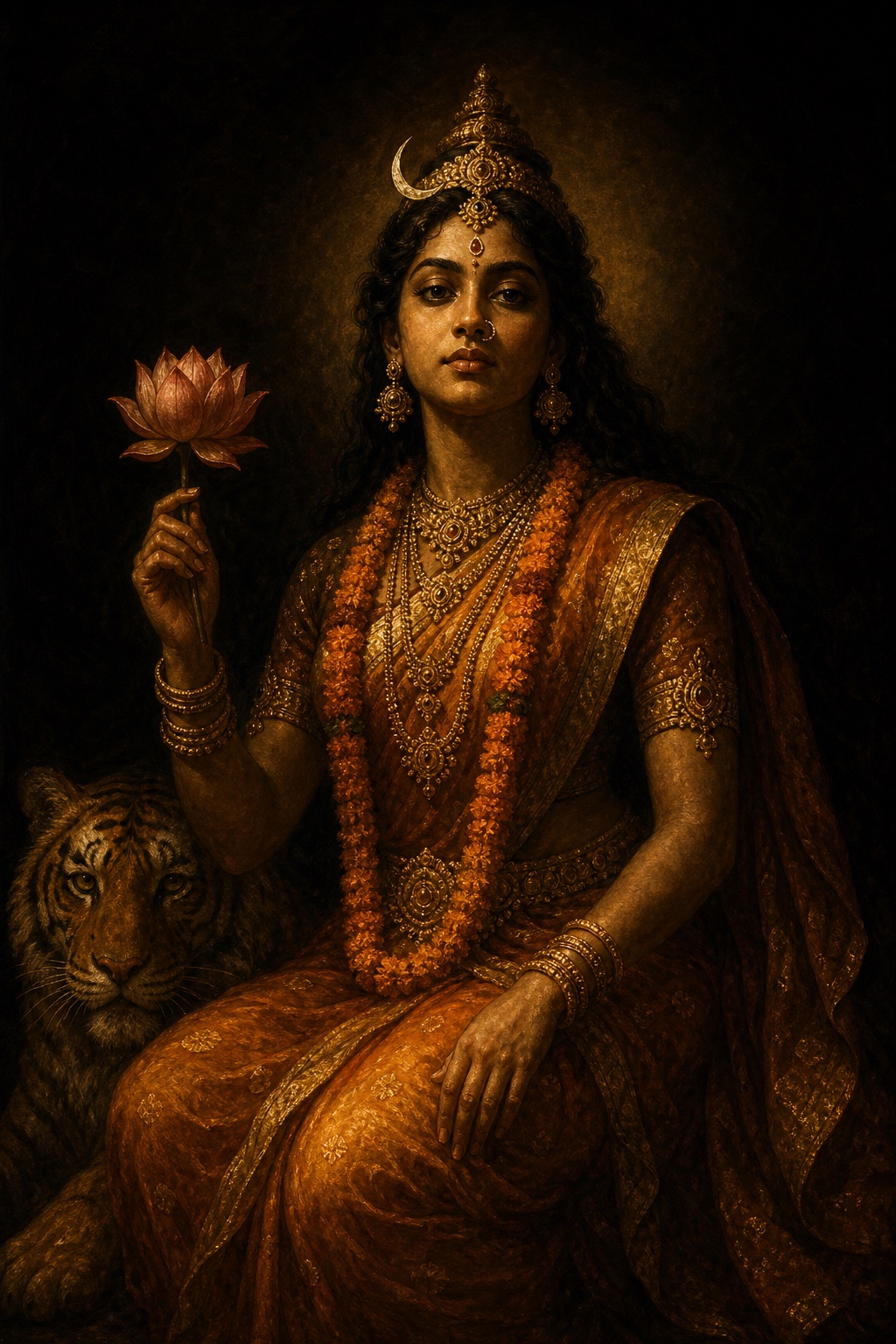
Parvati is the daughter of Himavat, the personified Himalaya, and her name simply means “of the mountain”. The Ramayana introduces her as the second of two daughters, the elder being the river Ganga — a pairing that sets the terms of her character, since one sister is given away to the gods to descend through the worlds and the other stays and practises austerities until she gets what she wants.
तस्यां गङ्गेयमभवज्ज्येष्ठा हिमवतः सुता । उमा नाम द्वितीयाभूत् कन्या तस्यैव राघव ॥१-३५-१६॥
“Gangá was elder-born: then came / The fair one known by Umá’s name.” — Valmiki, Ramayana 1.35.16, tr. Griffith
What she wants is Shiva, who at that point is a widower — his first wife Sati having burnt herself at her father’s sacrifice — and has withdrawn into meditation so complete that beauty makes no impression on him at all. Kama, the god of desire, is sent to shoot him and is burnt to ash for it. Parvati’s answer is to meet asceticism with asceticism: she goes to the mountain and performs tapas so severe and so protracted that Shiva finally comes to test her in disguise, abusing his own name to see what she will say, and gives in when she will not be moved. The marriage brings him back into the world of households and obligations, and much of the later mythology consists of her arguing him out of the extremes his nature pulls him toward.
She is also the mother in a family that everyone knows. Ganesha is made from the turmeric of her own body and set to guard her door, which is how he loses his head to Shiva and gains the elephant’s; Kartikeya is born to lead the gods’ armies. And she is not confined to the domestic register: when the situation requires it she manifests as Durga to meet Mahishasura on the battlefield, and as Kali when even that is not enough — the same goddess in her fiercest aspects, which the texts treat as her doing rather than as someone else’s.