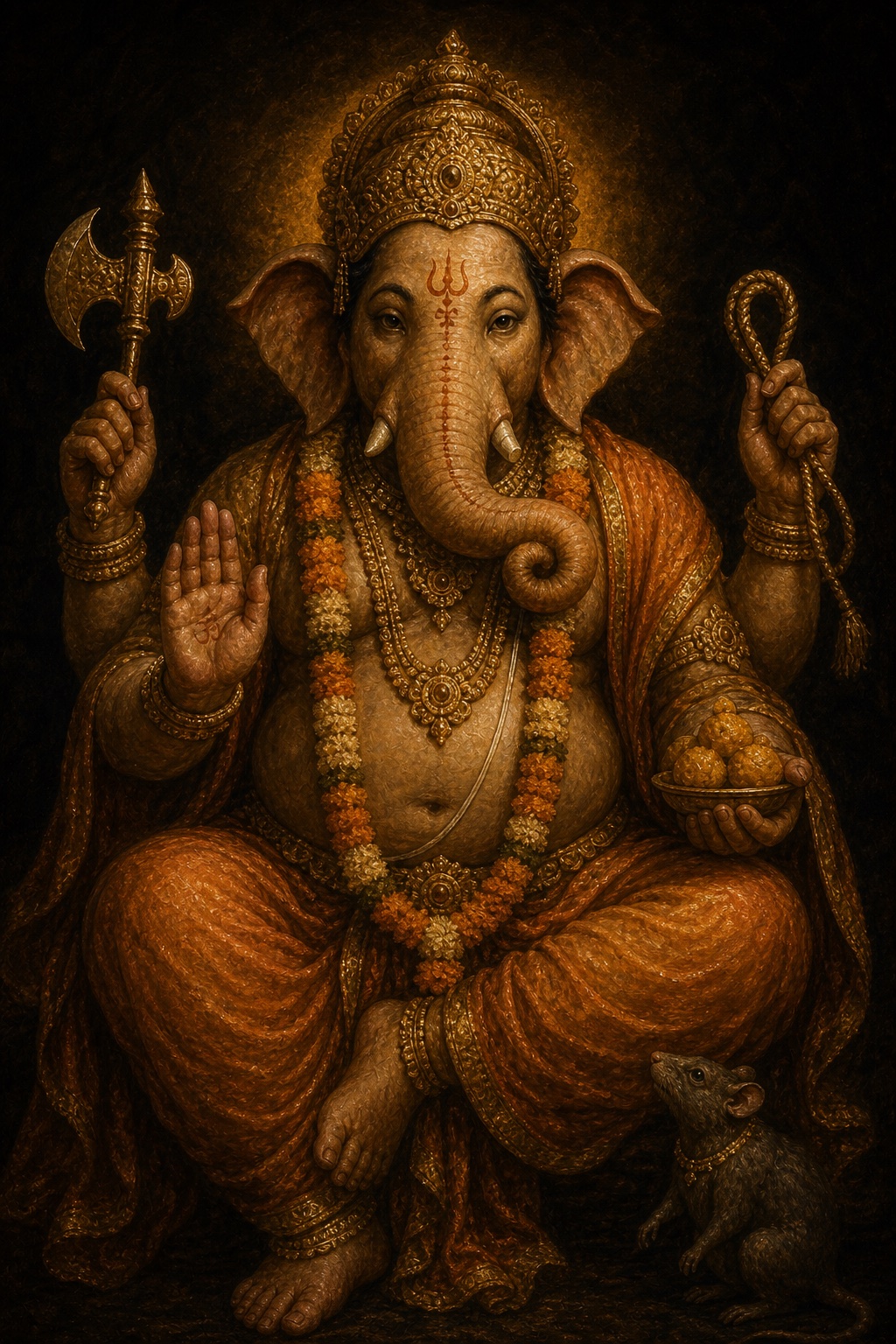
Ganesha, the elephant-headed son of Shiva and Parvati, is invoked before any undertaking as the remover of obstacles (Vighnaharta) — and, to those he chooses to obstruct, the placer of them. This dual role makes him the deity Hindus most commonly worship first, whatever their sect: his image sits at the threshold of temples of every tradition, and his blessing is sought at the start of journeys, businesses, weddings, and books. One popular account of his elephant head tells how Parvati, guarding her bath, set her newly created son to keep watch, and Shiva, not recognizing him, struck off his head in anger; to console his grieving wife, Shiva restored the boy to life with the head of the first creature found, an elephant.
He is also patron of learning and letters: tradition holds that when the sage Vyasa needed a scribe fast enough to take down the Mahabharata as he composed it, Ganesha agreed on condition that his pen never stop moving, so Vyasa in turn salted the poem with difficult verses that forced his scribe to pause and puzzle them out, buying himself time to keep pace. He is worshipped above all at Ganesh Chaturthi, when clay images of him are installed in homes and streets and ceremonially immersed in water.
श्रुत्वैतत्प्राह विघ्नेशो यदि मे लेखनी क्षणम्। लिखतो नावतिष्ठेत तदा स्यां लेखको ह्यहम्
“I will become the writer of thy work, provided my pen do not for a moment cease writing.” — Mahabharata, Adi Parva, Section I, tr. Kisari Mohan Ganguli