Brought down by a king’s penance
Valmiki’s Ramayana does not open on Ganga acting; it opens on her as a problem. She flows in Swarga, heaven, the daughter of Himavat — the personified Himalaya — and the elder sister Parvati leaves on the mountain when this story begins. King Bhagiratha spends years of penance to draw her down to earth, so that her waters might reach the dead of his own line and set them free. Brahma grants the boon, but he grants it with a warning that reshapes the whole story: the earth cannot survive her unbroken fall, and only one god is strong enough to receive her.
इयं हैमवती ज्येष्ठा गङ्गा हिमवतः सुता । तां वै धारयितुं राजन् हरस्तत्र नियुज्यताम् ॥१-४२-२३॥ गङ्गायाः पतनं राजन् पृथिवी न सहिष्यते । तां वै धारयितुं राजन् नान्यं पश्यामि शूलिनः ॥१-४२-२४॥
Gangá, whose waves in Swarga flow, Is daughter of the Lord of Snow. Win S’iva that his aid be lent To hold her in her mid descent, For earth alone will never bear Those torrents hurled from upper air; And none may hold her weight but He, The Trident wielding deity. — Valmiki, Ramayana 1.42.23–24, tr. Griffith
Brahma’s own phrase for her — “daughter of the Lord of Snow” — matches what this corpus already records: her father is Himavat, and the sister she leaves on the mountain is Parvati. What the warning adds is scale. No ordinary god, not even the pantheon acting together, is judged equal to a river falling out of the sky; the task goes to Shiva alone.
Wandering in Shiva’s hair
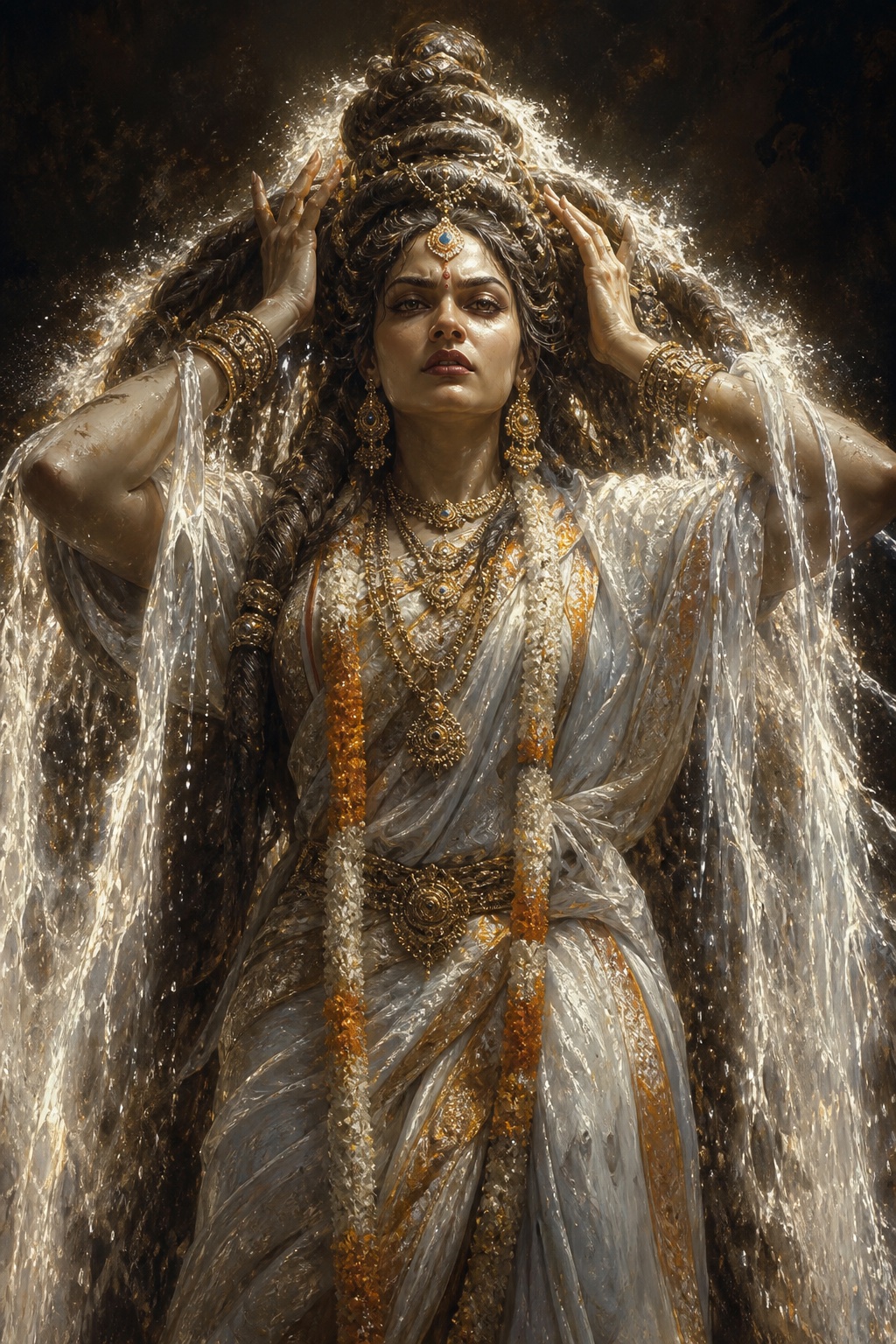
Brahma’s warning becomes literal in the canto that follows. Ganga does not descend meekly. She falls in fury, resents the very summons that brings her down, and the god ordered to catch her takes the full weight of that resentment.
ततो हैमवती ज्येष्ठा सर्वलोकनमस्कृता । तदा सातिमहद्रूपं कृत्वा वेगं च दुःसहम्॥१-४३-४॥ आकाशादपतद् राम शिवे शिवशिरस्युत । अचिन्तयच्च सा देवी गङ्गा परमदुर्धरा ॥१-४३-५॥ विशाम्यहं हि पातालं स्त्रोतसा गृह्य शङ्करम् । तस्यावलेपनं ज्ञात्वा क्रुद्धस्तु भगवान् हरः ॥१-४३-६॥ तिरोभावयितुं बुद्धिं चक्रे त्रिनयनस्तदा । सा तस्मिन् पतिता पुण्या पुण्ये रुद्रस्य मूर्धनि॥१-४३-७॥ हिमवत्प्रतिमे राम जटामण्डलगह्वरे । सा कथंचिन्महीं गन्तुं नाशक्नोद् यत्नमास्थिता ॥१-४३-८॥ नैव सा निर्गमं लेभे जटामण्डलमन्ततः । तत्रैवाबभ्रमद् देवी संवत्सरगणान् बहून् ॥१-४३-९॥
Down from her channel in the skies With awful might she sped With a giant’s rush, in a giant’s size. On S’iva’s holy head. ‘He calls me,’ in her wrath she cried, ‘And all my flood shall sweep And whirl him in its whelming tide To hell’s profoundest deep.’ He held the river on his head, And kept her wandering, where, Dense as Himalaya’s woods, were spread The tangles of his hair. No way to earth she found, ashamed, Though long and sore she strove, Condemned, until her pride were tamed, Amid his locks to rove. — Valmiki, Ramayana 1.43.4–9, tr. Griffith
She threatens to sweep him down to Patala with her, and Shiva answers not with force against her but with confinement: he simply keeps her, tangled in hair dense as a Himalayan forest, unable to find her way out for years. She is released only after Bhagiratha resumes his own penance and pleads on her behalf; freed at last, she divides into seven streams, one of which follows the king’s chariot all the way to the waiting dead.
Bhagirathi, Tripathaga, Jahnavi
The same canto explains three of the names she carries elsewhere in this corpus. Brahma tells Bhagiratha, “Called from thy name Bhágirathí” — she is Bhagirathi, named for the king whose penance brought her down. The text also calls her Tripathagá, “stream of the skies.” “Because three paths she glorifies,” it explains, “her waters fell From heaven and flow through earth and hell.” And she is Jahnavi, Jahnu’s child, after the sage who, later in the same canto, drinks her dry in anger when her flood disturbs his sacrifice, then relents and lets her out again through his own ear.
Ganga and Saraswati, two rivers
This corpus already tracks one other river turned goddess, Saraswati, and the two are easy to blur together — both eventually enthroned as major Hindu goddesses, both once simply water. The Rigveda keeps them apart by plain weight of evidence. Saraswati receives hymns addressed to her directly, describing her in motion, bursting the ridges of the hills with her waves. Ganga receives one line in the whole of the Rigveda, folded into the Nadistuti hymn’s roll call of rivers alongside the Yamuna, the Sutudri, the Parusni and Saraswati herself — a name in a catalogue, with no verb of her own. Her rise to prominence belongs to the epics and the Puranas, centuries after the hymns that gave Saraswati a voice.