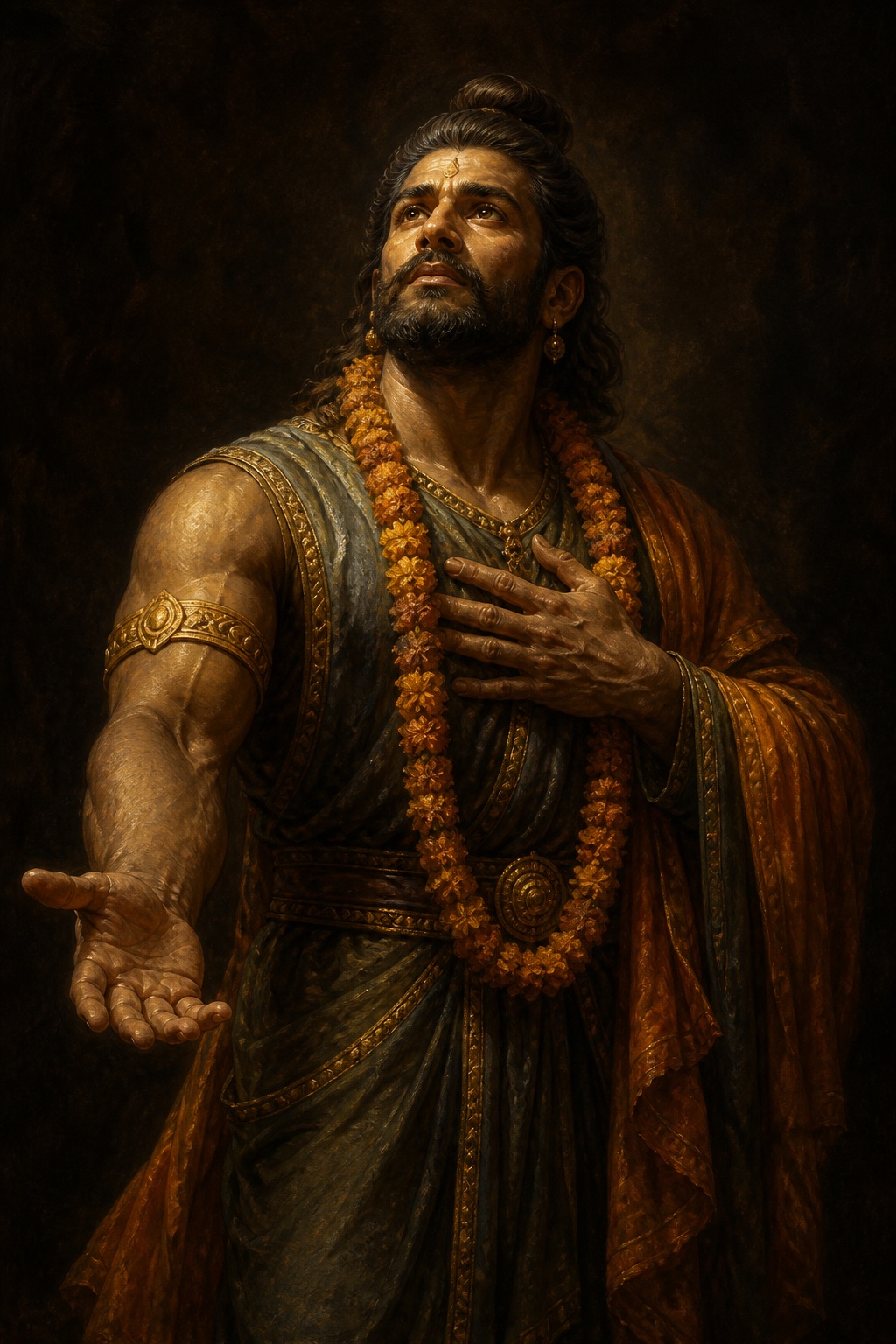
A mountain in human form
Hanuman is in mid-air over the sea, on the leap that opens the Sundarakanda, when Mainaka comes up out of the water beneath him. What Valmiki says next is the reason this corpus records Mainaka as a figure at all: मानुषं धारयन् रूपम्, holding a human form, आत्मनः शिखरे स्थितः, standing on his own summit. He is a mountain, and for the length of one speech he is also a person standing on himself.
The corpus keeps a standing rule that places and objects do not get entries — a river, a peak or a weapon is scenery, however famous. Mainaka is here because the verse itself breaks that rule for him. He takes a shape, chooses a form of address, makes an offer, and gives a reason for it. Nothing about the encounter works if he is treated as terrain.
What he says
The offer is three clauses long and entirely practical. He does not ask Hanuman to stop; he tells him he has already done something difficult, invites him down, and — in the same breath — releases him to continue.
दुष्करं कृतवान् कर्म त्वमिदं वानरोत्तम॥ १११॥ निपत्य मम शृङ्गेषु सुखं विश्रम्य गम्यताम्।
“Best of the Vánars’ noblest line, A mighty task, O chief, is thine. Here for a while, I pray thee, light And rest upon the breezy height.” — Valmiki, Ramayana 5.1.111–112; tr. Griffith
Griffith’s verse carries the address, the praise and the invitation, and stops there. The Sanskrit has one word more: गम्यताम्, let it be gone — go on. That single verb is what keeps the episode from being a delay. Mainaka is not trying to hold the messenger; he offers a landing, a rest, and a departure in one sentence, and the third part is as explicit as the first two.
Whose son he is
Both of Mainaka’s parents are already in this corpus, and both entries name him. Himavat, the Himalaya as a king, and Mena, his wife, are given three children by Valmiki’s Balakanda: Ganga, who goes to the gods; Parvati, who marries Rudra; and Mainaka, who goes into the sea. Until this entry existed, the corpus’s Mena page named him and then said, in every locale, that he was a named place and not a god and so was not recorded here on his own account. The Sundarakanda verse settles that against the earlier reading, and those pages have been corrected rather than left standing.
That parentage is also why the offer he makes is a family matter and not a stranger’s courtesy. The mountain who rises to help Rama’s envoy across the water is the son of the mountain king whose elder daughter the gods asked for and were given.