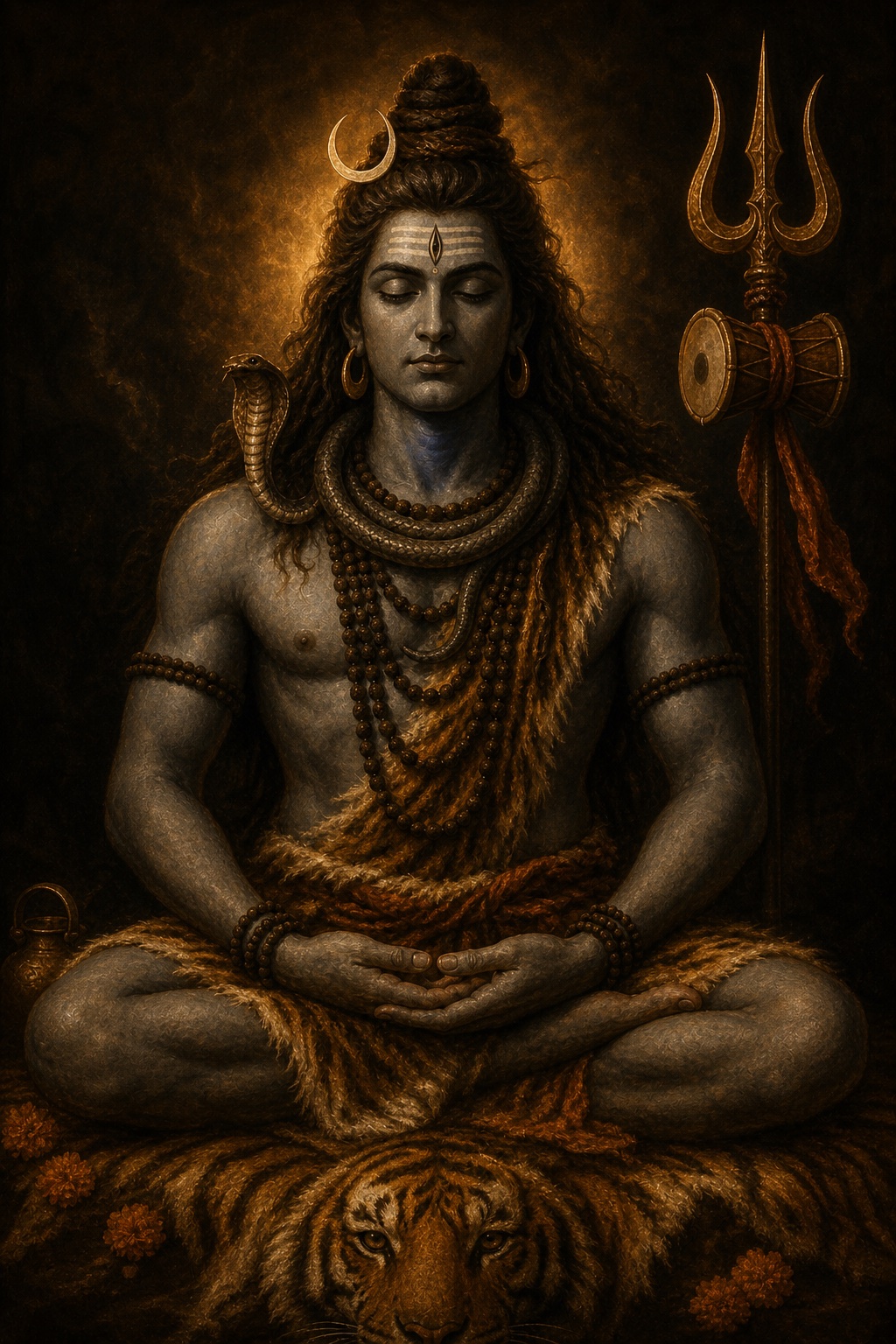
Shiva is the third of Hinduism’s central divine functions, the destroyer whose dissolution of the universe at the end of each cosmic age clears the ground for its renewal — destruction and creation understood in Shaiva theology as a single continuous act rather than opposites. He is worshipped across India both in image and, most widely, in the aniconic linga, and the Shaiva traditions that revere him as supreme approach him as the source of all being. He is the great ascetic, seated in meditation on Mount Kailasa, matted hair crowned with the crescent moon and the goddess Ganga descending through its locks, a third eye on his brow whose opening can reduce the world to ash, and a cobra coiled at his throat. As Nataraja he dances the cosmos into being and out of it again, drum and flame balanced in his hands.
Shiva descends from the Vedic storm-god Rudra, “the howler,” a fearsome, healing deity of the wild places invoked in the Rigveda for protection from disease and death; the later Puranic Shiva absorbs and transforms this older figure into the gentler ascetic-householder who marries Parvati and fathers Ganesha and Kartikeya, while still carrying Rudra’s terrible aspect as destroyer.
श्रेष्ठो जातस्य रुद्र श्रियासि तवस्तमस्तवसां वज्रबाहो । पर्षि णः पारमंहसः स्वस्ति विश्वा अभीती रपसो युयोधि ॥३॥
“Chief of all born art thou in glory, Rudra, armed with the thunder, mightiest of the mighty.” — Rigveda 2.33.3, tr. Ralph T. H. Griffith