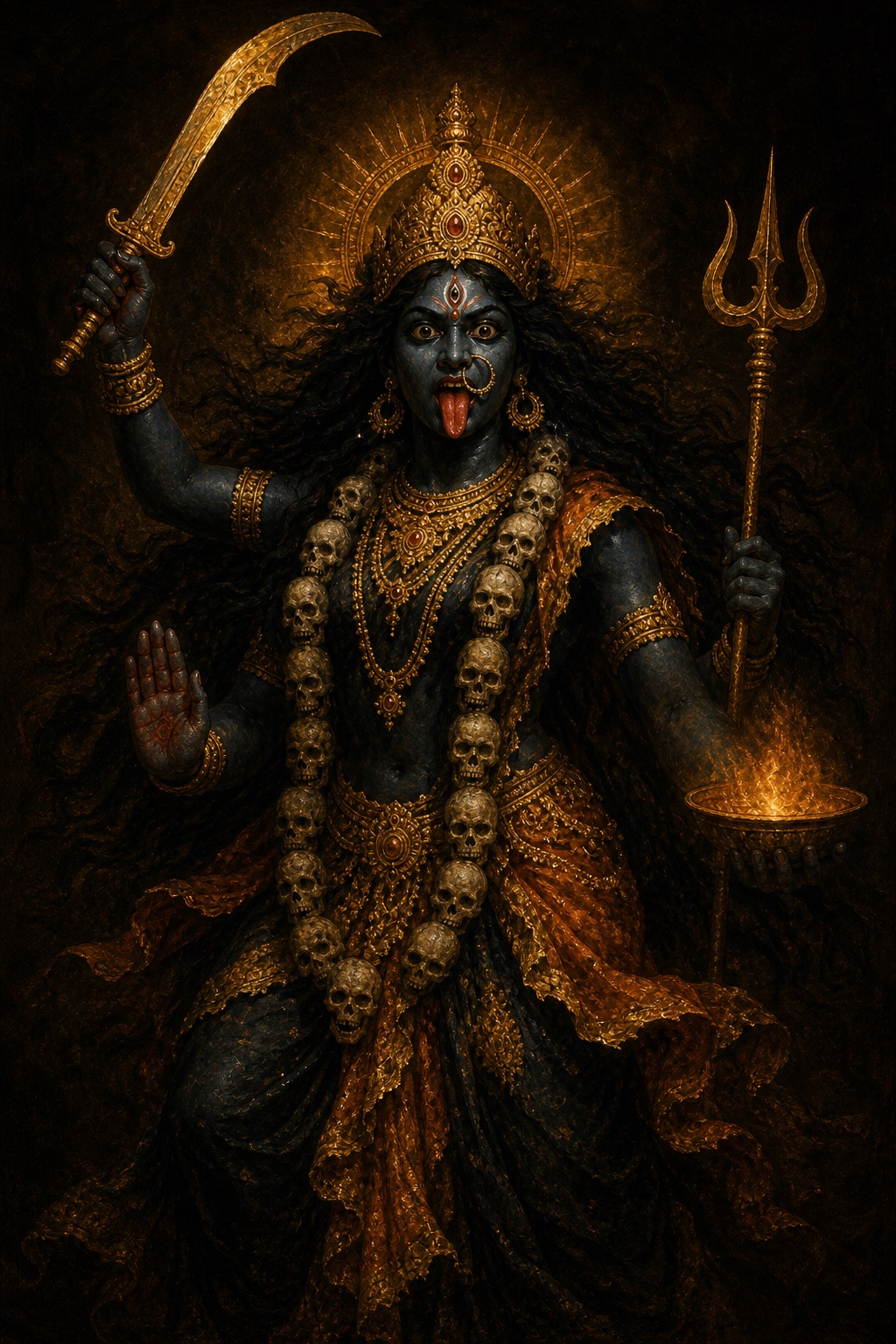
Kali erupts from the furrowed brow of Durga in the Devi Mahatmya, dark-skinned, gaunt, and terrible, sent to finish battles the other gods and even Durga’s own forces cannot. Her fiercest moment comes against the demon Raktabija, who reproduces himself from every drop of his own spilled blood; Kali defeats him by lapping up the blood before it touches the ground, devouring his endless clones one by one. She wears a garland of severed heads and a girdle of severed arms, her tongue lolling from her mouth, and in her most famous image she stands or dances upon the prostrate body of Shiva himself — a scene tradition explains variously as her recoiling in shock at whom she tramples, or as raw divine power (Shakti) requiring the stillness of pure consciousness (Shiva) beneath it to be contained.
Feared as she is, Kali is also worshipped as a supremely tender mother goddess, especially in Bengal, where the poet-saint Ramprasad Sen and the nineteenth-century mystic Ramakrishna addressed her with open devotion at Kolkata’s Kalighat and Dakshineswar temples. This fierce-maternal duality — devourer of demons, protector of her devotees — remains central to how she is approached in Shakta worship today, most visibly at Kali Puja.
“Out from the surface of her forehead, which was rugged with frowns, issued suddenly Kali of the terrible countenance, armed with a sword and noose.” — Markandeya Purana, Canto LXXXVII.5–6 (Devi Mahatmya 7), tr. Frederick Eden Pargiter