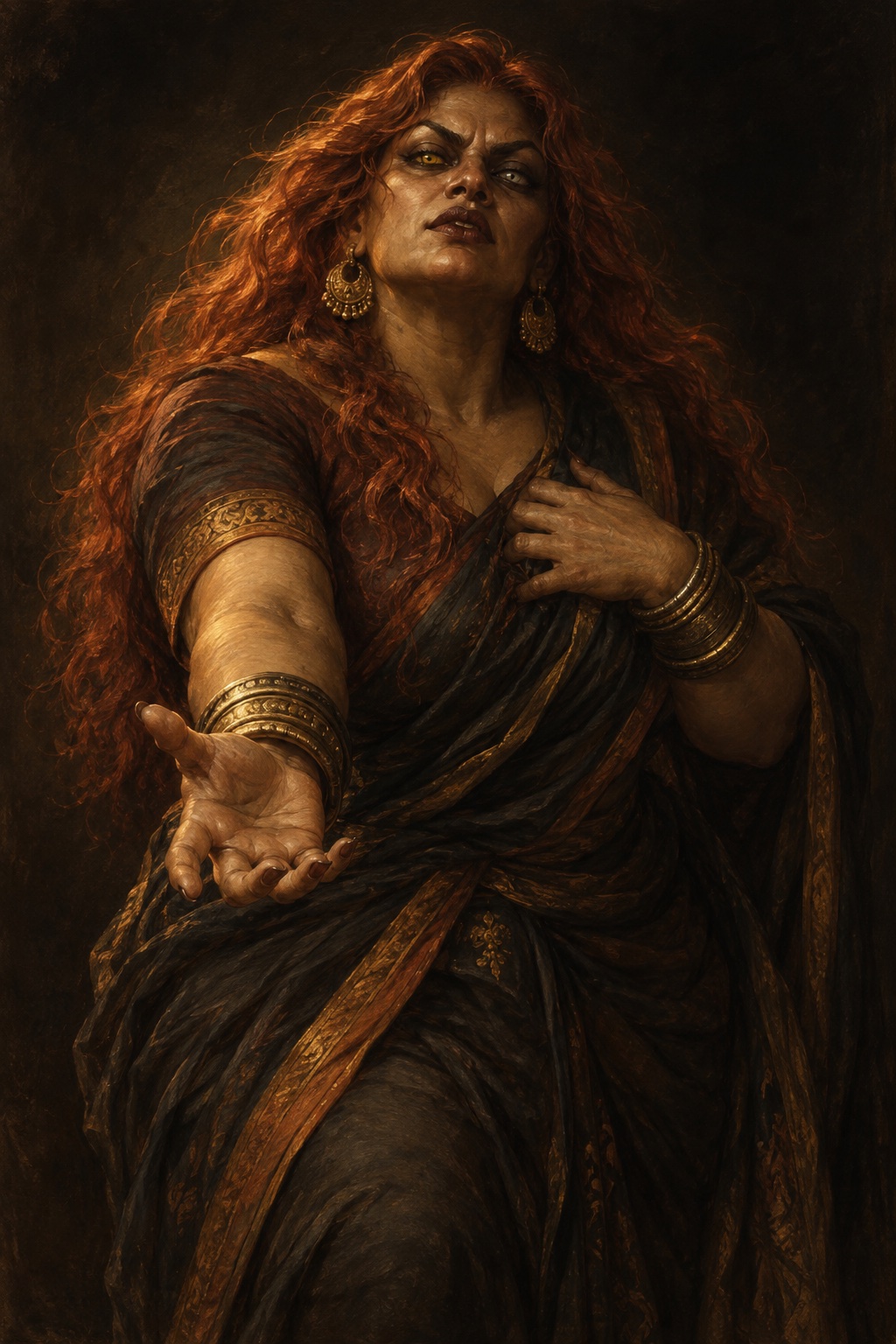
Ravana’s sister at Panchavati
Shurpanakha is a rakshasi, a woman of the rakshasa race, and the Ramayana brings her into its story by accident. Rama, Sita and Lakshmana have made their home at Panchavati in the Dandaka forest. In the seventeenth sarga of the Aranyakanda Rama sits in the leaf hut beside Sita and talks with his brother, and a rakshasi comes to that place यदृच्छया, by chance. The next verse gives her name and, in the same breath, her family: she is Shurpanakha, the भगिनी, the sister, दशग्रीवस्य रक्षसः, of the ten-necked rakshasa. Before she has done anything, the poem has said whose sister she is. She sees Rama and wants him at once. The text calls her राक्षसी काममोहिता, the rakshasi bewildered by desire.
Then the poem describes her, and it does so only by setting her against him, feature by feature, his word first and hers after it. सुमुखं दुर्मुखी: he fair of face, she foul of face. वृत्तमध्यं महोदरी: his waist trim, her belly great. विशालाक्षं विरूपाक्षी: his eyes wide, hers misshapen. सुकेशं ताम्रमूर्धजा: his hair fine, hers copper-coloured. सुस्वरं भैरवस्वना: his voice sweet, hers terrible. तरुणं दारुणा वृद्धा: he young, she harsh and old. Every fact the verse gives about her body is a way in which she is not Rama. Griffith keeps the device and runs it through a whole passage of couplets: “She grim of eye and foul of face Loved his sweet glance and forehead’s grace”, and “She whose dire form with age was dried, Him radiant in his youthful pride”. One of the paired words matters later. प्रियरूपं विरूपा सा: he pleasing in form, and she विरूपा, deformed.
This is her own body. She can take any shape she likes, and she will say so herself a few verses later, but in this canto she does not use the power. She comes to Rama as she is, and she speaks first. She asks what a man in hermit’s dress, with matted hair, a bow and a wife, is doing in country that the rakshasas hold. Rama, ऋजुबुद्धितया, out of plain honesty, tells her everything: his father Dasharatha, his brother, his wife, and the order that sent him to the forest. Then he asks his own question, कस्य त्वं कासि कस्य वा, whose are you, who are you? Griffith’s Rama asks for “Thy name, and race, and sire”, and guesses part of the answer before she gives it: “Thou art of giant race, I ween. Changing at will thy form and mien.”
Her answer
She answers him point by point.
अहं शूर्पणखा नाम राक्षसी कामरूपिणी॥ २०॥ अरण्यं विचरामीदमेका सर्वभयंकरा। रावणो नाम मे भ्राता यदि ते श्रोत्रमागतः॥ २१॥ वीरो विश्रवसः पुत्रो यदि ते श्रोत्रमागतः। प्रवृद्धनिद्रश्च सदा कुम्भकर्णो महाबलः॥ २२॥ विभीषणस्तु धर्मात्मा न तु राक्षसचेष्टितः। प्रख्यातवीर्यौ च रणे भ्रातरौ खरदूषणौ॥ २३॥ तानहं समतिक्रान्तां राम त्वापूर्वदर्शनात्। समुपेतास्मि भावेन भर्तारं पुरुषोत्तमम्॥ २४॥ अहं प्रभावसम्पन्ना स्वच्छन्दबलगामिनी। चिराय भव भर्ता मे सीतया किं करिष्यसि॥ २५॥ विकृता च विरूपा च न सेयं सदृशी तव। अहमेवानुरूपा ते भार्यारूपेण पश्य माम्॥ २६॥ इमां विरूपामसतीं करालां निर्णतोदरीम्। अनेन सह ते भ्रात्रा भक्षयिष्यामि मानुषीम्॥ २७॥ ततः पर्वतशृङ्गाणि वनानि विविधानि च। पश्यन् सह मया कामी दण्डकान् विचरिष्यसि
“Of giant race, what form soe’er My fancy wills, ’tis mine to wear. Named Śúrpaṇakhá here I stray, And where I walk spread wild dismay. King Rávaṇ is my brother: fame Has taught perchance his dreaded name, Strong Kumbhakarṇa slumbering deep In chains of never-ending sleep: Vibhíshaṇ of the duteous mind, In needs unlike his giant kind: Dúshaṇ and Khara, brave and bold Whose fame by every tongue is told: Their might by mine is far surpassed; But when, O best of men, I cast These fond eyes on thy form, I see My chosen love and lord in thee. Endowed with wondrous might am I: Where’er my fancy leads I fly. The poor misshapen Sítá leave, And me, thy worthier bride receive. Look on my beauty, and prefer A spouse more meet than one like her: I’ll eat that ill-formed woman there: Thy brother too her fate shall share. But come, beloved, thou shalt roam With me through all our woodland home; Each varied grove with me shalt seek, And gaze upon each mountain peak.” — Valmiki, Ramayana 3.17.20–28, tr. Griffith
Who she is comes first. अहं शूर्पणखा नाम, I am Shurpanakha by name, राक्षसी कामरूपिणी, a rakshasi who takes whatever shape she wishes, and she adds अरण्यं विचरामीदमेका सर्वभयंकरा, I roam this forest alone and everything in it fears me. Then whose she is, and her answer is a list of brothers, each given one trait. Ravana is first, and the Sanskrit gives him a father, वीरो विश्रवसः पुत्रो, the hero, Vishrava’s son; Griffith leaves the father out. Kumbhakarna is the one forever deep in sleep, प्रवृद्धनिद्रश्च सदा. Vibhishana is धर्मात्मा, righteous, न तु राक्षसचेष्टितः, not given to the ways of rakshasas. Last come Khara and Dushana, whom the Sanskrit calls भ्रातरौ, brothers, and whom Griffith only names. Rama asked for her sire, and she gives him her brothers. The only father in her answer is Ravana’s, which is why this entry records her siblings and no parent.
Then she puts all of them behind her. Griffith makes it a boast, “Their might by mine is far surpassed”, and the next verse bears him out: अहं प्रभावसम्पन्ना, I am endowed with power, स्वच्छन्दबलगामिनी, I go wherever I please by my own strength. The offer follows without a pause. चिराय भव भर्ता मे, be my husband for good; सीतया किं करिष्यसि, what will you do with Sita? The reason she gives is Sita’s body. विकृता च विरूपा च न सेयं सदृशी तव: she is deformed and she is ugly, she is no match for you. विरूपा is the word the poem used for Shurpanakha herself when it set her beside Rama, and she turns it on the woman she means to replace. In the next verse she says it again, इमां विरूपामसतीं, this deformed and faithless woman, and adds निर्णतोदरीम्, hollow-bellied, so that even Sita’s slender waist becomes a fault in the mouth of a woman the narrator called महोदरी, great-bellied. Griffith’s “misshapen” and “ill-formed” keep the charge, but not the echo.
The same verse carries the threat. अनेन सह ते भ्रात्रा भक्षयिष्यामि मानुषीम्: together with this brother of yours, I will eat the human woman. Sita is मानुषीम्, the human woman, and Lakshmana is to be eaten with her. It is not a figure of speech; in the next canto she comes back to do it. And then, with no change of tone, the last verse is an invitation. ततः पर्वतशृङ्गाणि वनानि विविधानि च, then the mountain peaks and the many forests: पश्यन् सह मया कामी दण्डकान् विचरिष्यसि, you will wander through Dandaka with me, looking at them, a man in love. The speech runs from family to boast to proposal to insult to a threat of eating people to a walk in the hills, and she means every part of it.
The joke, and what it cost her
Nobody answers her seriously. In Griffith’s Canto XVIII Rama smiles and tells her that he has a wife already, and that a woman like her would never put up with a rival; but his brother Lakshmana, he says, is unmarried. She leaves Rama and offers herself to Lakshmana in the same terms. Lakshmana calls himself his brother’s bondsman and asks whether so high a lady could agree to be the slave-wife of a slave. Then he sends her back to Rama: she should be Rama’s younger bride, he says, because Rama will soon leave his old, deformed, untrue wife for her. It is her own charge against Sita, handed back to her as a joke, and she does not hear the joke. Griffith’s narrator says she “fondly heard his speech, nor knew His mocking words were aught but true.”
She goes back to Rama with the charge grown larger. In Griffith’s Canto XVII the narrator made her old, with a form dried by age; now she makes Sita old, and in the same breath says what she will do about it: “This aged crone this very hour Before thy face will I devour”. She rushes at Sita. Rama stops her, and turns on his brother: they should never have joked with a creature of her kind, and she must not get away without a mark on her. Lakshmana draws his sword and cuts off her nose and her ears. The two verses that tell the cut, in Sanskrit and in Griffith’s English, are quoted in the entry on Lakshmana, and are not quoted again here.
She runs back into the forest shrieking, bleeding as she goes. In one conversation she offered herself twice, and was passed from one brother to the other and back. The rakshasi who can take any shape she wishes leaves the hermitage with a shape that someone else has chosen for her. From then on she speaks with that face, and she brings it before every brother she goes to.
From Janasthan to Lanka
She goes first to Janasthan, where her brother Khara commands a host of rakshasas. She falls at his feet, lies there a while without speaking, and then tells him everything. Griffith ends the canto on her gesture: she “showed her bleeding face.” Khara calls her sister and asks who did it. She names the two sons of Dasharatha, describes the woman between them, and asks for one thing: “Let me drink Their lifeblood as to earth they sink.” Khara gives her fourteen rakshasas. She leads them back to the hermitage and points out the brothers and Sita, and Rama kills all fourteen with fourteen arrows. She goes back to Khara a second time, and this time she does not plead. She tells him that she will die in front of him unless Rama is killed, that he is a hero in name only, and that if he cannot face Rama he had better leave Janasthan. He marches with his whole army. In the cantos that follow, Rama kills Dushana, Trishiras and Khara, and with them the fourteen thousand rakshasas of Janasthan. She sees the plain covered with the dead and flies to Lanka.
Ravana already knows. In Griffith’s Canto XXXI a survivor named Akampana has brought him the news, and Maricha has talked him out of doing anything about it. She has to change his mind, and she does not begin with her face. She begins, in front of his counsellors, with his kingship: a king who does not know what happens in his own realm is not a king, and his spies have failed him, “Thy counsellors are blind and weak”. Only when he asks who Rama is does she tell the story, and she tells it with care. Rama, she says, spared her when the rakshasas fell: “The high-souled Ráma would not deign His hand with woman’s blood to stain.” The wound she lays on Lakshmana alone: “Each wound upon my face I owe To cruel Lakshmaṇ’s savage blow.” In this speech she does not say who gave Lakshmana the order.
Then she describes Sita. The woman she called विरूपा to Rama is now, to Ravana, the most beautiful woman in the world: “In all the earth mine eyes have ne’er Seen female form so sweetly fair.” Sita, she tells him, “Is worthy bride, O King, for thee”, and she urges him to go and take her. Both speeches are about the same woman, and both are made to win a man. To win Rama for herself she needed Sita ugly. To send Ravana after Rama she needs Sita beautiful. Ravana goes to Maricha a second time, and what comes out of that visit is the deer that draws Rama away from Sita. The abduction and the war for Lanka follow from there.