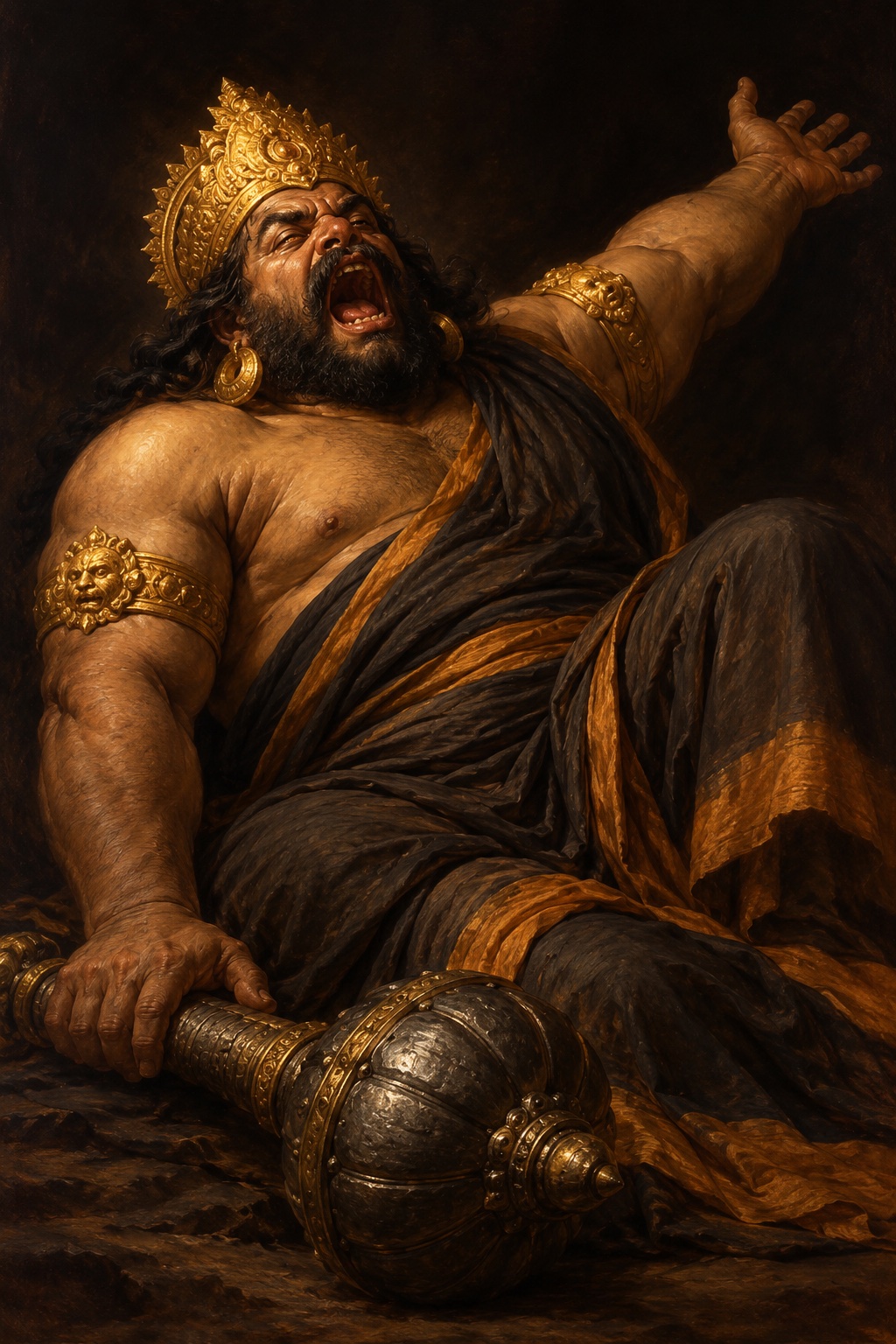
Brahma’s curse
Kumbhakarna is a rakshasa of Lanka, a son of Vishrava and a brother of Ravana, and in the Ramayana he is above all the one who sleeps. When his sister Shurpanakha lists her brothers to Rama in the Aranyakanda, what she says of him is that he sleeps: प्रवृद्धनिद्रश्च सदा, always deep in slumber. He comes into the story in person only in the Yuddhakanda, in the middle of the war, on the day Ravana needs him awake.
Why he sleeps is told after he has woken, and by the other side. In the sixty-first sarga Rama sees a crowned figure in Lanka as large as a mountain, and the monkeys run from the sight of it. He asks Vibhishana who it is. Vibhishana, a brother of the giant and of Ravana, who now stands with Rama, tells him: this is Kumbhakarna, the son of Vishrava, who has beaten Yama and Indra in battle. The other rakshasa lords owe their strength to boons, he says, and this one was born with his. As a newborn, and hungry, he ate many thousands of living creatures. The people went to Indra for help, and Indra struck him with the vajra. Kumbhakarna roared, tore a tusk out of Airavata, Indra’s elephant, and struck Indra in the chest with it. Then Indra and the people went to Brahma. Brahma summoned the rakshasas, looked at Kumbhakarna, and trembled at the sight of him. He told him that he had surely been begotten for the ruin of the worlds, and laid a curse on him: from that day on he would lie like the dead. In Griffith’s verse the sentence is “Thou like the dead henceforth shalt be”, and the rakshasa fell down where he stood.
It was Ravana who bargained the curse down. A golden tree, he told Brahma, is not cut down just as it comes into fruit, and it was not right for Brahma to curse his own descendant. Brahma’s word could not be false, so the sleep must stand, but let him fix a time for sleeping and a time for waking. Brahma fixed it: six months asleep, one day awake. In the next verse he says what that one day would be like. The hero would roam the earth hungry, with his mouth wide open, and eat the worlds like a fire that has grown large. Griffith gives the terms, “Six months in slumber shall he lie”, and leaves out what the waking day would bring. Vibhishana ends his story with advice for the monkeys, who are already running. Tell them, he says, that it is only a machine that has been set up there, and they will lose their fear. Griffith’s word for it is “A lifeless engine deftly made”.
Ravana’s own figures are different. In the sixtieth sarga, when he orders his brother woken, he says that Kumbhakarna sleeps for nine months at a time, or seven, or ten, or eight, and that he went to sleep after the council of war only nine days ago. The same speech has little good to say of him. He sleeps happily and without a care, Ravana says, a fool given to low pleasures. But in battle he is the banner of all the rakshasas, and once he is awake, Ravana will not grieve at having been beaten by Rama.
Woken by elephants
Ravana has come back into Lanka beaten. Rama has defeated him in the field and let him go, and Prahasta is dead. He sets guards on the gates and the walls and sends rakshasas to wake his brother. They find him in a cave that Griffith makes a league each way, asleep on a golden bed. In the Sanskrit he breathes like a serpent, his mouth is as wide as Patala, the underworld, he smells of fat and blood, and he wears golden armlets and a crown as bright as the sun. They heap food in front of him as high as Meru: deer, buffalo and boar, jars of blood and every kind of meat. They rub him with sandal paste, burn incense and praise him. Then they make noise. They blow conches, beat drums, roar and clap until the birds fall out of the sky. They beat his chest with mountain peaks, clubs and maces, and the wind of his breathing will not let them stand in front of him. Ten thousand of them surround him, all Lanka with its hills and woods fills with the din, and he does not wake, because, the poem says, he is in the power of the curse. Some pull his hair and some bite his ears. Others pour hundreds of jars of water into his ears, and Kumbhakarna does not stir. His name is made of two words, कुम्भ, a jar or pot, and कर्ण, an ear, and the verse puts both of them into the scene before it names him. Griffith’s line, “They drenched him with a hundred pails”, keeps the water and loses the jar. In the end they run elephants over him.
वारणानां सहस्रं च शरीरेऽस्य प्रधावितम्। कुम्भकर्णस्तदा बुद्ध्वा स्पर्शं परमबुध्यत॥ ५५॥ स पात्यमानैर्गिरिशृङ्गवृक्षै- रचिन्तयंस्तान् विपुलान् प्रहारान्। निद्राक्षयात् क्षुद्भयपीडितश्च विजृम्भमाणः सहसोत्पपात॥ ५६॥ स नागभोगाचलशृङ्गकल्पौ विक्षिप्य बाहू जितवज्रसारौ। विवृत्य वक्त्रं वडवामुखाभं निशाचरोऽसौ विकृतं जजृम्भे॥ ५७॥ तस्य जाजृम्भमाणस्य वक्त्रं पातालसंनिभम्। ददृशे मेरुशृङ्गाग्रे दिवाकर इवोदितः॥ ५८॥ स जृम्भमाणोऽतिबलः प्रबुद्धस्तु निशाचरः। निःश्वासश्चास्य संजज्ञे पर्वतादिव मारुतः॥ ५९॥ रूपमुत्तिष्ठतस्तस्य कुम्भकर्णस्य तद् बभौ। युगान्ते सर्वभूतानि कालस्येव दिधक्षतः॥ ६०॥ तस्य दीप्ताग्निसदृशे विद्युत्सदृशवर्चसी। ददृशाते महानेत्रे दीप्ताविव महाग्रहौ॥ ६१॥ ततस्त्वदर्शयन् सर्वान् भक्ष्यांश्च विविधान् बहून्। वराहान् महिषांश्चैव बभक्ष स महाबलः॥ ६२॥ आदद् बुभुक्षितो मांसं शोणितं तृषितोऽपिबत्। मेदःकुम्भांश्च मद्यांश्च पपौ शक्ररिपुस्तदा
“And elephants with ponderous tread Stamped on his limbs and chest and head. The unusual weight his slumber broke: He started, shook his sides, and woke; And, heedless of the wounds and blows, Yawning with thirst and hunger rose, His jaws like hell gaped fierce and wide, Dire as the flame neath ocean’s tide. Red as the sun on Meru’s crest The giant’s face his wrath expressed, And every burning breath he drew Was like the blast that rushes through The mountain cedars. Up he raised His awful head with eyes that blazed Like comets, dire as Death in form Who threats the worlds with fire and storm. The giants pointed to their stores Of buffaloes and deer and boars, And straight he gorged him with a flood Of wine, with marrow, flesh, and blood.” — Valmiki, Ramayana 6.60.55–63, tr. Griffith
The thousand elephants do what the drums and the clubs could not, and even then the first thing he knows is a touch: स्पर्शं परमबुध्यत, he became aware of the touch. Then the poem watches him yawn, and it takes four verses to do it. विजृम्भमाणः, yawning, he leaps up, pressed by hunger as his sleep runs out. He flings out arms like the coils of serpents and the peaks of mountains, and, विवृत्य वक्त्रं वडवामुखाभं, he opens a mouth like the mare’s-head fire that burns under the sea. The next verse looks into the same mouth and calls it पातालसंनिभम्, like Patala, and the verse after that gives him a breath like a wind off a mountain. Griffith turns the yawning into a single word and the mouth into a single couplet, and keeps both of the images: hell for Patala, and the flame beneath the ocean for the mare’s-head fire.
Then he stands, and the poem compares him not to a giant but to time. रूपमुत्तिष्ठतस्तस्य कुम्भकर्णस्य तद् बभौ: the form of Kumbhakarna as he rose shone like that of Kala, Time, at the end of an age, when he means to burn all living things. Then he eats. वराहान् महिषांश्चैव, boars and buffaloes; hungry, he takes the flesh, and thirsty, he drinks the blood, मांसं शोणितं. The last line of the passage gives him jars once more, मेदःकुम्भांश्च मद्यांश्च, jars of fat and jars of wine, and its last words give him a name: पपौ शक्ररिपुस्तदा, then the enemy of Shakra drank. Shakra is Indra, whose elephant’s tusk he tore out when he was a child.
His first words, in Griffith’s version, are a complaint: “How have ye dared my sleep to break?” In the Sanskrit he adds what he will do about the danger, whatever it is: he will tear Indra apart or put out the fire. Yupaksha, one of Ravana’s ministers, tells him that the danger is not from the gods at all. It comes from a man. Rama is at the walls with an army of monkeys, a single monkey has already burned the city, and Ravana has been beaten in battle and sent away alive. Kumbhakarna answers that he will beat the monkeys, Lakshmana and Rama first, and see Ravana afterwards. He will feed the rakshasas on the flesh and blood of monkeys, and drink the blood of Rama and Lakshmana himself.
The warning, and the war
He walks through Lanka to the palace, and the people throw flowers on him from their houses. He bows at his brother’s feet and asks what has happened. Ravana tells him that this is a fine time to be asleep: Rama has crossed the sea, and the bravest of the rakshasas are dead. He must go out and save Lanka. Kumbhakarna laughs. In Griffith’s sixty-third canto his answer is a reproach. “We warned thee, but thou wouldst not hear”, he says. He himself and the nobles in the council told Ravana what would come of his deed, and now it has come. Let him take, at last, the advice Vibhishana gave, and give Sita back to her husband. Ravana is angry. A younger brother, he says, has no business lecturing an elder, this is no time to argue over what is done, and if he has erred, Kumbhakarna should mend it. Kumbhakarna lets the argument go at once. Put away grief and anger, he says. Today Ravana will see the monkeys run and Rama and his brother dead, and he would fight Yama, Varuna, Indra and Agni together to make it so.
One of Ravana’s counsellors, Mahodara, mocks the boast and offers a trick instead. Let Kumbhakarna and four others go out together, and if they cannot kill Rama, let them come back wounded and announce that they have eaten Rama and Lakshmana, so that Sita, left without hope, will give in to the king. Kumbhakarna scorns him, and Ravana laughs and sends his brother out to fight. He hangs his own jewelled chain around Kumbhakarna’s neck. Kumbhakarna takes up a spear of black iron, spotted with the blood of old battles, and goes out in armlets and ear-pendants and a coat of mail trimmed with gold.
The monkeys run from him, and Angada, the son of Vali, shames them back into line. Rocks and trees break on his body and he does not seem to feel them. He whirls his mace and kills thousands. He gathers monkeys in his arms and eats them, and some of them get out again through his nostrils and his ears. Hanuman catches the spear he throws and breaks it across his knee. With a mountain peak he knocks Sugriva senseless and carries him off into Lanka, under the same rain of flowers that greeted him on his way to the palace. Then Sugriva comes to. In the Sanskrit, the king of the monkeys tears off Kumbhakarna’s ears with his nails and bites off his nose, rips at his sides with his feet, and leaps up into the sky and back to Rama. Griffith says only that he “bit and rent the giant’s side”. The poem’s next picture of Kumbhakarna is of a giant without ears or nose, running with blood like a mountain with streams. His sister Shurpanakha lost her nose and ears to Lakshmana’s sword in the forest, and her brother goes into his last fight with the same wound. He goes back out through the gate and kills whatever is in front of him, monkey or rakshasa.
Lakshmana meets him and wounds him with arrows through his armour. In Griffith, Kumbhakarna praises him for it, “Well fought, well fought”, and then passes him by: it is Rama he means to kill. Lakshmana laughs and points him to where Rama stands.
The fall
Rama strings his bow, and its sound brings Kumbhakarna straight at him. Rama calls him on, and names himself the destroyer of the rakshasa race. Kumbhakarna laughs, and his boast in the Sanskrit is a list of the enemies Rama has already killed. I am not Viradha, he says, not Kabandha and not Khara, not Vali and not Maricha: Kumbhakarna has come. He shows his mace, all of black iron, with which he once conquered the gods and the demons. Then he names his wound himself. Rama is not to think little of him because he has no ears and no nose, for the loss gives him not the slightest pain. Griffith’s giant names only Khara and Viradha, and says nothing of his ears.
The arrows that once cut through the sala trees and killed Vali do not hurt him. He drinks them with his body, the Sanskrit says, like streams of water. Rama uses the weapon of Vayu, the wind, and cuts off the arm that holds the mace, and the arm, as big as a mountain peak, falls on the monkey army and crushes the warriors under it. Kumbhakarna pulls up a tree with the other hand and comes on, and an arrow charged with Indra’s weapon cuts off that arm as well.
तं छिन्नबाहुं समवेक्ष्य रामः समापतन्तं सहसा नदन्तम्। द्वावर्धचन्द्रौ निशितौ प्रगृह्य चिच्छेद पादौ युधि राक्षसस्य॥ १६१॥ तौ तस्य पादौ प्रदिशो दिशश्च गिरेर्गुहाश्चैव महार्णवं च। लङ्कां च सेनां कपिराक्षसानां विनादयन्तौ विनिपेततुश्च॥ १६२॥ निकृत्तबाहुर्विनिकृत्तपादो विदार्य वक्त्रं वडवामुखाभम्। दुद्राव रामं सहसाभिगर्जन् राहुर्यथा चन्द्रमिवान्तरिक्षे॥ १६३॥ अपूरयत् तस्य मुखं शिताग्रै रामः शरैर्हेमपिनद्धपुङ्खैः। सम्पूर्णवक्त्रो न शशाक वक्तुं चुकूज कृच्छ्रेण मुमूर्च्छ चापि॥ १६४॥ अथाददे सूर्यमरीचिकल्पं स ब्रह्मदण्डान्तककालकल्पम्। अरिष्टमैन्द्रं निशितं सुपुङ्खं रामः शरं मारुततुल्यवेगम्॥ १६५॥ तं वज्रजाम्बूनदचारुपुङ्खं प्रदीप्तसूर्यज्वलनप्रकाशम्। महेन्द्रवज्राशनितुल्यवेगं रामः प्रचिक्षेप निशाचराय॥ १६६॥ स सायको राघवबाहुचोदितो दिशःस्वभासा दश सम्प्रकाशयन्। विधूमवैश्वानरभीमदर्शनो जगाम शक्राशनिभीमविक्रमः॥ १६७॥ स तन्महापर्वतकूटसंनिभं सुवृत्तदंष्ट्रं चलचारुकुण्डलम्। चकर्त रक्षोऽधिपतेः शिरस्तदा यथैव वृत्रस्य पुरा पुरंदरः॥ १६८॥ कुम्भकर्णशिरो भाति कुण्डलालंकृतं महत्। आदित्येऽभ्युदिते रात्रौ मध्यस्थ इव चन्द्रमाः॥ १६९॥ तद् रामबाणाभिहतं पपात रक्षःशिरः पर्वतसंनिकाशम्। बभञ्ज चर्यागृहगोपुराणि प्राकारमुच्चं तमपातयच्च॥ १७०॥ तच्चातिकायं हिमवत् प्रकाशं रक्षस्तदा तोयनिधौ पपात। ग्राहान् परान् मीनवरान् भुजंगमान् ममर्द भूमिं च तथा विवेश
“Then from the bow of Ráma sped Two arrows, each with crescent head; And, winged with might which naught could stay, They cut the giant’s legs away. They fell, and awful was the sound As those vast columns shook the ground; And sky and sea and hill and cave In echoing roars their answer gave. Then from his side the hero drew A dart that like the tempest flew— No deadlier shaft has ever flown Than that which Indra called his own— Nor could the giant’s mail-armed neck The fury of the missile check. Through skin and flesh and bone it smote And rent asunder head and throat. Down with the sound of thunder rolled The head adorned with rings of gold, And crushed to pieces in its fall A gate, a tower, a massive wall. Hurled to the sea the body fell: Terrific was the ocean’s swell, Nor could swift fin and nimble leap Save the crushed creatures of the deep.” — Valmiki, Ramayana 6.67.161–171, tr. Griffith
Two arrows with crescent heads, द्वावर्धचन्द्रौ, take his feet, and as the legs fall they make the quarters of the sky, the mountain caves, the ocean, Lanka and both armies ring. Then come two verses that Griffith does not translate. With no arms and no legs, Kumbhakarna tears open his mouth, वडवामुखाभम्, like the mare’s-head fire, the same simile the poem used for the yawn when he woke, and comes at Rama roaring, as Rahu comes at the moon. Rama fills the mouth with arrows. With his mouth full, Kumbhakarna cannot speak; he groans with the effort, and faints. The mouth that opened for the yawn and for the jars of fat and wine is shut with arrows.
The last arrow is Indra’s, as bright as the rays of the sun, and it lights up the ten directions as it flies. It cuts off the head, and the verse sets the killing beside an older one: यथैव वृत्रस्य पुरा पुरंदरः, as Purandara, that is Indra, once cut off the head of Vritra. The rakshasa who tore a tusk from Indra’s elephant dies by Indra’s weapon, in the way Indra’s old enemy died. Griffith also leaves out the verse after that, in which the great head, adorned with earrings, कुण्डलालंकृतं, shines like the moon standing in the middle of the sky at the hour the sun comes up. The poem hangs earrings on the head here and in the verse before, although Sugriva has torn the ears away; it does not stop over the difference.
The head falls like a mountain. It smashes the houses along the streets and the gate-towers, and throws down the high wall. The body, as large and as bright as a snow mountain, falls into the sea, crushes the crocodiles, the great fish and the serpents in it, and sinks into the ground beneath. The earth and the mountains shake, and the gods shout for joy.
The news is brought to Ravana in his hall, and he faints. When he comes round, Griffith’s sixty-eighth canto gives him a lament for his brother as his own right arm: “My better arm is lopped away.” At the end of it he blames himself for driving Vibhishana away and refusing his advice. It was the advice Kumbhakarna told him to take in the hour he woke, before he went out and died for him.