King and receiver of oblation
A hymn in the tenth book of the Rigveda is sung at the śrāddha, the rite that feeds the ancestors, and it opens by telling the singer to worship Yama with sacrifice. The verses that follow name him and state, in the same breath, what that worship is for.
परेयिवांसं प्रवतो महीरनु बहुभ्यः पन्थामनुपस्पशानम् । वैवस्वतं संगमनं जनानां यमं राजानं हविषा दुवस्य ॥१॥ यमो नो गातुं प्रथमो विवेद नैषा गव्यूतिरपभर्तवा उ । यत्रा नः पूर्वे पितरः परेयुरेना जज्ञानाः पथ्या अनु स्वाः ॥२॥
“Yama, Vivasvan’s Son, who gathers men together, Who travelled to the lofty heights above us, who searches out and shows the path to many. Yama first found for us a place to dwell in: this pasture never can be taken from Us. Men born on earth tread their own paths that lead them whither our ancient Fathers have departed.” — Rigveda 10.14.1–2, tr. Ralph T. H. Griffith
The two verses do their work without a seam between them. The first names him — Vivasvan’s Son, a king who gathers men together, who travelled to the heights and searches out and shows the path to many. The second states plainly what that means for everyone else: Yama first found a place to dwell in, a pasture that cannot be taken away, and the men born on earth walk their own paths toward the very place their fathers reached before them. He is worshipped as king and given oblation in the same hymn that credits him with reaching that place first. The Rigveda does not spell out the later formula that calls him the first mortal to die — that sentence is not here — but the shape it draws is the same one: someone who arrived at the far side before anyone else, and is now honored as the king the rest follow there.
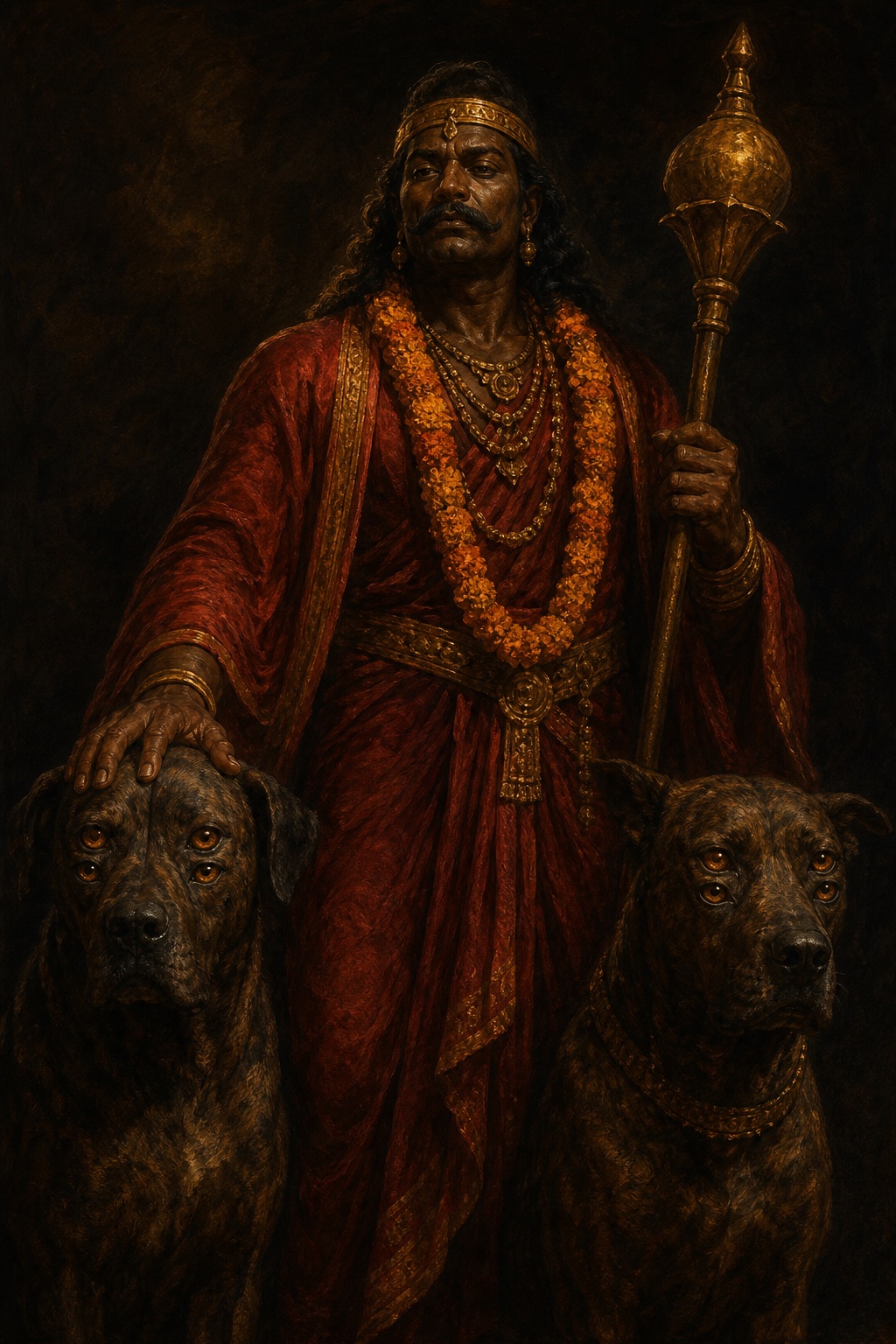
The two four-eyed dogs
Further in the same hymn, two watchers appear and hold the text’s attention longer than anything else about him. One verse calls them “Brindled, four-eyed.” The next names their post directly: “those two dogs of thine, Yama, the watchers, four-eyed, who look on men and guard the pathway.” A third gives them their office outright: “Dark-hued, insatiate, with distended nostrils, Yama’s two envoys.”
No part of the hymn’s king is described in as much bodily detail as these two animals — four eyes each, set to watch the very road the hymn has already said he was first to find and now shows to others. They belong to him alone, and their one task, repeated across three verses, is to guard that path and look on the men who travel it.
Yama and Yami
A second hymn, spoken by no one but the two of them, gives Yama a sister. She speaks first.
यमस्य मा यम्यं काम आगन्समाने योनौ सहशेय्याय । जायेव पत्ये तन्वं रिरिच्यां वि चिद्वृहेव रथ्येव चक्रा ॥७॥
“I, Yami, am possessed by love of Yama, that I may rest on the same couch beside him. I as a wife would yield me to my husband. Like car-wheels let us speed to meet each other.” — Rigveda 10.10.7, tr. Ralph T. H. Griffith
The same patronym that named Yama in the other hymn — Vivasvan’s Son — belongs to Yami too: this is a conversation between two children of one father, Vivasvat, not a meeting of strangers. Yama refuses her offer elsewhere in the same hymn, telling her that men “call it sin when one comes near his sister” — the very bond this verse spends its words establishing is the one he then turns back on her to say no.
Leader of the fathers
Read together, the two hymns settle what is given to Yama and what is withheld. He is king, addressed with oblation. He is brother, addressed and refused. And he is, by the Rigveda’s own account, the reason a road to the dead exists at all for anyone else to walk. Neither hymn shows him weighing a life, keeping a count, or handing down a verdict. What both hymns show instead is arrival and company: a king who reached the pasture first, two dogs set to guard the way there, and fathers who reach it too only because he already showed them how.