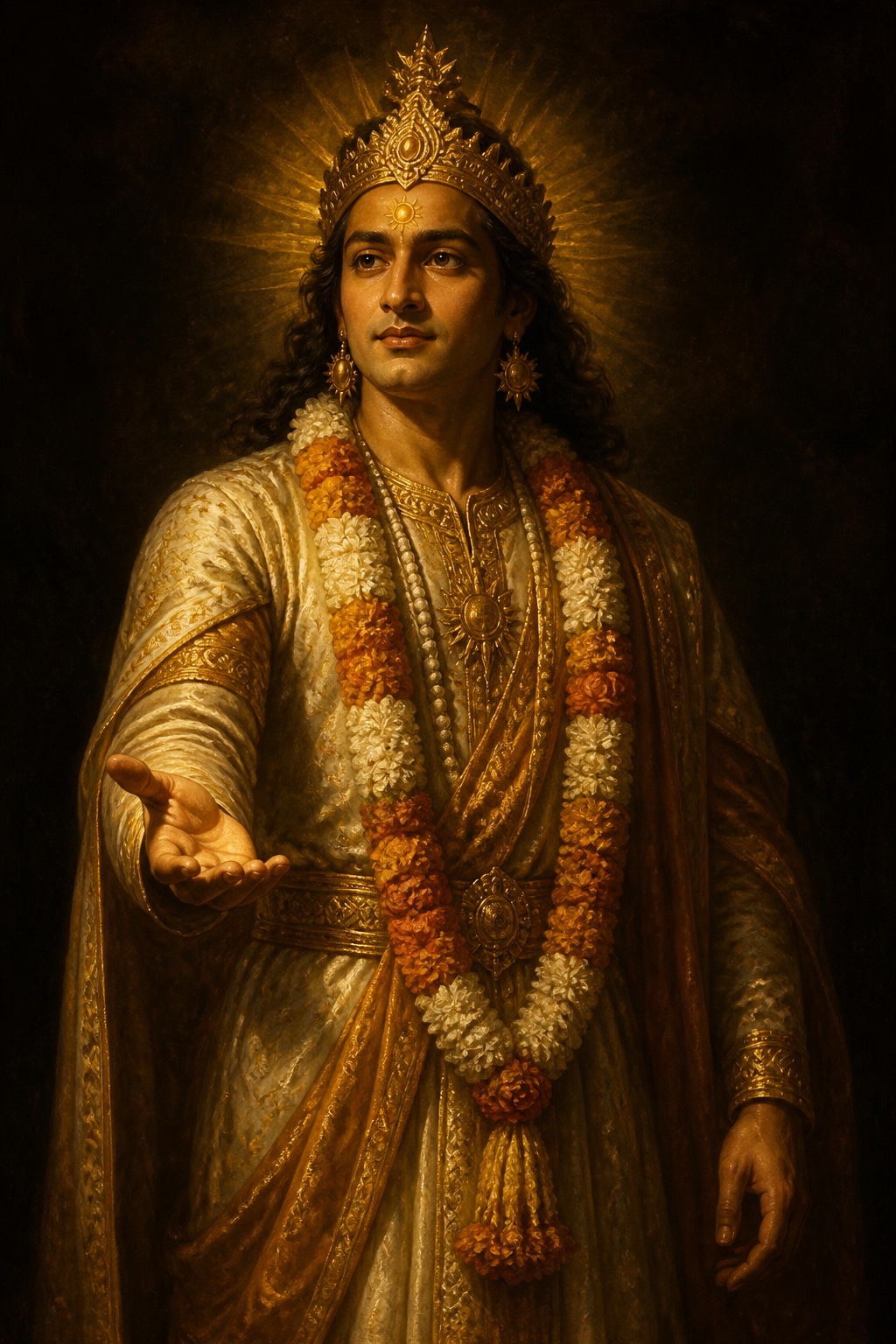
The bridegroom the world assembled to watch
Tvashtar — the craftsman god this corpus already names as the maker of Indra’s thunderbolt — gives his own daughter in marriage, and the wedding draws every witness a Rigvedic hymn can imagine: the whole world hears the news and assembles. The bride does not make it to her new home.
त्वष्टा दुहित्रे वहतुं कृणोतीतीदं विश्वं भुवनं समेति । यमस्य माता पर्युह्यमाना महो जाया विवस्वतो ननाश ॥१॥ अपागूहन्नमृतां मर्त्येभ्यः कृत्वी सवर्णामददुर्विवस्वते । उताश्विनावभरद्यत्तदासीदजहादु द्वा मिथुना सरण्यूः ॥२॥
“TVASTAR prepares the bridal of his Daughter: all the world hears the tidings and assembles. But Yama’s Mother, Spouse of great Vivasvan, vanished as she was carried to her dwelling. From mortal men they hid the Immortal Lady, made one like her and gave her to Vivasvan. Saranyu brought to him the Asvin brothers, and then deserted both twinned pairs of children.” — Rigveda 10.17.1–2, tr. Ralph T. H. Griffith
Vivasvat does nothing in either verse. He is the bridegroom a hymn convenes the world to watch, the husband whose bride vanishes out from under him, and — in the lines that follow — a man handed a substitute without being told.
A look-alike given, a wife who deserts
The “Immortal Lady” who vanishes is Saranyu, though the hymn does not pause to name her before it hides her away. In her place, verse 2 gives Vivasvat someone unnamed: सवर्णा, built on the word for matching form or colour — “made one like her and gave her to Vivasvan.” The hymn never explains how Saranyu, hidden from mortal sight in the same breath, is still the one who “brought to him the Asvin brothers” and then, in the verse’s last act, deserted “both twinned pairs of children.” That compression is the hymn’s own; nothing here smooths it into a single, orderly sequence. What stays unambiguous is who does the leaving: Saranyu is the subject of every verb that bears and abandons in this passage. The two pairs she deserts are Yama and his twin sister in one, the Ashvins in the other — four children in two pairs, left behind together. Vivasvat is named only as the one married, deceived, and left.
Called Vivasvan in Griffith’s English
Griffith’s translation calls him “great Vivasvan,” the form his own English uses throughout this hymn. The Sanskrit beneath it is विवस्वतः, an inflected form of the stem विवस्वत् — the same stem this corpus’s other five languages already render as Vivasvat in Yama’s own genealogy, and the spelling this entry keeps. “Vivasvan” is not a rival name so much as a period habit among English translators of softening the stem’s final consonant; later translators, and this corpus, keep the -t. Read the blockquote’s “Vivasvan” as this same figure under an older English spelling, not as someone else.
A sun by tradition, not by this hymn
Vivasvat’s name and the whole later tradition built on it are unambiguously solar. None of that is in these two verses. RV 10.17.1–2 is a wedding, a disappearance, a substitution and a desertion; nothing in it says “sun,” “sky,” or names any phenomenon he governs. The solar identification surfaces only later, in Sāyaṇa’s mediaeval commentary on this same hymn, which glosses Vivasvat outright as an Āditya — one of the sun-gods — while narrating a fuller story in which he and Saranyu both take the shape of horses. That narrative belongs to the commentary, centuries after the hymn, not to the Rigveda saṃhitā itself. The domain recorded here rests on his name and on that unbroken tradition, not on anything the hymn’s own two verses say.