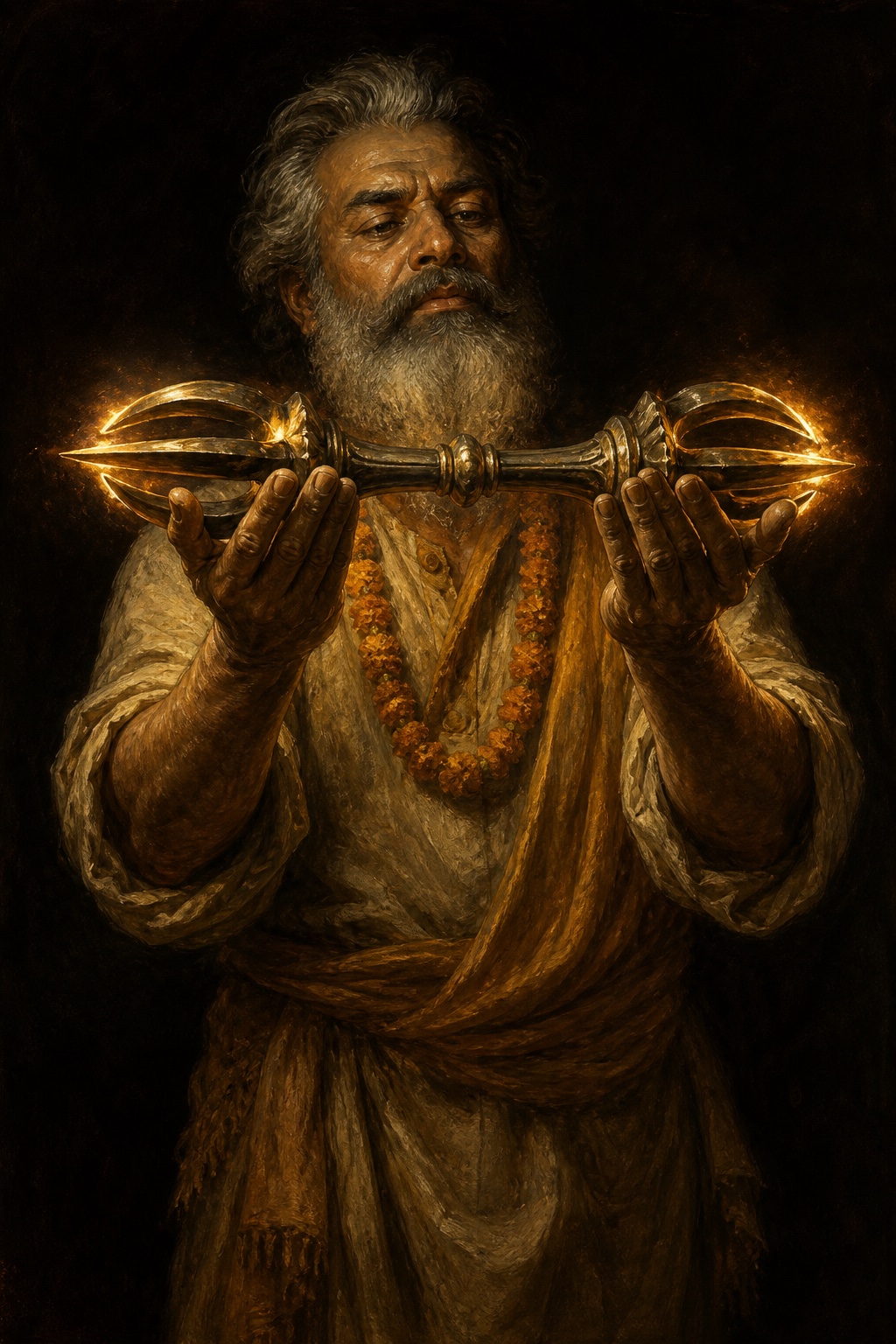
The maker of the weapon
Rigveda 1.32 is Indra’s hymn — the most celebrated deed in the Vedic corpus, the slaying of the dragon Vritra and the release of the pent-up waters. Its second verse contains the clause this entry stands on. Before the dragon dies, before the waters run, the hymn pauses to say where the weapon came from.
अहन्नहिं पर्वते शिश्रियाणं त्वष्टास्मै वज्रं स्वर्यं ततक्ष । वाश्रा इव धेनवः स्यन्दमाना अञ्जः समुद्रमव जग्मुरापः ॥२॥
“He slew the Dragon lying on the mountain: his heavenly bolt of thunder Tvashṭar fashioned. Like lowing kine in rapid flow descending the waters glided downward to the ocean.” — Rigveda 1.32.2, tr. Ralph T. H. Griffith
The verb is ततक्ष, fashioned — the craftsman’s verb, the word for hewing and shaping a made thing. Indra strikes; Tvashtar makes. The verse gives the deed and its instrument in one breath, and the instrument has a maker with a name.
One clause in another god’s hymn
That is the shape of Tvashtar’s presence in this corpus: not a hymn of his own, but a clause inside the great deeds of others. The entries on Indra and Vritra both lean on him already — Indra “wielding the vajra, a thunderbolt fashioned for him by the divine craftsman Tvashtar,” as this wiki’s own account of the storm-god puts it. The waters that pour to the ocean like lowing cattle in the second half of the verse are the result of Indra’s blow, but the blow was only possible because the smith had finished his work.
A weapon-maker who appears at the moment his weapon changes the world, and then steps back out of the hymn: the Rigveda does not stop to describe his workshop or his methods, and this entry does not invent them.
The father at the bridal
The other verse in this corpus that gives Tvashtar an act is the opening of the funeral hymn 10.17 — and there the craftsman is a father, doing what fathers of daughters do.
त्वष्टा दुहित्रे वहतुं कृणोतीतीदं विश्वं भुवनं समेति । यमस्य माता पर्युह्यमाना महो जाया विवस्वतो ननाश ॥१॥ अपागूहन्नमृतां मर्त्येभ्यः कृत्वी सवर्णामददुर्विवस्वते । उताश्विनावभरद्यत्तदासीदजहादु द्वा मिथुना सरण्यूः ॥२॥
“TVASTAR prepares the bridal of his Daughter: all the world hears the tidings and assembles. But Yama’s Mother, Spouse of great Vivasvan, vanished as she was carried to her dwelling. From mortal men they hid the Immortal Lady, made one like her and gave her to Vivasvan. Saranyu brought to him the Asvin brothers, and then deserted both twinned pairs of children.” — Rigveda 10.17.1–2, tr. Ralph T. H. Griffith
He prepares the wedding of his daughter Saranyu to Vivasvat, and the whole world assembles to watch. It is the last thing the hymn lets him do. The bride vanishes in transit; an unnamed plural hides her and hands over a look-alike in her place. The verse does not say the copy was Tvashtar’s work — the maker of the vajra is left standing at a wedding where somebody else has done the fabricating, and the hymn moves on without telling him or us who.
What later tradition makes of him
The corpus’s entry on Vritra records where the craftsman’s story goes after the Rigveda, and it turns him against the god he armed.
The Rigvedic layer this entry quotes knows nothing of that quarrel. In it Tvashtar stands on the same side as Indra’s bolt, and his two attested acts are a making and a marriage: the weapon that freed the waters, and the bridal the whole world assembled to see.