The yaksha’s daughter
Rama hears about Tataka before he sees her. In the twenty-fourth sarga of the Balakanda the sage Vishvamitra, who is leading the young Rama and his brother Lakshmana to guard a sacrifice, tells them that a yakshi with the strength of a thousand elephants is laying waste the country ahead of them. At the start of the twenty-fifth sarga Rama asks how that can be. A yakshi is said to have little strength, he says, so how can an abala, a woman, a word that means one without strength, carry the strength of a thousand? Vishvamitra answers that her strength was made by a boon, and he tells where the boon came from.
पूर्वमासीन्महायक्षः सुकेतुर्नाम वीर्यवान् । अनपत्यः शुभाचारः स च तेपे महत्तपः ॥१-२५-५॥ पितामहस्तु सुप्रीतस्तस्य यक्षपतेस्तदा । कन्यारत्नं ददौ राम ताटकां नाम नामतः ॥१-२५-६॥ ददौ नागसहस्रस्य बलं चास्याः पितामहः । न त्वेव पुत्रं यक्षाय ददौ चासौ महायशाः ॥१-२५-७॥ तां तु बालां विवर्धन्तीं रूपयौवनशालिनीम् । जम्भपुत्राय सुन्दाय ददौ भार्यां यशस्विनीम् ॥१-२५-८॥ कस्यचित्त्वथ कालस्य यक्षी पुत्रं व्यजायत । मारीचं नाम दुर्धर्षं यः शापाद् राक्षसोऽभवत्
“A mighty spirit lived of yore; Suketu was the name he bore. Childless was he, and free from crime In rites austere he passed his time. The mighty Sire was pleased to show His favour, and a child bestow. Tádaká named, most fair to see. A pearl among the maids was she. And matched, for such was Brahmá’s dower, A thousand elephants in power. Nor would the Eternal Sire, although The spirit longed, a son bestow. That maid in beauty’s youthful pride Was given to Sunda for a bride. Her son, Máricha was his name, A giant, through a curse, became” — Valmiki, Ramayana 1.25.5–9, tr. Griffith
Suketu was a great yaksha, virtuous and childless, and he performed a great austerity, स च तेपे महत्तपः. The one who rewarded it is पितामहः, the Grandsire, whom Griffith names as Brahma. The Grandsire gave the yaksha कन्यारत्नं, a jewel of a daughter, ताटकां नाम नामतः, named Tataka, and he gave her the strength of a thousand elephants as well. The word the Sanskrit uses is naga, which can mean an elephant or a serpent, and Griffith takes it as elephants. What the Grandsire did not give was a son: न त्वेव पुत्रं यक्षाय, to the yaksha he gave no son. Griffith adds that Suketu longed for one. The Sanskrit says only that none was given.
The girl grew up रूपयौवनशालिनीम्, rich in beauty and youth, and she was given as a wife to Sunda, जम्भपुत्राय सुन्दाय, Sunda the son of Jambha. In time the yakshi bore a son, मारीचं नाम दुर्धर्षं, Maricha, hard to overcome, who became a rakshasa through a curse. Vishvamitra goes straight on to the curse, and it falls on the mother as well as the son. सुन्दे तु निहते, when Sunda had been killed (the verse does not say by whom), Tataka and her son set out to attack the sage Agastya, and she ran at him roaring, भक्षार्थं जातसंरम्भा, in a fury to eat him. Agastya turned the son into a rakshasa. Then he cursed Tataka: पुरुषादी महायक्षी विकृता विकृतानना, great yakshi, be an eater of men, deformed, with a deformed face, and give up this form at once for a dreadful one. The beauty of the eighth verse is gone. The fourteenth verse tells what followed. Maddened by the curse, Tataka lays waste the fair country where Agastya once lived, and that is the country into which Vishvamitra has brought the two princes.
No pity for a woman
Vishvamitra has already told Rama what she does. In the twenty-fourth sarga he says that she keeps on destroying two lands, Malada and Karusha, that she lives across the road, and that no one can come into the country. He tells Rama to go into her forest, kill her by the strength of his own arm, and make the country free of thorns again (1.24.28–31). At the end of the twenty-fifth sarga, when he has told the story of her birth, he gives the order a second time and argues for it. एनां राघव दुर्वृत्तां यक्षीं परमदारुणाम्: this yakshi of evil ways, most terrible, kill her, descendant of Raghu, गोब्राह्मणहितार्थाय, for the good of cows and brahmins. Cursed as she is, शापसंसृष्टां, no man in the three worlds but Rama has the heart to kill her, कश्चिदुत्सहते पुमान्. That verb, to have the heart for a thing, comes back in the next sarga.
Then the sage answers an objection before Rama has made it. नहि ते स्त्रीवधकृते घृणा कार्या नरोत्तम: you must feel no pity over the killing of a woman, best of men. A king’s son must act चातुर्वर्ण्यहितार्थं, for the good of all four varnas, and whether the act is cruel or not cruel, a sin or a fault, the one who protects the people must always do it. राज्यभारनियुक्तानामेष धर्मः सनातनः: this is the eternal dharma of those who carry the burden of a kingdom, or in Griffith’s words, “Such, through all time, should be the care Of those a kingdom’s weight who bear.” And she herself is outside dharma. अधर्म्यां जहि काकुत्स्थ धर्मो ह्यस्यां न विद्यते: kill this lawless one, Kakutstha, for there is no dharma in her. Kakutstha here is Rama.
Last he gives precedents. Shakra, that is, Indra, killed Manthara, the daughter of Virochana, when she wanted to destroy the earth. Vishnu killed the wife of Bhrigu, the mother of Kavya, when she wanted a world without Indra, अनिन्द्रं लोकमिच्छन्ती. The second example is not a monster. The verse calls Bhrigu’s wife पतिव्रता, faithful to her husband, and what condemned her was what she wanted. These and many other great princes killed women who were joined with adharma, अधर्मसहिता नार्यो, and so, the sage ends, तस्मादेनां घृणां त्यक्त्वा जहि मच्छासनान्नृप: give up pity, then, and kill her at my command, prince.
Rama’s bowstring
Rama answers at the start of the twenty-sixth sarga, Griffith’s Canto XXVIII. सोऽहं पितुर्वचः श्रुत्वा शासनाद् ब्रह्मवादिनः: he has heard his father’s word, and he has the sage’s command, and करिष्यामि न संदेहस्ताटकावधमुत्तमम्, he will do this great deed, the killing of Tataka, and there is no doubt of it. He gives the reason in Vishvamitra’s own words, गोब्राह्मणहितार्थाय, for the good of cows and brahmins, and he adds देशस्य च हिताय च, and for the good of the country.
Then he takes the bow by the middle and makes the string ring, ज्याघोषमकरोत् तीव्रं, until the sound fills every quarter of the sky. Those who live in Tataka’s forest are terrified. Tataka herself, confused and furious at the sound, runs to the place it came from. Rama sees her, विकृतां विकृताननाम्, deformed, with a deformed face, and प्रमाणेनातिवृद्धां, grown huge in size. These are the words of Agastya’s curse, विकृता विकृतानना, turned from a command into a description. What Rama sees is the curse. He says to Lakshmana, पश्य लक्ष्मण यक्षिण्या भैरवं दारुणं वपुः, look, Lakshmana, at the yakshi’s terrible and cruel body. The sight of it would break a timid heart.
एतां पश्य दुराधर्षां मायाबलसमन्विताम् । विनिवृत्तां करोम्यद्य हृतकर्णाग्रनासिकाम् ॥१-२६-११॥ न ह्येनामुत्सहे हन्तुं स्त्रीस्वभावेन रक्षिताम् । वीर्यं चास्या गतिं चैव हन्यामिति हि मे मतिः
“Behold the demon hard to smite, Defended by her magic might. My hand shall stay her course to-day, And shear her nose and ears away. No heart have I her life to take: I spare it for her sex’s sake. My will is but, with ‘minished force, To check her in her evil course” — Valmiki, Ramayana 1.26.11–12, tr. Griffith
Rama has accepted the order, and he still will not carry it out as it was given. न ह्येनामुत्सहे हन्तुं: he does not have the heart to kill her, स्त्रीस्वभावेन रक्षिताम्, protected as she is by being a woman. It is the same verb that Vishvamitra used when he said that no man but Rama had the heart to kill her. Rama is that man, and he says that he cannot. What he means to do instead is to make her turn back, हृतकर्णाग्रनासिकाम्, with the tips of her ears and her nose cut off, and to destroy वीर्यं चास्या गतिं चैव, her strength and her power to move.
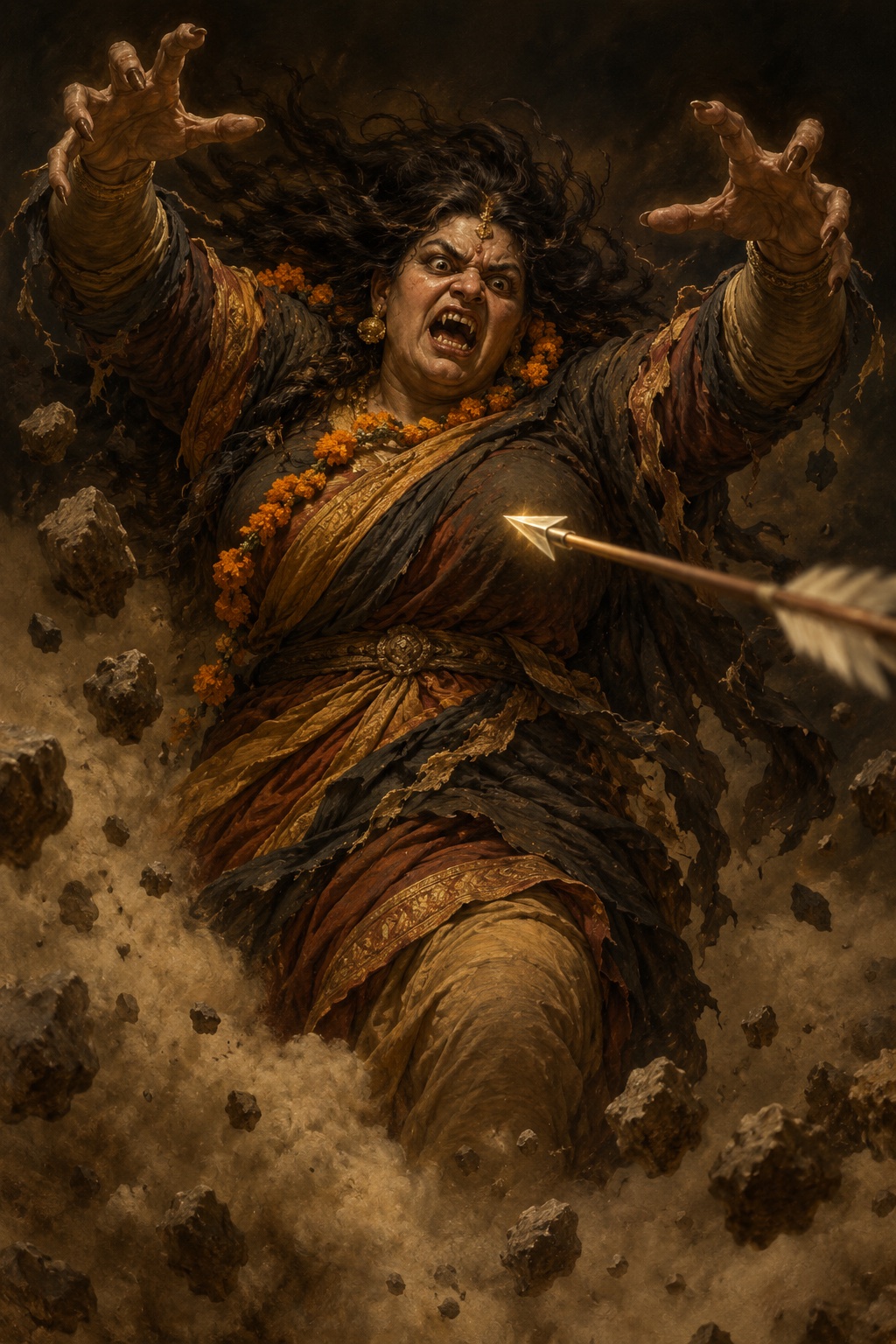
She does not wait for him. एवं ब्रुवाणे रामे तु, while Rama is still speaking, Tataka raises both arms, roaring, and runs straight at him, राममेवाभ्यधावत. Vishvamitra, the brahmarshi, checks her with a threatening cry, हुंकारेणाभिभर्त्स्य ताम्, and calls out a blessing on the two sons of Raghu and on their victory. In Griffith he says “Fight, and be fortunate”.
Before twilight
The fight is Tataka’s magic against the brothers’ arrows. She raises a dreadful dust, उद्धुन्वाना रजो घोरं, and for a moment she confuses both princes with a great cloud of it, रजोमेघेन महता. Then, ततो मायां समास्थाय, calling on her magic, she covers them with a great rain of stones. Rama is angered. He stops the stones with a rain of arrows, and as she runs at him he cuts off her two hands, करौ चिच्छेद पत्रिभिः. Then Lakshmana cuts off the tips of her ears and her nose in his anger: सौमित्रिरकरोत् क्रोधाद्धृतकर्णाग्रनासिकाम्. It is the maiming that Rama planned, in the same compound, but Lakshmana is the one who does it.
Maimed, she is still not beaten. कामरूपधरा सा तु, able to take any shape she wishes, she puts on many forms and vanishes, अन्तर्धानं गता, confusing the princes with her own magic, and she moves about unseen, raining down stones. The poem has two names for her by now. In the eighth verse of this sarga she is a राक्षसी, a rakshasi, and here she is still a यक्षी, a yakshi. Vishvamitra, the son of Gadhi, sees the princes pelted with stones on every side, and he speaks again. अलं ते घृणया राम पापैषा दुष्टचारिणी: enough of your pity, Rama, she is wicked and evil in her ways. She is यज्ञविघ्नकरी यक्षी, a yakshi who spoils sacrifices, Griffith’s “Disturber of each holy rite”, and her magic will make her strong again. वध्यतां तावदेवैषा पुरा संध्या प्रवर्तते: kill her now, before the twilight comes, because रक्षांसि संध्याकाले तु दुर्धर्षाणि भवन्ति हि, at twilight rakshasas become hard to overcome.
इत्युक्तः स तु तां यक्षीमश्मवृष्ट्याभिवर्षणीम् ॥१-२६-२३॥ दर्शयञ्शब्दवेधित्वं तां रुरोध स सायकैः । सा रुद्धा बाणजालेन मायाबलसमन्विता ॥१-२६-२४॥ अभिदुद्राव काकुत्स्थं लक्ष्मणं च विनेषुदी । तामापतन्तीं वेगेन विक्रान्तामशनीमिव ॥१-२६-२५॥ शरेणोरसि विव्याध सा पपात ममार च
“Then Ráma, skilful to direct His arrow to the sound, With shafts the mighty demon checked Who rained her stones around. She sore impeded and beset By Ráma and his arrowy net, Though skilled in guile and magic lore, Rushed on the brothers with a roar. Deformed, terrific, murderous, dread, Swift as the levin on she sped, Like cloudy pile in autumn’s sky, Lifting her two vast arms on high, When Ráma smote her with a dart, Shaped like a crescent, to the heart. Sore wounded by the shaft that came With lightning speed and surest aim, Blood spouting from her mouth and side. She fell upon the earth and died” — Valmiki, Ramayana 1.26.23–26, tr. Griffith
She cannot be seen, and Rama shoots anyway. दर्शयञ्शब्दवेधित्वं, showing his skill at hitting a target by its sound, he hems her in with arrows. Held in that net, she rushes at Rama and Lakshmana, and as she comes on, fast, like a thunderbolt, विक्रान्तामशनीमिव, he strikes her: शरेणोरसि विव्याध सा पपात ममार च, he pierced her in the chest with an arrow, and she fell and died. The Sanskrit ends her in half a verse. Griffith’s crescent-shaped dart, his autumn cloud, her raised arms and the blood from her mouth and side are not in the Sanskrit that sa.wikisource prints for these verses.
The twilight that Vishvamitra feared comes only after she is dead. Indra, the king of the gods, sees her lying there, and he and the other gods call out well done and honour Rama. They ask Vishvamitra to hand over to Rama the sons of Krishashva, which Griffith calls “heavenly arms”, because the king’s son still has a great deed to do for the gods (1.26.26–31). They go back to the sky, and then the twilight comes. Vishvamitra, delighted by the killing of Tataka, kisses Rama’s head, and they spend the night in Tataka’s forest. That same day the forest is freed from its curse, and it shines like the forest Chaitraratha (1.26.32–35). The last verse of the sarga names her once more, by her father: Rama has killed the yaksha’s daughter. Her son Maricha is not in this fight at all.