The cosmic egg
At the very opening of the Mahabharata, before the poem tells any other story, the bard Sauti recites its frame cosmogony to the sages gathered to hear the whole epic — an account of how the world began, in a darkness with nothing yet in it to see by.
निष्प्रभेऽस्मिन्निरालोके सर्वतस्तमसा वृते। बृहदण्डमभूदेकं प्रजानां बीजमव्ययम्
“In this world, when it was destitute of brightness and light, and enveloped all around in total darkness, there came into being, as the primal cause of creation, a mighty egg, the one inexhaustible seed of all created beings.” — Mahabharata, Adi Parva 1.1.42, tr. K. M. Ganguli
Brahma the creator, and Brahman the Absolute
Two verses stand between the egg’s forming and the creator’s birth, and this entry does not quote them. They describe something within the egg as the true light, the eternal one, present alike in all places — and Ganguli’s translation renders that word as “Brahma” too, the same English spelling used two verses later for the creator god. But the Sanskrit is not the same word in both places: the neuter ब्रह्म there is Brahman, the impersonal Absolute of later Vedantic thought — a principle, not a person — while the god actually born from the egg, two verses further on, is named with the masculine ब्रह्मा. The translation flattens a distinction the Sanskrit keeps; this entry follows the Sanskrit, and is about the god, not the principle he is sometimes confused with.
Born from the egg
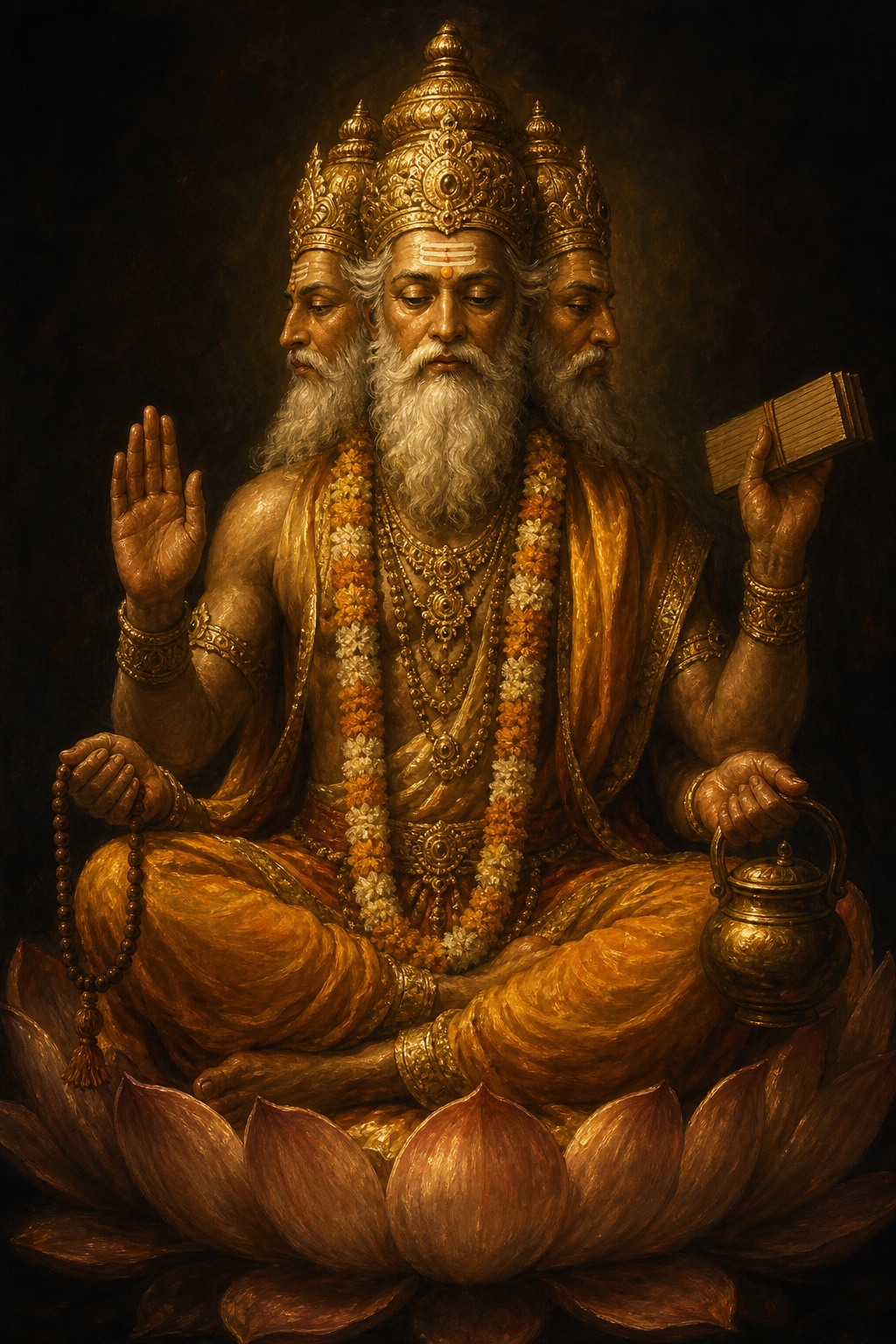
From that egg, in the same breath as several of the first beings, the god himself is named.
यस्मिन्पितामहो जज्ञे प्रभुरेकः प्रजापतिः। ब्रह्मा सुरगुरुः स्थाणुर्मनुः कः परमेष्ठ्यथ
“From this egg came the lord Pitamaha, Brahma, the one only Prajapati; with Suraguru and Sthanu; so Manu, Ka, and Parameshti.” — Mahabharata, Adi Parva 1.1.45, tr. K. M. Ganguli
Pitamaha, “the Grandsire,” and Prajapati, “lord of creatures,” are titles the epic reaches for as readily as his own name; both fall in this single verse. He is named beside Sthanu, an epithet given elsewhere to Shiva, and beside Manu, forefather of the human race — a reminder that the epic’s list of what comes first is looser, and stranger, than the tidy triad later theology settles into.
Four heads, the lotus, and the Trimurti
Later tradition remembers Brahma chiefly by his image: four heads facing the four directions, said to correspond to the four Vedas he is shown reciting or holding; a seat on a lotus; the hamsa, a swan or goose, as his mount; and Saraswati, goddess of learning and speech, as his consort. With Vishnu the preserver and Shiva the destroyer he completes the Trimurti, the three functions later Hindu thought divides creation, maintenance, and dissolution between — Brahma opens each cycle of the world that Vishnu then sustains and Shiva, in time, brings to an end. The Puranic tradition tells his origin differently again from the Mahabharata’s cosmic egg: in the Vaishnava account, he is born instead from a lotus that grows from Vishnu’s own navel, seated at its center to begin the work of creation — one god, two births, remembered in traditions the texts never troubled to reconcile.