The throne he would not keep
Bharata is Dasharatha’s son by Kaikeyi, the junior of the king’s three queens, and one of four brothers born at Ayodhya. Griffith’s birth canto spends four lines on him and they are conventional lines: a child of truest valour, blessed with every princely virtue, one fourth of Vishnu manifest. At the wedding in Mithila, where Janaka gives Sita to Rama, the same rite gives Bharata his wife Mandavi. None of that is what he is remembered for. He is remembered for a refusal, and what he refused was lawfully his.
Kaikeyi holds two boons that Dasharatha granted her long before and never had to honour. On the eve of Rama’s consecration she names them: fourteen years of forest exile for Rama, and the vacant throne for her own son. The king is bound by his own word and dies of keeping it. The whole arrangement is made for Bharata, and Bharata is not in the kingdom while it is made. Griffith’s Canto LXX sends him away and Canto LXXI brings him back across the Satadru and the Sarasvati at speed, reading omens the whole road, until his “boding spirit gathers hence Dire sins of awful consequence” out of a silence he cannot account for. He comes in through Vaijayanta’s gate to a city with its eyes on the ground, and learns there that his father is dead, that his brother is in the forest in bark, and that the crown is waiting for him.
He goes first to his mother, and the reproach Griffith gives him is not about the crown at all. It is about what the crown cost somebody else: has she driven Kausalya’s son out of the kingdom, “with bark around his waist, To the wild wood, to dwell therein”, and does she not sorrow for her sin? Only then does he raise his own position, and he raises it as a disqualification rather than a claim — “What power have I the realm to sway?” When he comes before Kausalya she has already decided what he is. She greets him with the throne: “Now all is thine, without a foe, This realm for which thou longest so.” The accusation drops him at her feet, and what he says when he can speak again is the sentence the rest of his life is built on. “Why these reproaches, noble dame? I, knowing naught, am free from blame.”
Then he swears, at length. Griffith’s Canto LXXV is a chain of self-curses with no name in it, aimed at whoever consented to the exile and therefore at himself if he did: let that man inherit the guilt of a ruler who takes a sixth of everything and then neglects to guard his people, of a man who promises a fee at a sacrifice and withholds it, of a man who betrays what he swore to keep secret, of a man who strikes a sleeping cow. “Be his who willed the prince should fly” is the refrain, reworded verse after verse. Note what he does not argue. He never says the boons were invalid, or that his mother had no right to them, or that the sentence on Rama can be undone by law. He separates himself from the profit and leaves the transaction standing.
What he asked for, and what he was given
He takes the army, the priests, the queens and the citizens into the forest to fetch Rama home, and the speech he makes at Chitrakuta is a legal argument rather than a plea. Among a king’s duties, he tells Rama, the wise count consecration paramount, so that he may keep his people and his land with ready heart and hand. No warrior born to royal sway turns from a certain good to pursue a doubtful duty “That mocks him with the distant view”. Of the four orders of life the wise prefer the householder’s, and Rama proposes to leave the best of them. He asks Rama to forgive their father the haste and the fear that produced the sentence, since the sons of a man who covers his father’s offence live approved by all. Then he offers his own unfitness as the clinching term: “My better thou in lore divine, My birth, my sense must yield to thine: While thou, my lord, art here to reign, How shall my hands the rule maintain?” He asks that “my mother’s words of hate” be expiated by his brother’s virtues. And he names his fallback in the last four lines of the speech: if the prayers fail, he will make his home in the forest too.
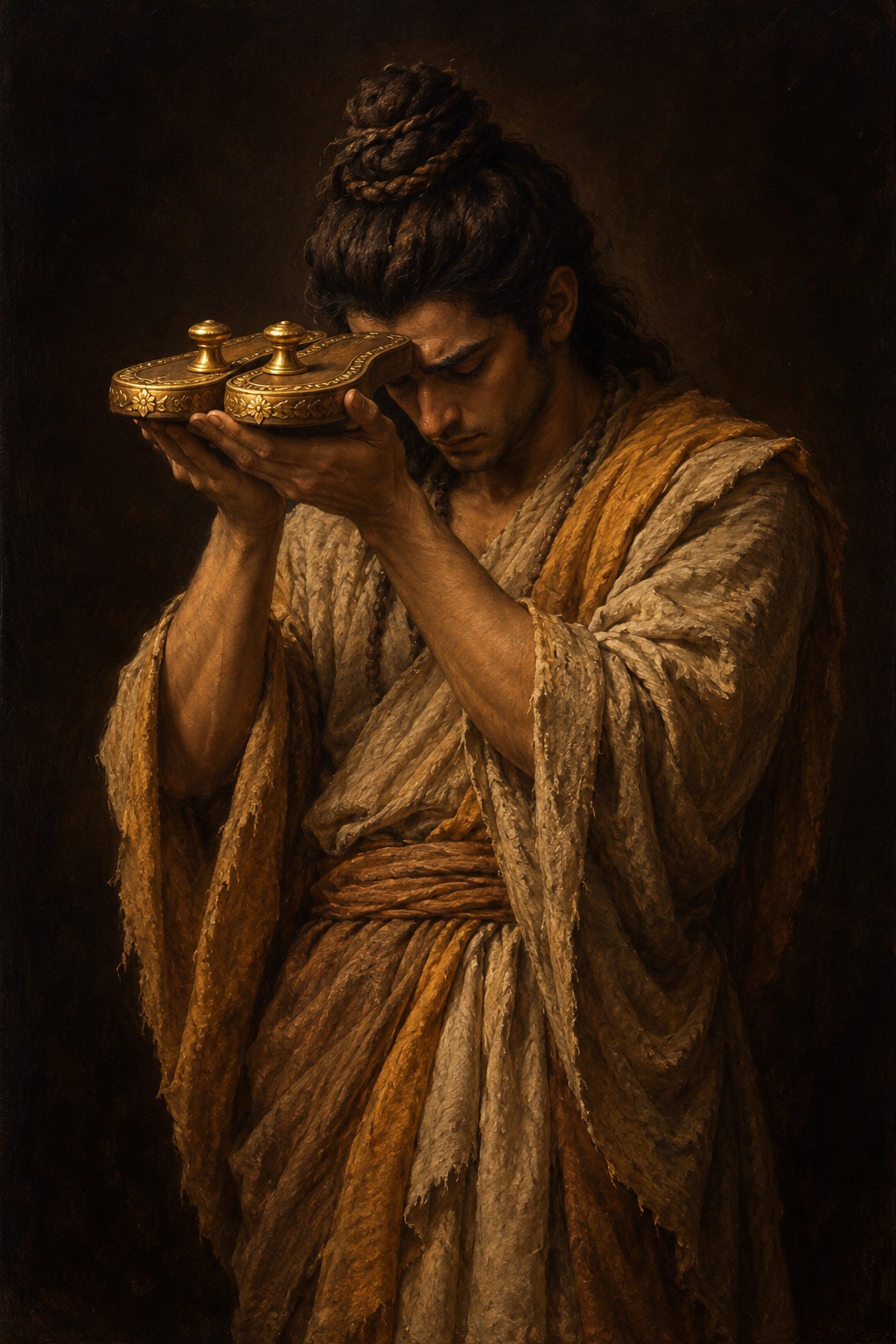
One argument in it is worth marking, because the rest of his life contradicts it. “Nor can the hermit’s matted hair Suit fitly with a ruler’s care,” he tells Rama — the discipline of a forest ascetic cannot be combined with the work of governing. Rama is unmoved. His father’s word stands, and the assembled people weep and approve of his refusing. What Bharata is given instead of his brother is a pair of shoes.
अधिरोहार्य पादाभ्यां पादुके हेमभूषिते । एते हि सर्वलोकस्य योगक्षेमं विधास्यत: ।। २.११२.२१ ।। सो ऽधिरुह्य नरव्याघ्र: पादुके ह्यवरुह्य च । प्रायच्छत् सुमहातेजा भरताय महात्मने ।। २.११२.२२ ।। स पादुके सम्प्रणम्य रामं वचनमब्रवीत् । चतुर्दश हि वर्षाणि जटाचीरधरो ह्यहम् ।। २.११२.२३ ।। फलमूलाशनो वीर भवेयं रघुनन्दन । तवागमनमाकांक्षन् वसन् वै नगराद्बहि: ।। २.११२.२४ ।। तव पादुकयोर्न्यस्तराज्यतन्त्र: परन्तप । चतुर्दशे हि सम्पूर्णे वर्षे ऽहनि रघूत्तम । न द्रक्ष्यामि यदि त्वां तु प्रवेक्ष्यामि हुताशनम् ।। २.११२.२५ ।।
“Put, noble brother, I entreat, These sandals on thy blessed feet: These, lord of men, with gold bedecked, The realm and people will protect.’ Then Ráma, as his brother prayed Beneath his feet the sandals laid, And these with fond affection gave To Bharat’s hand, the good and brave. Then Bharat bowed his reverent head And thus again to Ráma said: ‘Through fourteen seasons will I wear The hermit’s dress and matted hair: With fruit and roots my life sustain, And still beyond the realm remain, Longing for thee to come again. The rule and all affairs of state I to these shoes will delegate. And if, O tamer of thy foes, When fourteen years have reached their close, I see thee not that day return, The kindled fire my frame shall burn” — Valmiki, Ramayana 2.112.21–25, tr. Griffith
The transfer is physical and the verses are careful about it. अधिरोहार्य पादाभ्यां: mount them with your feet. The sandals are worth nothing until Rama has stood in them, and the next verse makes him do exactly that and then step down again, सो ऽधिरुह्य नरव्याघ्र: पादुके ह्यवरुह्य च, before he hands them over. What they carry once he has is named in the first verse: एते हि सर्वलोकस्य योगक्षेमं विधास्यत:, they will arrange the योगक्षेम of all the world, its safety and its keeping, which Griffith turns into “The realm and people will protect”. Then Bharata answers, and his answer takes Rama’s sentence and applies it to himself term by term. चतुर्दश हि वर्षाणि, fourteen years, the same count. जटाचीरधरो, wearing matted hair and bark. फलमूलाशनो, living on fruit and roots. वसन् वै नगराद्बहि:, dwelling outside the city. Rama was sentenced to all of it; Bharata, whom nobody has sentenced to anything, takes the identical terms on himself. The one clause with no counterpart in Rama’s sentence is the constitutional one, तव पादुकयोर्न्यस्तराज्यतन्त्र:, the business of the kingdom laid down upon your two sandals, which Griffith gives as delegating the rule and all affairs of state to the shoes. And the arrangement has an expiry written into it. चतुर्दशे हि सम्पूर्णे वर्षे, when the fourteenth year is complete, if he does not see Rama, then प्रवेक्ष्यामि हुताशनम्, I will enter the fire.
Fourteen years outside the city
He carries them home on his head. Griffith brings him to Nandigrama “with the sandals on his head”, and at the town he tells his escort what he is carrying: his brother’s hand consigned to him “the lordship of the land” in trust when he gave “these gold-wrought sandals” as emblems “to protect and save”. Then he bows, takes the pledge down from his head, and gives his first order as regent, which is an order about precedence. “Haste, for these sandals quickly bring The canopy that shades the king.” The people are to pay them the reverence owed to his elder brother’s feet, “For they will right and law maintain” until the king comes back. His own office he describes as a term with a handover at the end of it: “My watchful task will soon be done, The pledge restored to Raghu’s son.”
The regency itself Griffith gives in a few closing lines, and they are the whole of the regency. “With hermit’s dress and matted hair He dwelt with all his army there. The sandals of his brother’s feet Installed upon the royal seat”, and with the throne thus occupied he referred all his powers to them and administered the affairs of state. The detail that finishes the picture is fiscal. When treasure came in, before anything was done with it, he went to the sandals first, “as though their rede to ask”.
So the argument he lost at Chitrakuta is the one his own government disproves. He had told Rama that matted hair cannot suit a ruler’s care, and then he ruled for fourteen years in matted hair, from a town outside his own capital, dressed as the exile he had gone to fetch home, with the authority of Ayodhya sitting on a pair of shoes and himself standing beside them asking their advice before he spent anything. Nothing in it is a compromise between having the throne and not having it. The sandals are not an emblem he chose; they were put into his hands by the man whose feet had just been in them, and he governs as their servant rather than as a king with a scruple. The last clause of the vow is what holds the whole arrangement upright: if the fourteenth year closes and Rama has not come, he goes into the fire. A regency with that written into it is not a seat kept warm. It is a debt with a date on it.