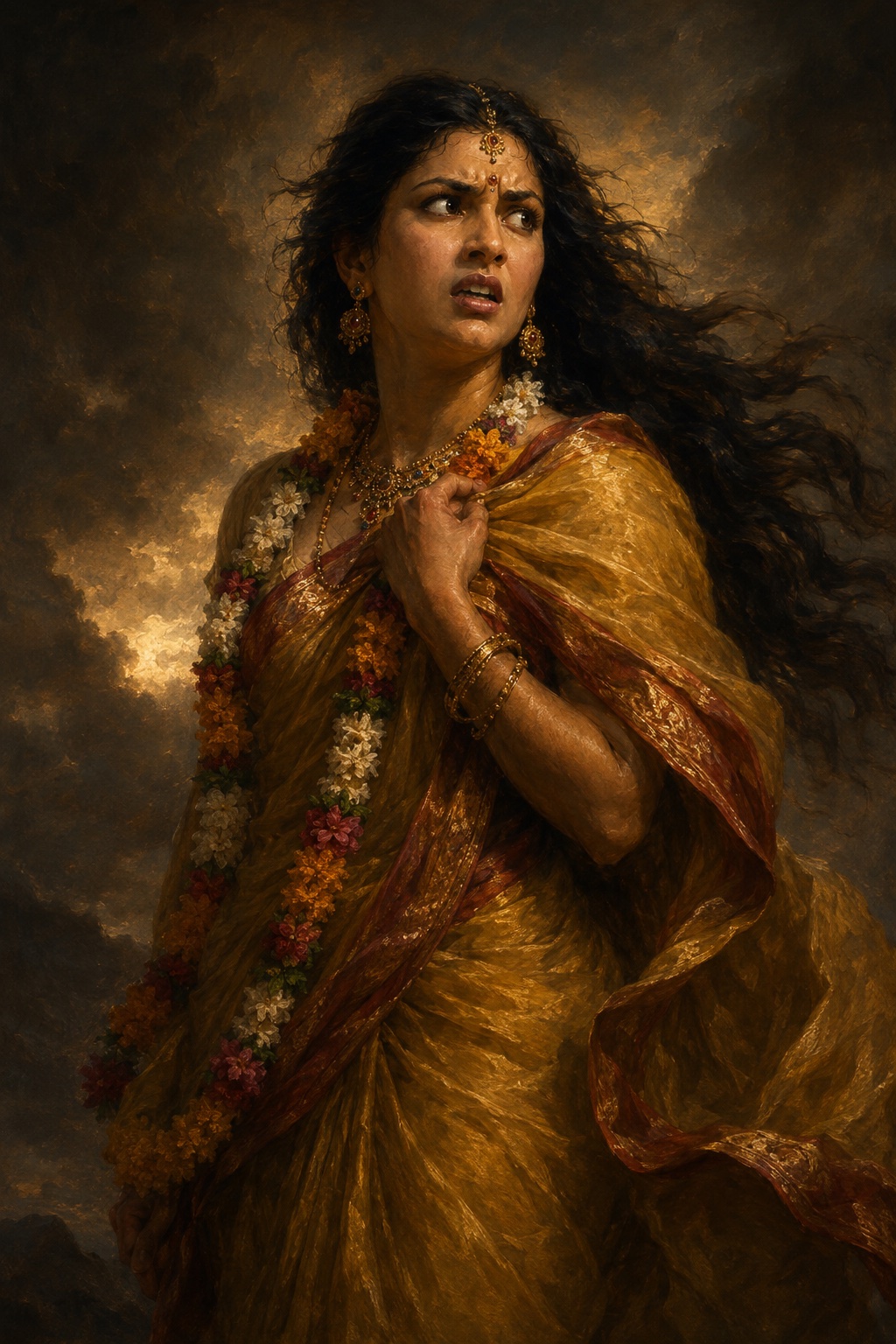
अभिशापादभूत् — who she was before
Hanuman’s entry gives her one word, as his mother, and Vayu’s gives her one more, as the woman on the mountain. Neither has room for the sentence Valmiki actually spends on her, which is not about either of them. The whole of it is spoken by Jambavan, the old bear-king, who is trying to remind Hanuman what he is by telling him where he came from. Griffith’s verse picks her up at her rank, mid-line.
अप्सराऽप्सरसां श्रेष्ठा विख्याता पुञ्जिकस्थला। अञ्जनेति परिख्याता पत्नी केसरिणो हरेः॥ ८॥ विख्याता त्रिषु लोकेषु रूपेणाप्रतिमा भुवि। अभिशापादभूत् तात कपित्वे कामरूपिणी॥ ९॥ दुहिता वानरेन्द्रस्य कुञ्जरस्य महात्मनः। मानुषं विग्रहं कृत्वा रूपयौवनशालिनी॥ १०॥
“the fairest found Of nymphs for heavenly charms renowned, Sweet Punjikasthalá, became A noble Vánar’s wedded dame. Her heavenly title heard no more, Anjaná was the name she bore, When, cursed by Gods, from heaven she fell In Vánar form on earth to dwell, New-born in mortal shape the child Of Kunjar monarch of the wild. In youthful beauty wondrous fair, A crown of flowers about her hair, In silken robes of richest dye She roamed the hills that kiss the sky.” — Ramayana, Kishkindhakanda 4.66.8–10, tr. Ralph T. H. Griffith
Three facts, and every one of them is a demotion. She was Punjikasthala, and अप्सराऽप्सरसां श्रेष्ठा — an apsara, the foremost of the apsaras: not one of the celestial dancers but the first of them, matchless in beauty त्रिषु लोकेषु, in all three worlds. Then अभिशापाद्, by a curse, she became कपित्वे — monkeyhood. The verse does not say whose curse or what for. Valmiki, who elsewhere will spend a canto on the reason for a thing, gives the sentence that ends her career in heaven four syllables and moves on.
What the curse leaves her is the one thing worth having: कामरूपिणी, taking whatever form she wills. So the vanara-shape is a sentence, not a body, and the woman on the mountain in the next verses is there by choice — मानुषं विग्रहं कृत्वा, having made a human form. She is a fallen goddess wearing her own old face on purpose.
What she said on the mountaintop
The scene that follows is told in Vayu’s entry from his side, because it is the clearest thing the Ramayana shows him doing on his own account: he sees her on the crest in her yellow silk, the wind takes the garment, and he seizes her. Her side of it is one verse, and it is the only line she speaks in the poem.
सा तु तत्रैव सम्भ्रान्ता सुव्रता वाक्यमब्रवीत्। एकपत्नीव्रतमिदं को नाशयितुमिच्छति॥ १६॥ अञ्जनाया वचः श्रुत्वा मारुतः प्रत्यभाषत। न त्वां हिंसामि सुश्रोणि मा भूत् ते मनसो भयम्॥ १७॥
“Then to the eager God she cried In trembling accents, terrified: ‘Whose impious love has wronged a spouse So constant in her nuptial vows?’ He heard, and thus his answer made: ‘O, be not troubled, nor afraid, But trust, and thou shalt know ere long My love has done thee, sweet, no wrong’” — Ramayana, Kishkindhakanda 4.66.16–17, tr. Ralph T. H. Griffith
She is सुव्रता, firm in her vow, and what she says is not a plea but a question with an accusation folded into it: एकपत्नीव्रतमिदं को नाशयितुमिच्छति — who is it that wishes to destroy this vow of one husband? Not let me go and not who are you. She names the thing being broken and demands to know who thinks he can break it. Valmiki gives the god the next verse and a half to answer, and the answer is a defence — I do you no harm, do not be afraid — which is the shape a reply takes when the question landed.
The next verse names her outright: अञ्जनाया वचः श्रुत्वा, having heard Anjana’s words. It is the poem’s own signal that the exchange counts. He does not simply act on her; he hears her, and answers.
Down in a cave
Two verses later the god has promised her a son who will match him in leaping and in strength, and the canto turns.
एवमुक्ता ततस्तुष्टा जननी ते महाकपे। गुहायां त्वां महाबाहो प्रजज्ञे प्लवगर्षभ॥ २०॥
“Thus spoke the God; the conquered dame Rejoiced in heart nor feared the shame. Down in a cave beneath the earth The happy mother gave thee birth.” — Ramayana, Kishkindhakanda 4.66.20, tr. Ralph T. H. Griffith
तुष्टा — satisfied, contented — and then जननी ते, your mother, because Jambavan is still speaking to Hanuman and she has become a term in someone else’s genealogy in the space of one word. That is the last the Ramayana has to say about her. The verses that follow are the child mistaking the sun for fruit, the leap of three hundred leagues, Indra’s bolt and the broken jaw that gives Hanuman his name; the mother who bore him in the cave is not mentioned again, not when the child is struck down, not when the gods gather to appease his father, and not when the boons are handed out.
Read the canto straight through and the shape is plain enough. It is fourteen verses about how Hanuman got his strength, and it uses her for three of them: to establish that his mother was the finest thing in heaven before she was anything else, to give him a moment of moral seriousness by having her object, and then to put him in the world. Her own story — an apsara cursed out of the sky for a reason nobody records, who kept the power to look like herself — is finished in two lines and never picked up. This entry exists because the two lines are there.