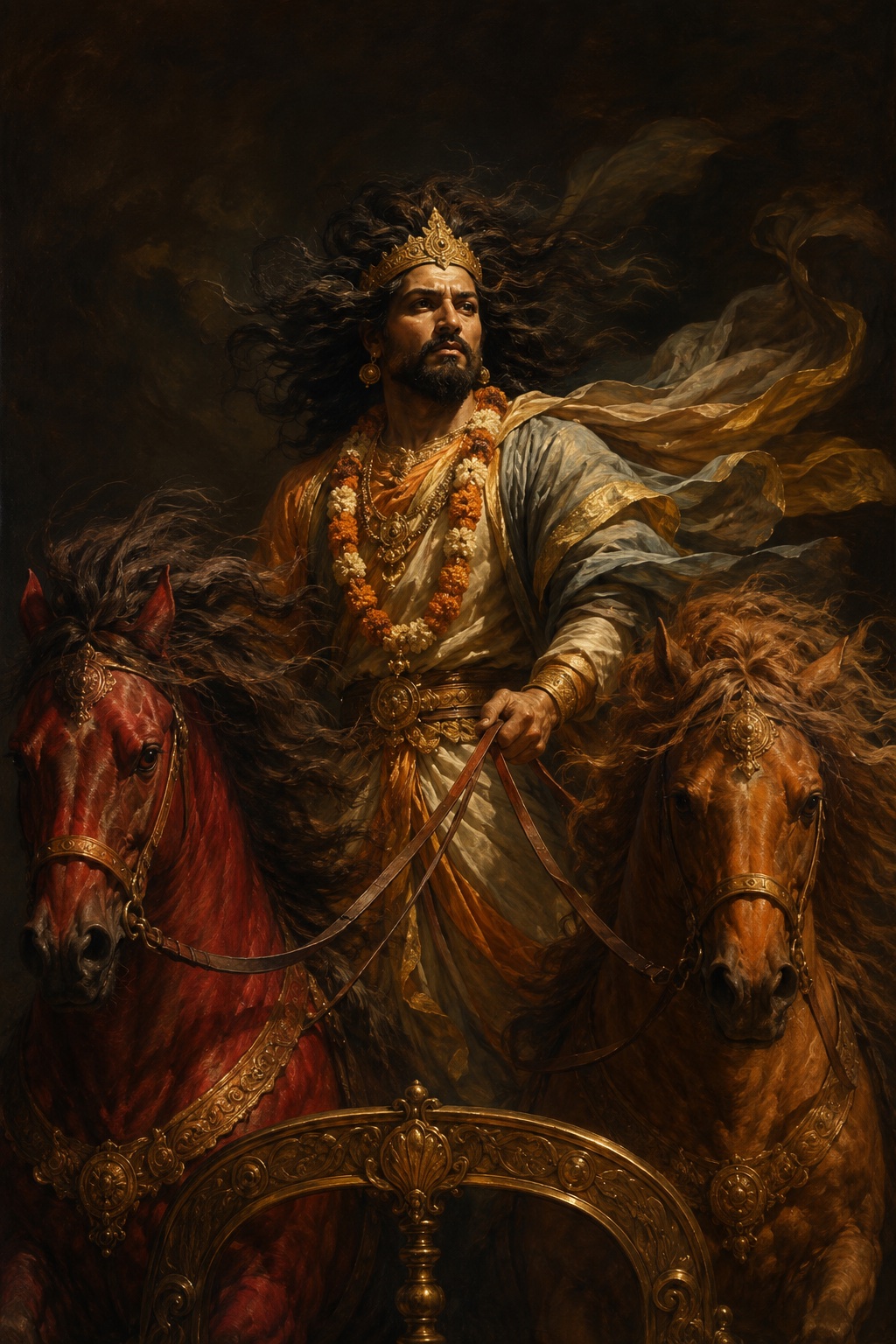
A promise on the mountain
Before Hanuman is born, Vayu already does the thing this entry is built on: he acts on his own account, without being asked. Wandering the hills the way wind does, he comes upon Anjana on a mountain crest and is overcome with desire for her; he takes her in his arms, and when she cries out, afraid for her marriage vow, he tells her plainly that he means her no harm — and what will come of the meeting instead. A son will be born to her, he promises, strong in body and clear in mind. Valmiki’s Ramayana makes this Vayu’s own word, spoken before the birth rather than a blessing added afterward: the child’s whole nature, fixed in advance by the god who fathers him.
वायुर्युङ्क्ते रोहिता — the chariot of the ruddy pair
The Rigveda’s hymns to Vayu mostly ask him to come — to descend, to drink the soma poured out for him, to hear the singer’s call. He is invited far more often than he is shown doing anything of his own. One verse of Hymn 1.134 breaks that pattern: between two stretches of invitation, the poet turns instead to describe the god already in motion, yoking his own team for the day’s crossing.
वायुर्युङ्क्ते रोहिता वायुररुणा वायू रथे अजिरा धुरि वोळ्हवे वहिष्ठा धुरि वोळ्हवे । प्र बोधया पुरंधिं जार आ ससतीमिव । प्र चक्षय रोदसी वासयोषसः श्रवसे वासयोषसः ॥३॥
“Two red steeds Vayu yokes, Vayu two purple steeds, swift-footed, to the chariot, to the pole to draw, most able, at the pole, to draw. Wake up intelligence, as when a lover wakes his sleeping love. Illumine heaven and earth, make thou the Dawns to shine, for glory make the Dawns to shine.” — Rigveda 1.134.3, tr. Ralph T. H. Griffith
रोहिता, red, names one half of the pair this entry’s one symbol is built on; sandhi welds the other color word straight onto the god’s own name two words later, वायुररुणा, “Vayu-ruddy.” Not a mount, not a weapon: a chariot team he yokes with his own hands, to wake the world’s intelligence and set the dawn alight. It is the closest any of the hymns addressed to him comes to showing him do something, rather than simply arrive.
न ववौ वै प्रभञ्जनः — the tempest that did not blow
The clearest instance of Vayu acting, rather than being invited, comes from a very different text. In the Ramayana, the old bear-king Jambavan tells the assembled vanaras how Hanuman came to be scarred and named. As an infant, mistaking the rising sun for ripe fruit, Hanuman leapt three hundred leagues to seize it; Indra struck the child down with the vajra and shattered his jaw — hanu, “jaw,” is where the name Hanuman comes from. Vayu is not asked for anything here. He simply sees his son struck down, and answers by refusing to move.
ततस्त्वां निहतं दृष्ट्वा वायुर्गन्धवहः स्वयम्। त्रैलोक्यं भृशसंक्रुद्धो न ववौ वै प्रभञ्जनः॥ २५॥ सम्भ्रान्ताश्च सुराः सर्वे त्रैलोक्ये क्षुभिते सति। प्रसादयन्ति संक्रुद्धं मारुतं भुवनेश्वराः॥ २६॥ प्रसादिते च पवने ब्रह्मा तुभ्यं वरं ददौ। अशस्त्रवध्यतां तात समरे सत्यविक्रम॥ २७॥
“The wandering Wind-God saw thee lie With bleeding cheek and drooping eye, And stirred to anger by thy woe Forbade each scented breeze to blow. The breath of all the worlds was stilled, And the sad Gods with terror filled Prayed to the Wind, to calm the ire And soothe the sorrow of the sire. His fiery wrath no longer glowed, And Brahmá’s self the boon bestowed That in the brunt of battle none Should slay with steel the Wind-God’s son.” — Ramayana, Kishkindhakanda 4.66.25–27, tr. Ralph T. H. Griffith
He stops, and that is the whole of his revenge. Vayu carries breath and scent and weather to all three worlds at once, and for as long as his anger lasts, he simply withholds it — no wind moves anywhere, for anyone, until the gods themselves come to make their peace with him. Appeased, he wins his son more than any blow could have: Brahma grants that no weapon of steel will ever kill him, and in the lines that follow, Indra himself swears never again to loose his bolt at Hanuman. A god who carries everything the world breathes chooses, once, simply not to — and every other god in the passage has to come and persuade him to start again.