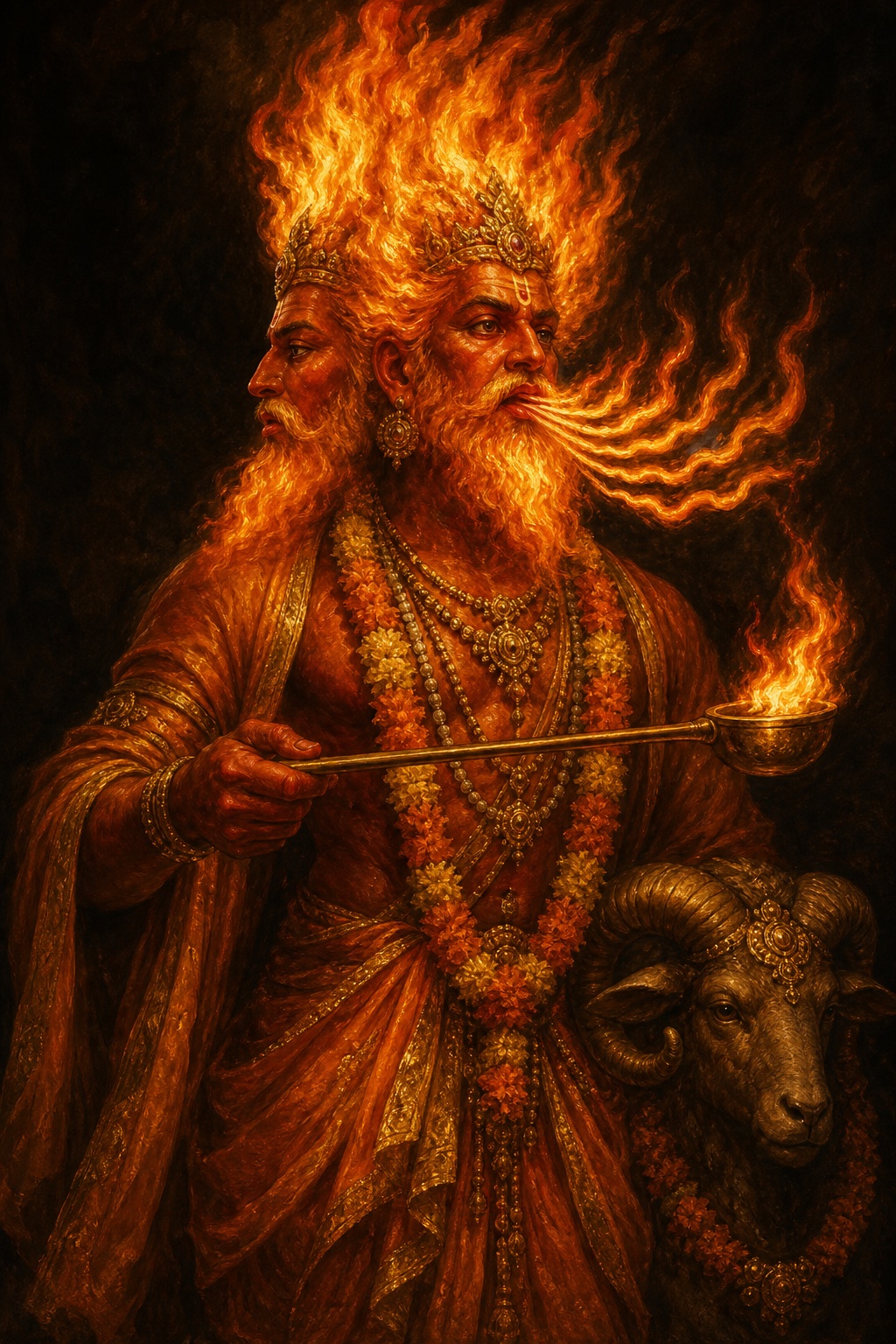
The first hymn of the Rigveda
The Rigveda opens with him. Of the more than a thousand hymns collected across its ten books, the very first is addressed to Agni, and it asks for exactly what a sacrifice needs: a priest who will officiate faithfully and carry the offering to where it has to go.
अग्निमीळे पुरोहितं यज्ञस्य देवमृत्विजम् । होतारं रत्नधातमम् ॥१॥ अग्निः पूर्वेभिरृषिभिरीड्यो नूतनैरुत । स देवाँ एह वक्षति ॥२॥
“I laud Agni, the chosen Priest, God, minister of sacrifice, The Hotar, lavishest of wealth. Worthy is Agni to be praised by living as by ancient seers: He shall bring hitherward the Gods.” — Rigveda 1.1.1–2, tr. Ralph T. H. Griffith
Both verses do the same job from two directions. The first names him — priest, minister, Hotar — a set of ritual offices, not a genealogy or a description of flame. The second states his function outright: “he shall bring hitherward the Gods.” That clause is the hinge the rest of the hymn, and much of what Agni does elsewhere in the tradition, turns on. Agni does not merely burn; he fetches. A collection of hymns that opens by sending the fire to go get the gods has already told its readers what the fire is for.
The mouth that carries the offering
Vedic sacrifice runs on a problem of logistics: the gods live somewhere the offering cannot walk to, and something has to make the crossing. Agni is that something. Ghee, grain, and soma go into the fire and leave it as smoke, understood as the offering in its traveling form, rising toward whichever god the hymn names. Later ritual and iconography give the fire a body to match the job: a ram to carry him, seven tongues of flame to take in the oblation from every side at once, a ladle in his hand for the butter that feeds him. None of it is decoration — every attribute names a stage of the same transaction, fire standing in the middle of it, taking in on one side and delivering on the other.
That double motion, carrying the offering up and calling the gods down, is why “priest” undersells him. A human priest recites and pours; Agni is also the road the words and the butter travel on. He is invoked first in nearly every Vedic rite for exactly that reason — nothing else reaches the gods until he does.
Guardian of law eternal
The same hymn that opens the Rigveda also names what Agni protects. Later in RV 1.1, Griffith renders him “Ruler of sacrifices, guard of Law eternal” — Law eternal being ṛta, the cosmic order the Vedic gods uphold rather than invent. Fire earns the title by never breaking its own rule: correctly kindled and correctly fed, it burns the same way every time, which is exactly the reliability a rite depends on to work at all.
The same steadiness extends to the household. Every hearth fire is, in miniature, the fire the Rigveda addresses — kept alight, watched over, treated as a guest who has to be looked after rather than merely used. Agni’s guardianship runs in both directions: he protects the order the gods maintain, and he is the one possession every household is trusted to protect in turn.
The seed he could not hold
Agni’s usefulness as a carrier has one memorable failure. When the gods need Shiva’s seed conveyed somewhere it can safely grow into the child who will kill the demon Taraka, Agni is again the one sent to fetch and deliver — but this time the substance is too potent for him. He takes it up and cannot hold it, and passes it to the river-goddess Ganga, who releases it into her own current; only then does it come to rest, in a thicket of reeds on the Himalaya, where it becomes Kartikeya. The episode survives only in Sanskrit — the Ramayana’s Victorian English translators left this canto out as unsuited to the taste of their day, so it remains untranslated even now — but its shape is consistent with everything else Agni does. He is always the vessel in transit, never the source and never quite the destination, and this is the one time in the tradition the vessel comes close to overflowing.