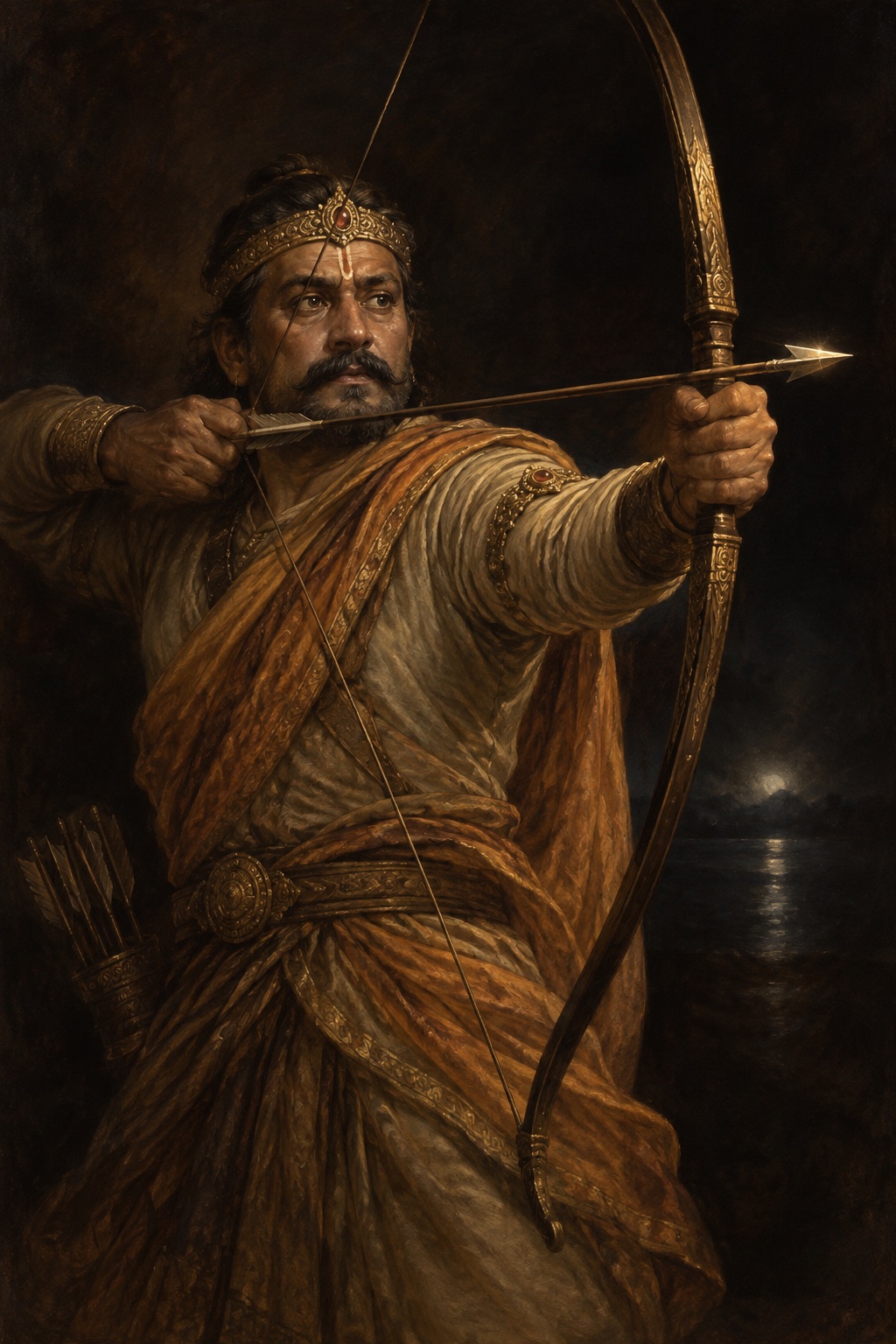
The archer who shot at a sound
Dasharatha is the king of Ayodhya, the husband of Kausalya, Kaikeyi and Sumitra, and the father of Rama, Lakshmana, Bharata and Shatrughna. The story he is remembered for is one he tells himself, late, to a single listener. It is the sixth night after Rama has gone to the forest. The king wakes at midnight, remembers an old crime, and calls to Kausalya, who is still grieving for her son. He begins with a parable rather than a confession: a man cuts down his mango grove and waters the palasa trees for their flowers, and grieves when the season for fruit comes round. The Sanskrit says outright who the mango grove is. He has abandoned Rama just as the fruit was coming, and he grieves for it afterward, a fool.
Then the crime. He was young then, the crown prince, not yet married to Kausalya, and proud of a skill he had a name for: he could hit what he could only hear. In the rains he took his bow and drove his chariot along the bank of the Sarayu at night, a man, in his own words, who had not mastered his senses, hoping to kill an elephant, or a buffalo come down to drink, or some other beast at the water’s edge.
अथ अन्ध कारे तु अश्रौषम् जले कुम्भस्य पर्यतः ॥२-६३-२४॥ अचक्षुर् विषये घोषम् वारणस्य इव नर्दतः । ततः अहम् शरम् उद्धृत्य दीप्तम् आशी विष उपमम् ॥२-६३-२५॥
“When all around was dark and still, I heard a pitcher slowly fill, And thought, obscured in deepest shade, An elephant the sound had made. I drew a shaft that glittered bright, Fell as a serpent’s venomed bite;” — Valmiki, Ramayana 2.63.24–25, tr. Griffith
The verse is built on hearing. Its verb is अश्रौषम्, I heard, and अचक्षुर् विषये puts the whole event outside the range of the eyes. What he heard was a jar, कुम्भस्य, filling in the river, and what he took it for was an elephant, वारणस्य इव नर्दतः, a sound like an elephant’s bellow. Nothing in the verse is seen. The only bright thing in it is the arrow, दीप्तम्, blazing, and आशी विष उपमम्, like a venomous snake, and Griffith’s “glittered bright” and “serpent’s venomed bite” keep both. The skill he was proud of is exactly the skill the verse describes: to aim at something that the dark hides. In the next verse he turns toward the sound and lets the arrow go. The verse after that is what came back.
तत्र वाग् उषसि व्यक्ता प्रादुर् आसीद् वन ओकसः । हा हा इति पततः तोये बाणाभिहतमर्मणः ॥२-६३-२७॥
“Then in the calm of morning, clear A hermit’s wailing smote my ear: ‘Ah me, ah me,’ he cried, and sank, Pierced by my arrow, on the bank.” — Valmiki, Ramayana 2.63.27, tr. Griffith
हा हा इति: the cry comes first, before the verse knows who is crying. वन ओकसः, a forest-dweller, is all it can say of him, and बाणाभिहतमर्मणः gives the wound before the name, a vital place struck by the arrow. Dasharatha throws down his bow and runs to the place. He finds a young ascetic with matted hair, dressed in skin and bark, his water jar empty on the ground. The boy asks what wrong he has done. He came by night to fill the jar for his father and mother, who are old and blind and are waiting for him, thirsty, and the one arrow, he says, kills all three of them. He tells the king to take a little path to his father’s hut and ask for pardon before the old man’s anger burns him, and he asks him to pull out the arrow. Dasharatha is afraid to, because the shaft is all that keeps the boy alive. The boy sees what he is thinking and lifts one fear from him: he is not twice-born, since his father was a Vaisya and his mother a Sudra, so the king has not killed a Brahmin. Then Dasharatha draws the arrow, and the boy dies. In all of this the boy is never named. He is the hermit’s son, the boy, and his parents’ only son.
The father’s curse
Dasharatha fills the jar at the river himself and follows the boy’s path to the hut. The parents sit side by side, old and blind, talking about their son and when he will come back. The father hears footsteps and scolds him for the delay: his mother is thirsty and crying, and he is the eyes of two people who have none. Dasharatha has to tell him who has really come. He names himself, a warrior called Dasharatha, and tells him what happened: a sound from the stream as if a jar were stirring the water, an elephant, he thought, and an arrow. Then he asks for pardon. The old man’s first answer is a verdict, not a pardon. If the king had not told the story with his own tongue, his head would have burst into a thousand pieces, and a warrior who killed a hermit on purpose would bring down even the king of the gods. He lives, and the line of Raghu with him, only because his hand did not know what it was doing.
Then the old man asks to be taken to the body. He and his wife lay their hands on it, and the father talks to the dead boy as if he were only sulking. He asks who will recite scripture to him in the evenings now, and who will bring the berries and roots that feed a blind old couple. He promises that he and the mother will follow the boy to Yama’s realm the next day. The boy’s spirit rises in a heavenly form, tells his parents that they will soon join him in the home his care for them has earned, and goes up in a bright chariot with Indra beside him. The parents pour the funeral water. Then the father turns to the king, who stands in front of him with joined hands.
अद्य एव जहि माम् राजन् मरणे न अस्ति मे व्यथा । यत् शरेण एक पुत्रम् माम् त्वम् अकार्षीर् अपुत्रकम् ॥२-६४-५३॥
“Slay me this day, O, slay me, King, For death no longer has a sting. Childless am I: thy dart has done To death my dear, my only son.” — Valmiki, Ramayana 2.64.53, tr. Griffith
मरणे न अस्ति मे व्यथा: in death there is no pain for me. The old man asks the killer to finish the work, and he gives the reason in the second line. यत् शरेण एक पुत्रम् माम् त्वम् अकार्षीर् अपुत्रकम्: because with an arrow you have made me, who had one son, sonless. एक पुत्रम् and अपुत्रकम् sit in the same half-line, the same man before a single shot and after it. In the next verse he lays his curse on the king. What the curse is comes in half a line.
एवम् त्वम् पुत्र शोकेन राजन् कालम् करिष्यसि ॥२-६४-५५॥
“Bereft and suffering e’en as I, So shalt thou mourn thy son, and die.” — Valmiki, Ramayana 2.64.55, tr. Griffith
एवम्, thus, makes the father himself the pattern: the king will grieve, and die of it, the way this father grieves now. पुत्र शोकेन, through grief for a son, is the means, and कालम् करिष्यसि, literally you will make your time, is the Sanskrit idiom for dying. The curse does not say which son, or when. The father answers the second question himself. Because the king’s hand struck without knowing, the time when he must suffer for it is far away. But it will come, the way a debt comes due in later days. Then the two old people lay themselves on the pyre and pass to heaven, and Dasharatha goes home with the curse.
Two boons, and the debt paid
The curse falls through a promise, not through an arrow. Dasharatha once granted Kaikeyi, the junior of his queens, two boons, and on the eve of Rama’s consecration she calls them in: the throne for her own son Bharata, and fourteen years of forest exile for Rama. At the opening of the thirteenth sarga the king lies on the ground like Yayati fallen from heaven with his merit spent, and Kaikeyi reminds him that he has always boasted of loving the truth and keeping his word. He answers her with his own history.
अपुत्रेण मया पुत्रः श्रमेण महता महान्। रामो लब्धो महातेजाः स कथं त्यज्यते मया॥ ८॥ शूरश्च कृतविद्यश्च जितक्रोधः क्षमापरः। कथं कमलपत्राक्षो मया रामो विवास्यते॥ ९॥
“Childless so long, at length I won, With mighty toil, from Heaven a son, Ráma, the mighty-armed; and how Shall I desert my darling now? A scholar wise, a hero bold, Of patient mood, with wrath controlled, How can I bid my Ráma fly, My darling of the lotus eye?” — Valmiki, Ramayana 2.13.8–9, tr. Griffith
अपुत्रेण मया पुत्रः: by me, a sonless man, a son. The first thing he says about Rama is that he was once without him, and that he won him श्रमेण महता, with great toil. The rest is a list of what that son is, brave and learned, master of his anger and given to patience, and it closes on the question it opened with: कथं कमलपत्राक्षो मया रामो विवास्यते, how is lotus-eyed Rama to be exiled by me? It is the hermit’s word. अपुत्र, sonless, is what Dasharatha was before Rama, and अपुत्रकम् is what his arrow made the hermit. When the curse was laid he was not yet married to Kausalya and had no son, and a curse of grief for a son needs a son to fall on. In the order of the book the king’s word comes first, at 2.13.8, and the hermit’s only at 2.64.53, so the reader hears the sonless king plead for his son fifty-one sargas before learning what he once did to another father.
The verses do not move Kaikeyi. Night falls, and the king tells the night that he does not want the morning, then asks it to pass more quickly instead, because he cannot bear to see Kaikeyi’s face any longer. He pleads again, and asks her to let Rama rule and win a name that will never die. She does not answer, and she still claims Rama’s banishment, and he falls senseless on the ground again. Rama goes without arguing, because his father’s word has been given. The son Dasharatha grieves for is not dead. He is alive in the forest, sent there by his father’s own promise, and the curse needs no more than that: पुत्र शोकेन, grief for a son.
On the sixth night, when he has told Kausalya the whole story, the king says that the deed has borne its fruit and that it hangs ripe on the bough now, which closes the parable of the mango grove he began with. The hermit’s words have come back to him, that he would grieve for a dear son and lose his life of it. Then his sight goes. He tells Kausalya that he cannot see her and asks her to put her hand in his, and says that if Rama touched him so, he would live. He admits that he has been unjust to Rama and that Rama has only been himself. Gods, not men, he says, will see Rama’s face when the fourteen years are over and he comes home. His senses fail one by one, like a torch as the oil runs out. His last words call on Rama, on Kausalya, whom he cannot see, on Sumitra, and on Kaikeyi as his bitter enemy. Kausalya and Sumitra keep watch beside him, and he dies grieving for his son.
The pattern is exact, and it is built out of the senses. The young prince was proud that he could hit what he could not see. The boy he killed was the only son of two people who could not see, and the father had called the boy their eyes. The blind parents laid their hands on their son’s body before they went to the pyre, and the old king dies unable to see his wife, asking for her hand and for the touch of a son who is not there. The curse was put off because the hand that struck did not know what it did. It was fulfilled through a promise that he made knowingly and kept against his own will.