She who breaks the hills
In the Rigveda, Saraswati is first of all a river, and one of the few Vedic deities whose hymns describe her doing something rather than simply ruling or receiving praise. Hymn 6.61 praises her as a physical force in motion — water that carves stone.
इयं शुष्मेभिर्बिसखा इवारुजत्सानु गिरीणां तविषेभिरूर्मिभिः । पारावतघ्नीमवसे सुवृक्तिभिः सरस्वतीमा विवासेम धीतिभिः ॥२॥
“She with her might, like one who digs for lotus-stems, hath burst with her strong waves the ridges of the hills. Let us invite with songs and holy hymns for help Sarasvati who slayeth the Paravatas” — Rigveda 6.61.2, tr. Ralph T. H. Griffith
A different hymn, 2.41, goes further still and calls her outright the finest of rivers, of mothers, and of goddesses — the single line for which she is now best remembered, though it belongs to that hymn and not to this one. What neither hymn gives her is a body. The Saraswati of the Rigveda has no robe, no ornament, no object held in a hand; she is current and flood and wave, a name given to a real, named watercourse of the northwest, not yet a figure a sculptor could carve.
Vac and Saraswati: two goddesses, one name
The Rigveda also knows a goddess of speech in her own right: Vac, who in her own hymn declares herself the power that carries the gods, upholds the sacrifice, and speaks through the mouths of poets. Vac and Saraswati begin as distinct figures — nothing in the hymns addressed to the river speaks of eloquence, utterance, or the power of the spoken word, and nothing in the hymn to Vac names her a river. The closest the Rigveda comes to bridging them is a single further verse to Saraswati that calls her a guardian of sacred thought, prayer and hymn kept safe, not speech personified. Only in the Brahmanas and the Puranas that follow does Vac’s identity fold into Saraswati’s, and the fusion holds: it is the merged goddess, mistress of both river and word, whom later Hinduism worships as patron of learning.
Consort of Brahma, goddess of learning
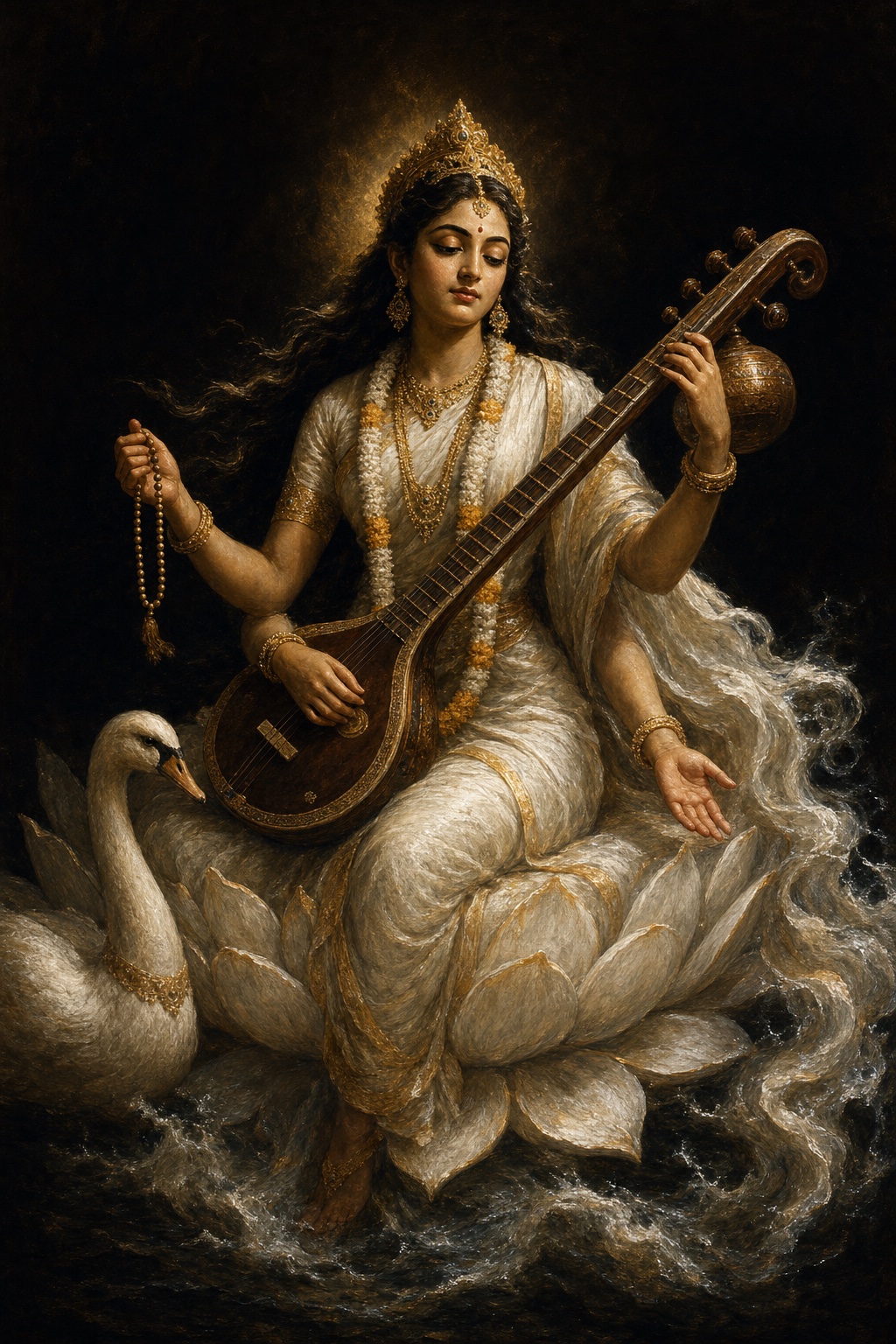
That later goddess looks nothing like the river of the Rigveda. Puranic and classical tradition dresses her in a white or pale-gold robe, seats her on a lotus, and gives her a vina resting against one shoulder, a strand of prayer beads, and a palm-leaf manuscript standing for the Vedic learning she now presides over; a white hamsa, a swan or goose, carries her, or waits at her side. She is named consort to Brahma, the creator, sharing his mount and his association with the Vedas — a pairing this corpus’s own account of Brahma already records. None of this belongs to the Rigveda; it is the iconography later centuries built around a name that had once meant only a river.
Names across traditions
As devotion to Saraswati spread beyond the subcontinent, Buddhist tradition carried her east and gave her new names along the way. In Japan she became Benzaiten, goddess of music, eloquence and fortune; in Chinese Buddhist usage her name is not a transliteration of Saraswati at all but a translated title built from the words for eloquence and talent, the same naming pattern already used in this corpus for Lakshmi, whose Chinese name likewise translates rather than transliterates. The figure underneath stays the one the Rigveda and the Puranas together describe, a river that became a goddess of speech; only the language of her name changes.