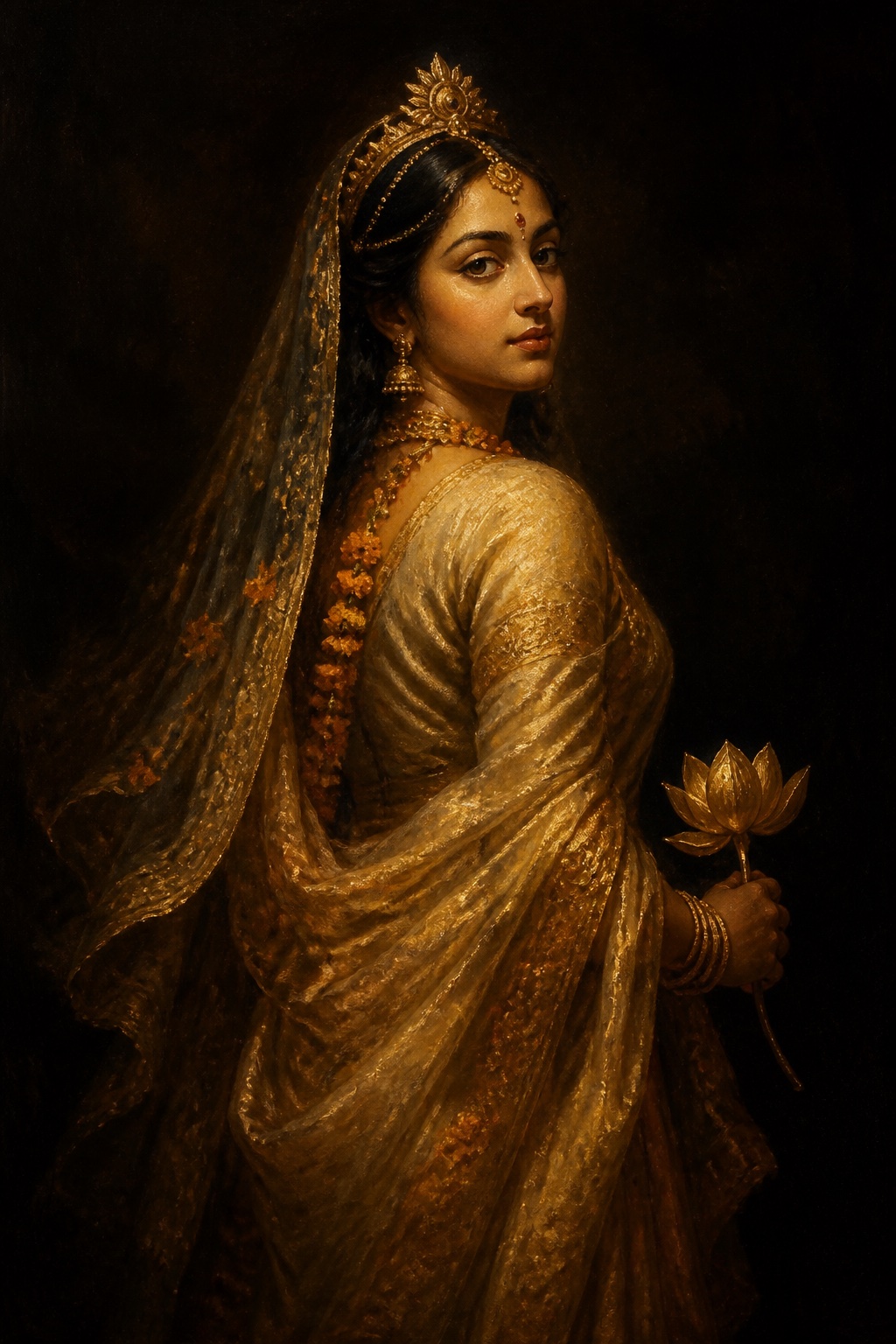
Two verses, and everything happens in them
The Rigveda gives Saranyu two verses at the head of hymn 10.17, and nothing anywhere else. In that space her father marries her off, the whole world assembles to watch, she disappears on the way to her husband’s house, someone builds a copy of her and hands it over, she bears the Ashvins, and she abandons two pairs of children. The hymn does not pause for any of it.
त्वष्टा दुहित्रे वहतुं कृणोतीतीदं विश्वं भुवनं समेति । यमस्य माता पर्युह्यमाना महो जाया विवस्वतो ननाश ॥१॥ अपागूहन्नमृतां मर्त्येभ्यः कृत्वी सवर्णामददुर्विवस्वते । उताश्विनावभरद्यत्तदासीदजहादु द्वा मिथुना सरण्यूः ॥२॥
“TVASTAR prepares the bridal of his Daughter: all the world hears the tidings and assembles. But Yama’s Mother, Spouse of great Vivasvan, vanished as she was carried to her dwelling. From mortal men they hid the Immortal Lady, made one like her and gave her to Vivasvan. Saranyu brought to him the Asvin brothers, and then deserted both twinned pairs of children.” — Rigveda 10.17.1–2, tr. Ralph T. H. Griffith
Her name is the last word of the second verse. Until it arrives she is three relationships and no person: Tvashtar’s daughter, Yama’s mother, Vivasvat’s wife. The verse that finally names her is the one in which she leaves.
Vanished on the way
The verb is ननाश, vanished — and its grammar matters, because Griffith’s English keeps it. She vanishes पर्युह्यमाना, while being carried: not before the wedding and not after arriving, but in transit, in the middle of the procession the first half of the verse has just filled the world for. The hymn assigns no cause, names no pursuer, and offers no place she went to. It reports a disappearance the way a witness would, from the outside.
What follows is stranger still, and the hymn is equally terse about it: अपागूहन्, they hid her — an unnamed plural, hiding अमृताम्, the immortal one, from mortals. Whether she vanished or was concealed is a distinction the two clauses do not make. Both are in the passive or the impersonal; nobody is held responsible in either.
A copy handed over in her place
Then the substitution, in four words: कृत्वी सवर्णाम् अददुः विवस्वते — having made one of matching appearance, they gave her to Vivasvat. सवर्णा is built on वर्ण, form or colour, and that is the whole of the description. The copy is never named, never speaks, and is never mentioned again in the hymn; later commentary would give her a name and a history, but the Rigveda closes the subject in half a line.
The corpus’s entry on Vivasvat reads this from his side: a bridegroom handed something other than what he was promised, and not told. From Saranyu’s side it is the opposite problem. Nothing in the verse says she consented to the copy, or made it, or knew of it. She is hidden, and a substitute is delivered — and yet the very next clause has her acting again, in her own name.
The subject of every verb
Whatever the compression is hiding, the grammar is unambiguous about who does things in these two verses. Saranyu vanishes. Saranyu is hidden. Saranyu अभरत्, bore, the Ashvins to him. Saranyu अजहात्, deserted, both twinned pairs. Vivasvat receives a wife, receives a substitute, receives sons; Tvashtar arranges; the unnamed plural hides and gives. Only Saranyu acts, and both of her acts are departures.
The two pairs she leaves are the ones this corpus records: Yama and Yami, twins, and the Ashvins, twins. Four children, in two pairs, left together — and that is the last the hymn has to say about her. The rest of hymn 10.17 turns to Pushan and the funeral road, and Saranyu, having been married, hidden, copied and gone, does not return to it.