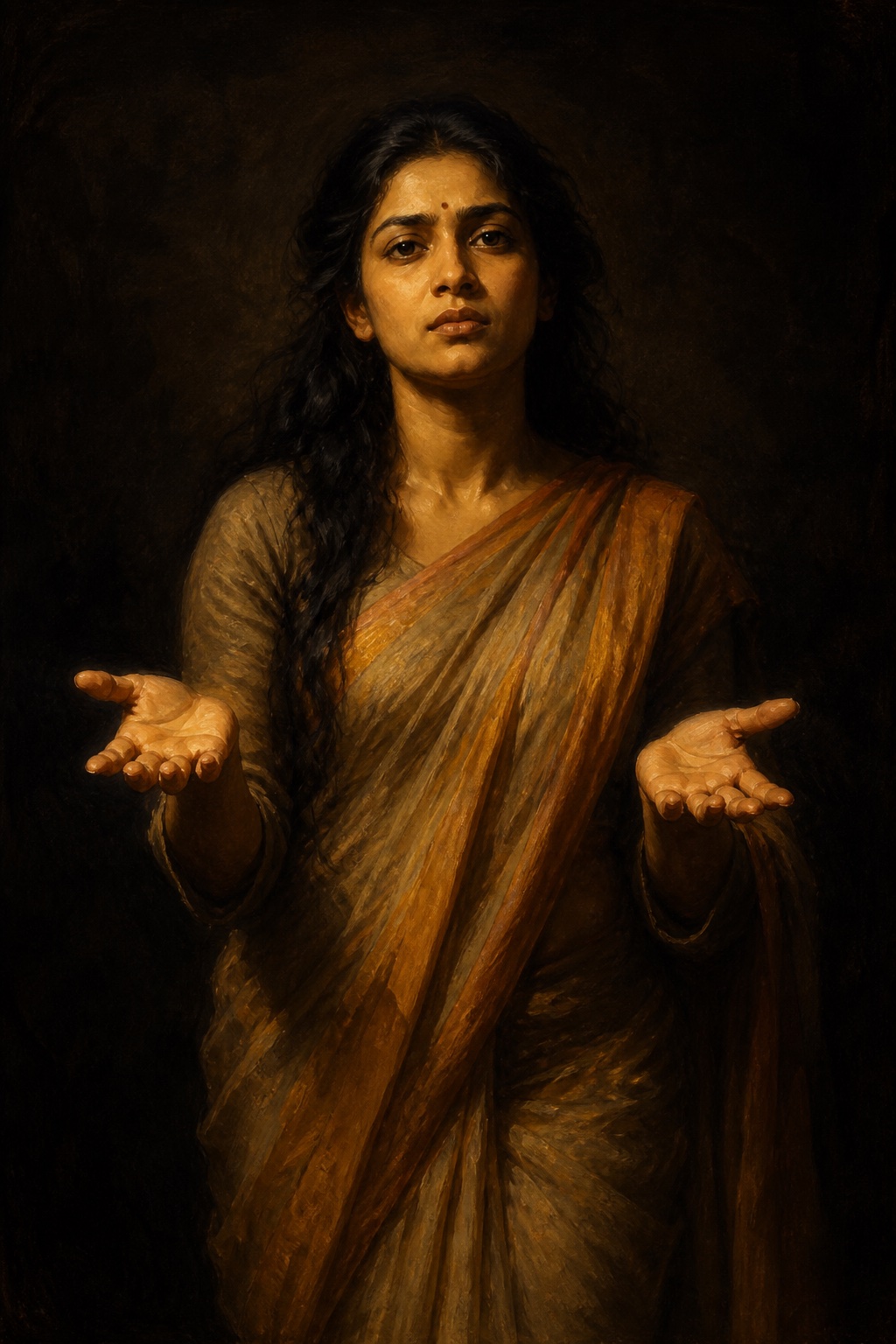
Known only by her own words
Rigveda 10.10 is spoken by no one but two people, and the sung verses never once step aside to say which of them is speaking or what either looks like. It falls instead to the hymn’s own traditional index — a header of authorship and address printed at the top of the page, not sung — to settle the division. It calls Yami ऋषिका, the speaking seer, of seven of the hymn’s fourteen verses, and marks her दे. — its own abbreviation for देवता, the deity addressed — of Yama’s other seven, the identical office the same header gives Yama over hers. The same header names her वैवस्वती, Vaivasvatī, Vivasvat’s daughter, the feminine counterpart of the वैवस्वतः, Vaivasvata, it gives Yama — confirming, on the tradition’s own terms, that the two share one father. Within the sung verses themselves nothing describes her face, her dress, or anything she owns. What the hymn preserves of Yami is entirely what she says: a proposal, an argument pressed after two refusals, and, after a third refusal, a reply.
A proposal in the words of a bride
She speaks first, and she speaks in the vocabulary of marriage rather than kinship.
यमस्य मा यम्यं काम आगन्समाने योनौ सहशेय्याय । जायेव पत्ये तन्वं रिरिच्यां वि चिद्वृहेव रथ्येव चक्रा ॥७॥
I, Yami, am possessed by love of Yama, that I may rest on the same couch beside him. I as a wife would yield me to my husband. Like car-wheels let us speed to meet each other. — Rigveda 10.10.7, tr. Ralph T. H. Griffith
काम, kāma — love, desire — is the force she names as acting on her, and जायेव पत्ये, as a wife to a husband, is the office she offers to take up, not one she already holds. Her own image for the meeting she wants is a pair of car-wheels racing to close the distance between them, a simile of speed and symmetry rather than of family. Yama will later fling the same image back at her when he sends her toward someone else instead, but here it belongs to her alone.
Pressed after two refusals
Yama says no twice, and each time Yami answers not with more of the same appeal but with a sharper kind of argument. By verse 11 she has stopped asking to be his wife and started arguing that the very word “sister” has nothing left to stand on.
किं भ्रातासद्यदनाथं भवाति किमु स्वसा यन्निरृतिर्निगच्छात् । काममूता बह्वेतद्रपामि तन्वा मे तन्वं सं पिपृग्धि ॥११॥
Is he a brother when no lord is left her? Is she a sister when Destruction cometh? Forced by my love these many words I utter. Come near, and hold me in thy close embraces. — Rigveda 10.10.11, tr. Ralph T. H. Griffith
Her two questions work as a pair. Brother and sister are words that presuppose a wider world of other kin and other protectors still standing; take that world away, leave only the two of them at the edge of everything, and the terms that named their bond stop meaning anything at all. काममूता, “forced by my love,” is her own account of why she keeps speaking after two refusals — not persuasion for its own sake, but words driven out of her by the same काम that named her in verse 7. It is the only force the hymn ever credits her with, and the only domain this entry gives her.
Nothing left to describe
Yama refuses her a third time after this, and Yami answers him again — the hymn’s own index still credits that reply to her, the same as the rest of her seven verses. What that refusal says, and what it costs Yama to say it, belongs to his own entry in this corpus; it is his refusal, not her portrait. Across the whole hymn, in fact, nothing is ever added to Yami beyond what she has already said herself. The same text that spends three separate verses describing Yama’s two dogs — four eyes apiece, dark hides, flared nostrils — never turns that attention on her at all. She is proposal, then argument, then reply: a voice the tradition names devatā of seven verses, and, within the sung text itself, nothing more.