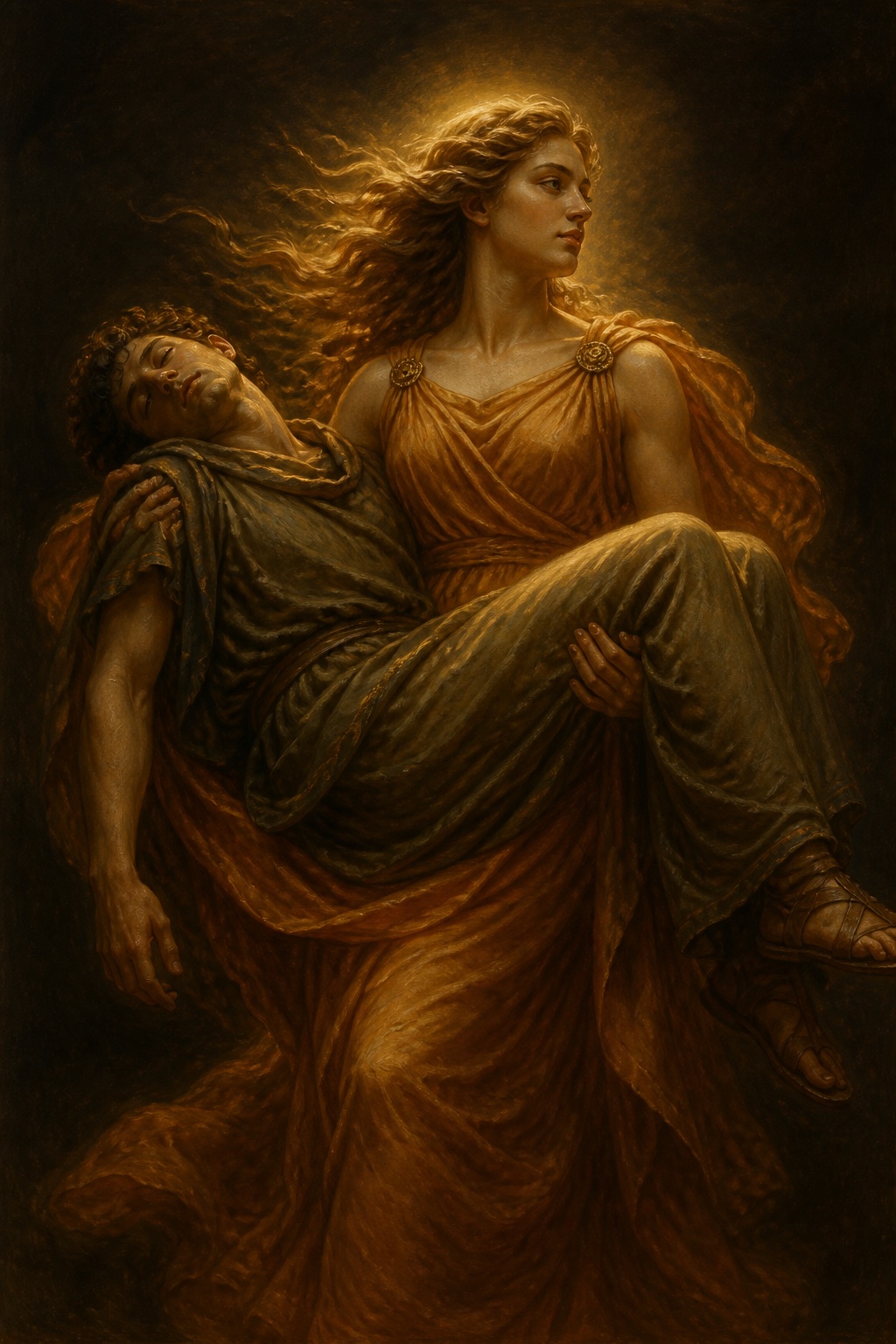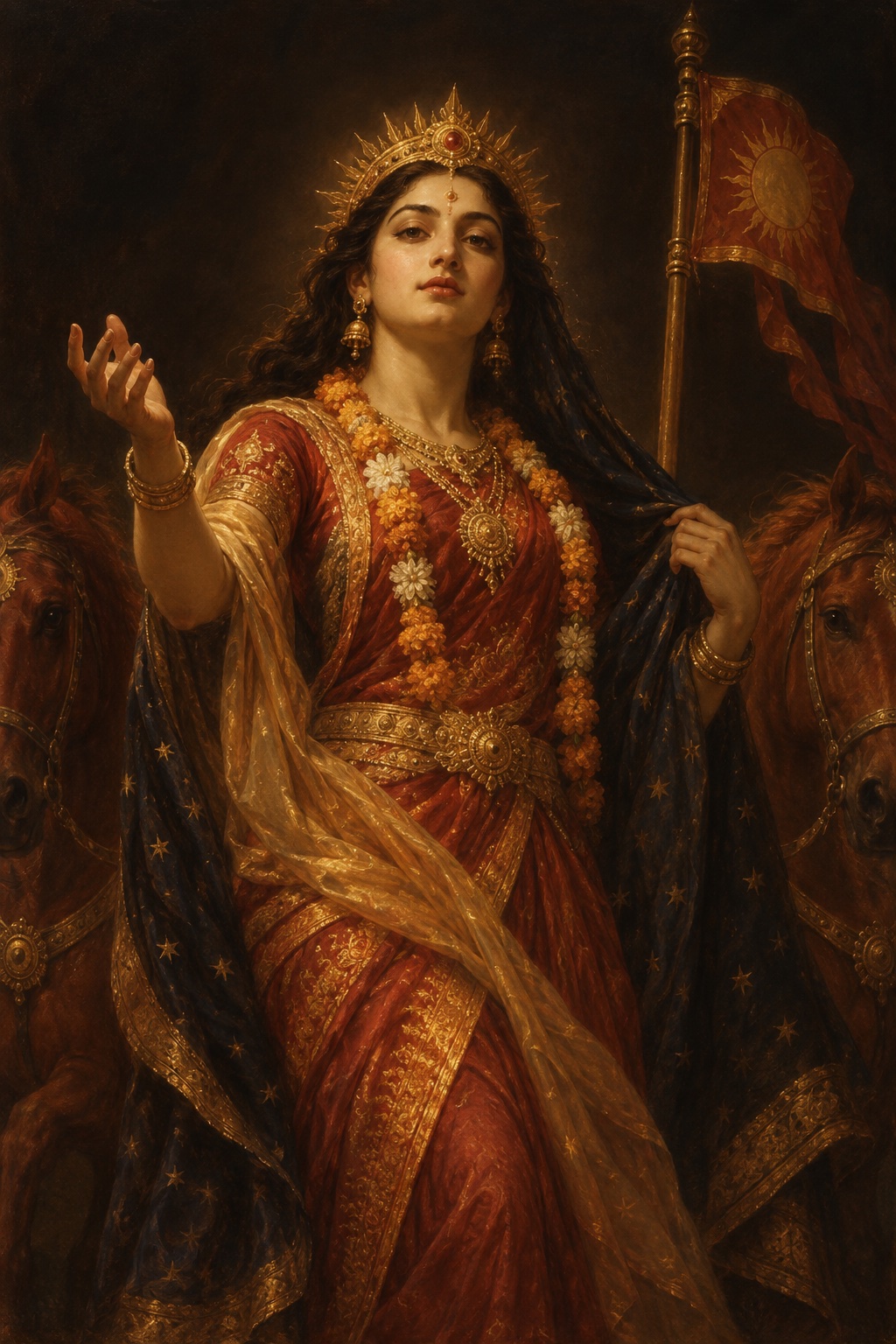
The dancer’s garments, and the stall thrown open
Rigveda 1.92 belongs to Ushas — Uṣas in scholarly transliteration — and the traditional header printed above the Sanskrit text says so outright, naming her the deity of the hymn and handing only its last three verses to the Ashvins. Its fourth verse is the goddess in the act of being herself, and it is built out of four things she does, one after another.
अधि पेशांसि वपते नृतूरिवापोर्णुते वक्ष उस्रेव बर्जहम् । ज्योतिर्विश्वस्मै भुवनाय कृण्वती गावो न व्रजं व्युषा आवर्तमः ॥४॥
“She, like a dancer, puts her broidered garments on: as a cow yields her udder so she bares her breast. Creating light for all the world of life, the Dawn hath laid the darkness open as the cows their stall.” — Rigveda 1.92.4, tr. Ralph T. H. Griffith
She dresses first. पेशांसि are embroidered or figured things, the ornament worked into cloth, and the comparison the poet reaches for is a dancer putting on a costume — not a queen robing, not a bride, but a performer dressing for the piece she is about to give. Then, in the same breath, she uncovers: the second clause undoes the first, and the image for it is a cow letting down her udder, which is a Vedic poet’s way of saying that what she reveals is food and not spectacle. Only after those two gestures does the verse mention light at all, and it puts it in the widest possible terms — made for the whole world of living things, not for any worshipper in particular.
The last clause is the one that turns the verse around. What she opens is the darkness. The night is the byre and the day is what walks out of it, so the dark is not something she destroys or drives off but something she unlatches, and it stays there behind the cattle the way a stall stays standing behind a herd. This is the same move the hymns make elsewhere with her clothing: at 1.113.14 “the Goddess hath thrown off the veil of darkness”, a black garment discarded rather than an absence of light, and at 1.113.4 “she hath unclosed the portals”. Every one of these is a door or a wrapping, and the dawn is what happens when it is opened, never what happens when it is made.
The self-same raiment, and what it costs
Between that verse and this one the hymn puts the waking. Verse 9 has her bend her looks on all the world and shine westward with her bright eye, waking to motion every living creature and understanding “the voice of each adorer” — the light comes out of her face, and what comes back to her is speech. Six verses after she dressed, the hymn returns to the garment and settles the account.
पुनःपुनर्जायमाना पुराणी समानं वर्णमभि शुम्भमाना । श्वघ्नीव कृत्नुर्विज आमिनाना मर्तस्य देवी जरयन्त्यायुः ॥१०॥
“Ancient of days, again again born newly, decking her beauty with the self-same raiment. The Goddess wastes away the life of mortals, like a skilled hunter cutting birds in pieces.” — Rigveda 1.92.10, tr. Ralph T. H. Griffith
समानं वर्णमभि शुम्भमाना answers अधि पेशांसि वपते across six verses of the same hymn. In verse 4 the dressing is an event, a performer putting on her costume for the piece she is about to give; here it is the same costume, every morning, worn by someone who was doing it before there was anyone to watch. पुनःपुनर्जायमाना पुराणी holds both halves in one line — born again and again, and ancient — and the hymn makes no attempt to soften the contradiction. Whatever is new at dawn, it is not the dress.
The second half of the verse is what the first section’s four gestures were leading to. The hymn does not simply call her undying. It makes her undying at somebody’s expense, and it says whose. She wears the life of mortals away, and the image it reaches for is a skilled hunter cutting birds in pieces — not a hunt but the work after one, a practised man dividing a catch already taken, unhurried and good at it. There is no malice anywhere in the verse. The morning that renews her is subtracted from the sleeper she has just set on his feet, because a morning is both of those things at once. Her own side of the arithmetic is stated without the cost at 1.113.13, where she “moves on in her own strength, undecaying”; verse 10 is that same permanence with the bill attached.
Every sleeper, and a different errand for each
Rigveda 1.113 is the hymn she shares with Ratri, and it is where the waking is itemized rather than announced. Its fifth verse sets “the coiled-up sleeper” on his feet and immediately begins to divide him up — “one for enjoyment, one for wealth or worship” — and its sixth verse finishes the division.
क्षत्राय त्वं श्रवसे त्वं महीया इष्टये त्वमर्थमिव त्वमित्यै । विसदृशा जीविताभिप्रचक्ष उषा अजीगर्भुवनानि विश्वा ॥६॥
“One to high sway, one to exalted glory, one to pursue his gain, and one his labour: All to regard their different vocations, all moving creatures hath the Dawn awakened.” — Rigveda 1.113.6, tr. Ralph T. H. Griffith
The verse is a list, and the list is the argument. She does not wake the world as a mass and leave it to sort itself out. Four men get four incompatible mornings — power, reputation, profit, labour — and nothing in the verse ranks them or suggests that any of them chose. The clause standing behind Griffith’s “different vocations” is विसदृशा जीविता, lives unlike one another, and the hymn puts that unlikeness on her side of the ledger: verses 5 and 6 both close on the same refrain, that the Dawn has woken every creature there is, so the sorting and the waking are one act. Sunrise is general; what it starts is not.
The hymn is explicit that this is office work and not kindness. She is “born of Law, the Law’s protectress” at 1.113.12, and the sorting reads accordingly — a roll called, each name sent where it belongs. The line that gives the practice its edge comes at 1.113.8: “Dawn, at her rising, urges forth the living him who is dead she wakes not from his slumber”. The one man she passes over is the one whose days she has finished spending. To be woken at all is to be still on her list.
Mother of the gods, or the face Aditi turns
Late in that hymn a single line addresses where she comes from. It can be read two ways, and the Rigveda does not choose between them.
माता देवानामदितेरनीकं यज्ञस्य केतुर्बृहती वि भाहि
“Mother of Gods, Aditi’s form of glory, ensign of sacrifice, shine forth exalted.” — Rigveda 1.113.19, tr. Ralph T. H. Griffith
Taken as two epithets laid side by side, the line makes her the mother of the gods and, separately, the splendour of Aditi. Taken as one claim carried across the phrase, it says nearly the opposite: that she is not a mother at all but the aspect Aditi turns outward, the visible front of an older goddess who does the actual bearing. The word Griffith renders “form of glory” here is the word he renders “presence” at Rigveda 1.115.1, of the risen sun — a face, the outward side of something — and the two lines are built the same way, देवानामदितेरनीकं against देवानामुदगादनीकं. Whether that face belongs to her or to somebody else is exactly what the grammar leaves open.
Aditi has her own entry in this wiki, and its list of children does not include Ushas. Both readings survive that, and neither is comfortable: if the dawn is Aditi’s face, the older goddess’s family has no place to record her; if she is herself the mother of the gods, the line sets her beside the goddess who bore the Adityas without saying a word about how the two of them stand to one another. So no mother is recorded in this entry’s relations. A field would have to pick one reading, and picking it would settle by markup what Rigveda 1.113.19 declines to settle in Sanskrit. The rest of the line is easier and worth keeping: she is the banner of the sacrifice, and her own hymn opens with dawns who have “raised their banner” in the eastern half of the sky, so the standard and the goddess who carries it are the same thing.
The sun behind her, and a lover the hymn will not name
The verse immediately after the accounting keeps the subtraction running, and adds the two figures who stand nearest her.
व्यूर्ण्वती दिवो अन्ताँ अबोध्यप स्वसारं सनुतर्युयोति । प्रमिनती मनुष्या युगानि योषा जारस्य चक्षसा वि भाति ॥११॥
“She hath appeared discovering heaven’s borders: to the far distance she drives off her Sister. Diminishing the days of human creatures, the Lady shines with all her lover’s splendour.” — Rigveda 1.92.11, tr. Ralph T. H. Griffith
प्रमिनती मनुष्या युगानि is verse 10 again, now counted in generations: युगानि is the noun Rigveda 1.115.2 uses of the ages and generations that worshippers lay out in front of her, so the same word carries both entries in the ledger — what men extend, she shortens. The sister she drives off is Ratri, and the driving is less hostile than it sounds, since the two of them keep one road between them: “Common, unending is the Sisters’ pathway”, 1.113.3, travelled by turns. Then the last clause, and the one word in the hymn that gives her a lover: जारस्य, Griffith’s “her lover’s splendour”. She shines with light that belongs to somebody else, and the hymn does not say whose.
Surya’s entry answers that from his side, reading his daily failure to overtake her as the sky’s fixed order in the shape of a courtship that never concludes. Her own hymns give something narrower, because they are not about him. He enters Rigveda 1.92 once, at verse 12, and not as a figure — she is beheld visible with the “sunbeams”, which makes him a condition of her being seen rather than someone following her. Where he does appear in 1.113 he is downstream of her in the same way: “She for the Sun hath left a path to travel” at verse 16, and at verse 9 she has caused Agni to be kindled and has revealed creation “with the Sun’s eye”. She makes his road and uses his eye. The gap between them is therefore not flight and not courtship but precedence — he is behind because she goes first, and going first is her whole office.
That is why no relation in this entry names him. There is no key in this corpus for goes ahead and is never overtaken; consort would assert a marriage the Rigveda offers only as a comparison, one hymn saying the sun follows the dawn the way a young man follows a girl. The strongest thing her own poets will say is जारस्य, an unnamed lover whose brightness she is wearing — which is the same figure as the garment in verse 10, and no more of a husband than the borrowed dress is a new one.