Golden-throned, early-born
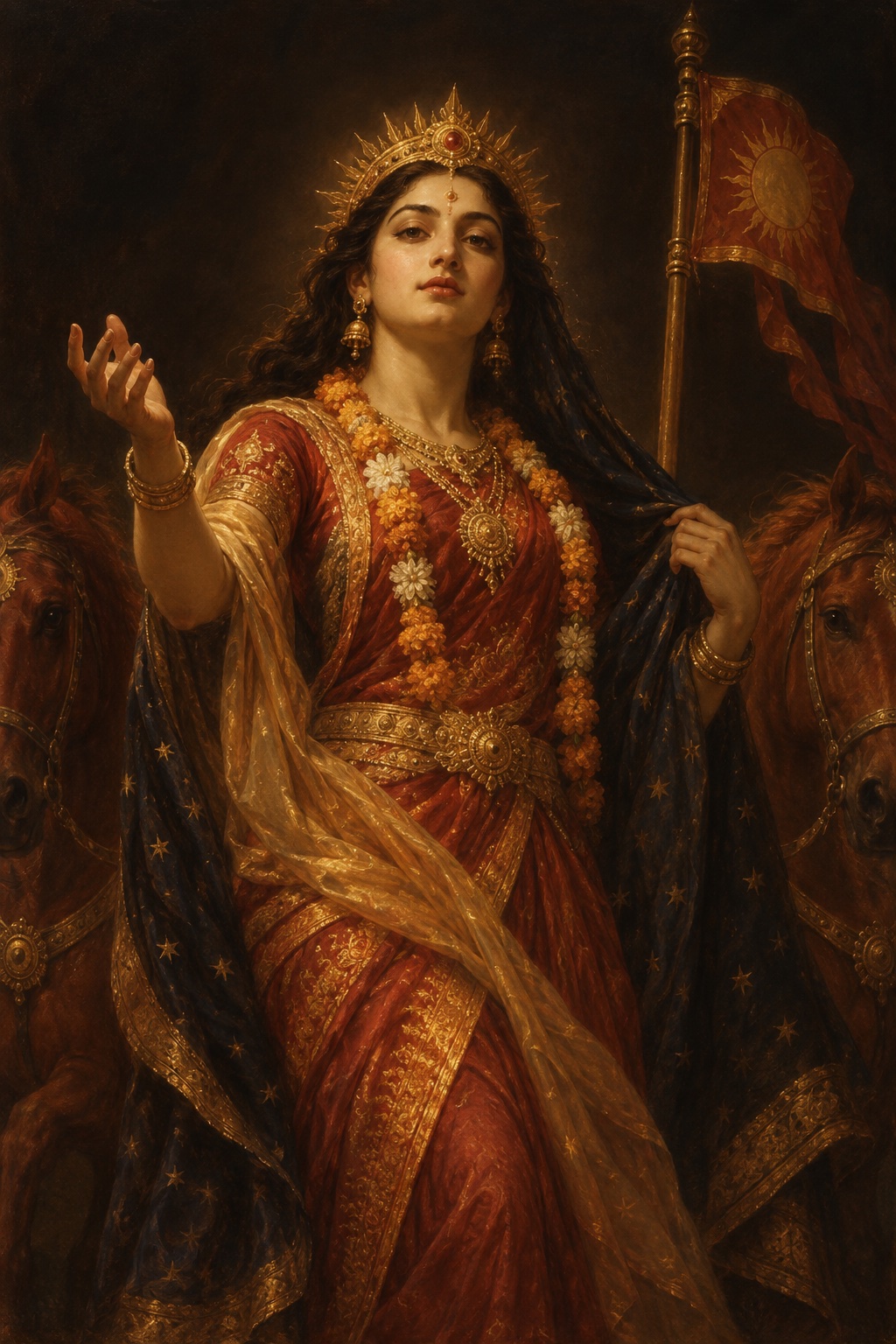
Eos is born, with her brother Helios and her sister Selene, in a single sentence of Hesiod’s — Theia’s three children by Hyperion, delivered in one clause of the Theogony and never separated again in the poem. Of the three, Helios keeps a portfolio of his own and Selene rides out nightly, but Eos is the one who does something: she seizes a mortal man, asks a god a favor on his behalf, and gets exactly what she asks for. Two words survive from the passage that tells that story — she is golden-throned, and, in the same lines, early-born — and both describe her literally in the act of doing the one thing anyone still remembers her for.
The gift she forgot to finish
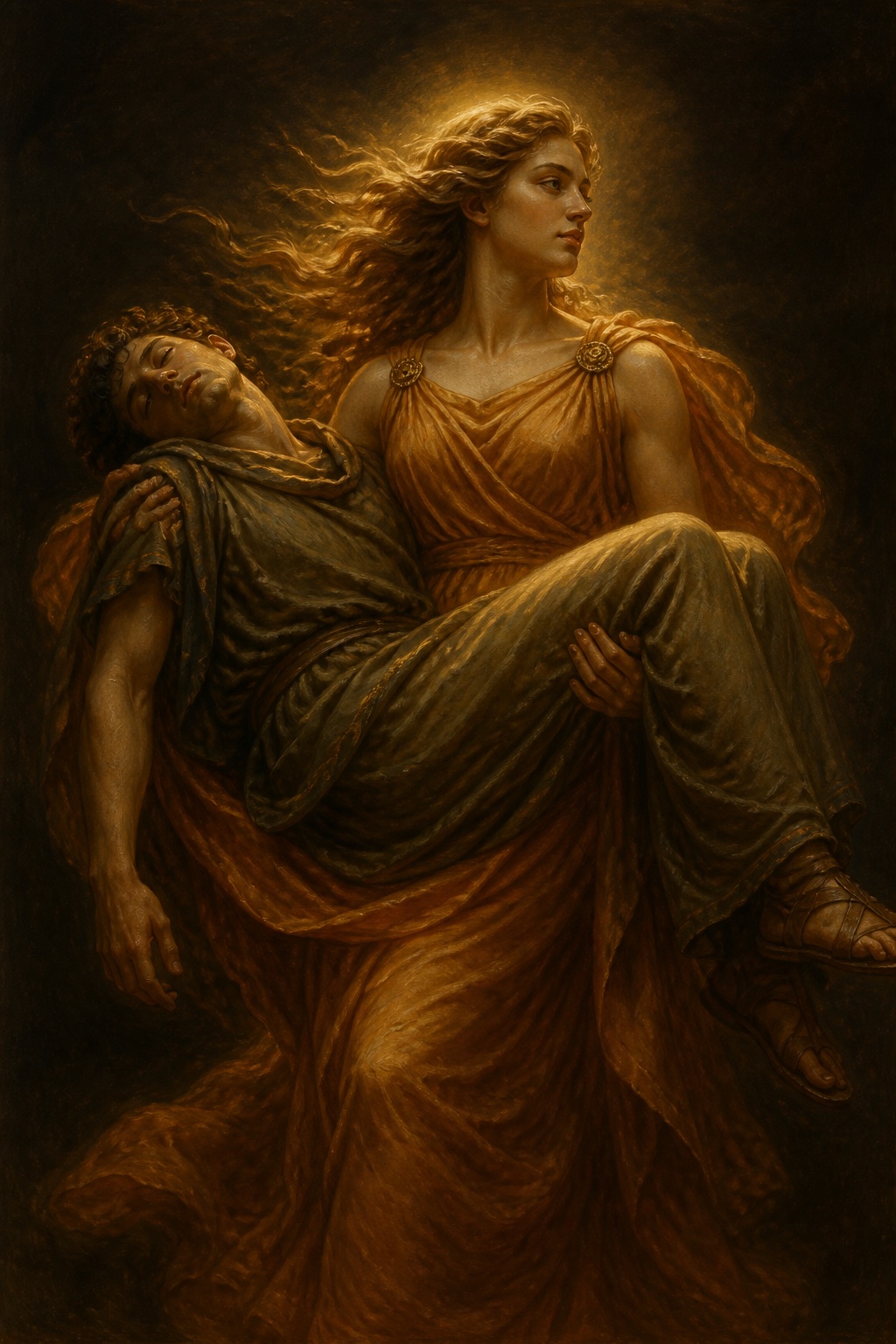
Aphrodite has just been caught in bed with the mortal Anchises, in the fifth Homeric Hymn, and Zeus’s revenge is a lecture: she must now recite every case of a god who loved a mortal and lived to regret it. Eos furnishes the cruelest example on her own list.
ὣς δ’ αὖ Τιθωνὸν χρυσόθρονος ἥρπασεν Ἠὼς ὑμετέρης γενεῆς ἐπιείκελον ἀθανάτοισι. βῆ δ’ ἴμεν αἰτήσουσα κελαινεφέα Κρονίωνα ἀθάνατόν τ’ εἶναι καὶ ζώειν ἤματα πάντα· τῇ δὲ Ζεὺς ἐπένευσε καὶ ἐκρήηνεν ἐέλδωρ. νηπίη, οὐδ’ ἐνόησε μετὰ φρεσὶ πότνια Ἠὼς ἥβην αἰτῆσαι, ξῦσαί τ’ ἄπο γῆρας ὀλοιόν. τὸν δ’ ἦ τοι εἵως μὲν ἔχεν πολυήρατος ἥβη, Ἠοῖ τερπόμενος χρυσοθρόνῳ ἠριγενείῃ ναῖε παρ’ Ὠκεανοῖο ῥοῇς ἐπὶ πείρασι γαίης· αὐτὰρ ἐπεὶ πρῶται πολιαὶ κατέχυντο ἔθειραι καλῆς ἐκ κεφαλῆς εὐηγενέος τε γενείου, τοῦ δ’ ἦ τοι εὐνῆς μὲν ἀπείχετο πότνια Ἠώς, αὐτὸν δ’ αὖτ’ ἀτίταλλεν ἐνὶ μεγάροισιν ἔχουσα σίτῳ τ’ ἀμβροσίῃ τε καὶ εἵματα καλὰ διδοῦσα. ἀλλ’ ὅτε δὴ πάμπαν στυγερὸν κατὰ γῆρας ἔπειγεν οὐδέ τι κινῆσαι μελέων δύνατ’ οὐδ’ ἀναεῖραι, ἥδε δέ οἱ κατὰ θυμὸν ἀρίστη φαίνετο βουλή· ἐν θαλάμῳ κατέθηκε, θύρας δ’ ἐπέθηκε φαεινάς. τοῦ δ’ ἦ τοι φωνὴ ῥέει ἄσπετος, οὐδέ τι κῖκυς ἔσθ’ οἵη πάρος ἔσκεν ἐνὶ γναμπτοῖσι μέλεσσιν
So also golden-throned Eos rapt away Tithonus who was of your race and like the deathless gods. And she went to ask the dark-clouded Son of Cronos that he should be deathless and live eternally; and Zeus bowed his head to her prayer and fulfilled her desire. Too simply was queenly Eos: she thought not in her heart to ask youth for him and to strip him of the slough of deadly age. So while he enjoyed the sweet flower of life he lived rapturously with golden-throned Eos, the early-born, by the streams of Ocean, at the ends of the earth; but when the first grey hairs began to ripple from his comely head and noble chin, queenly Eos kept away from his bed, though she cherished him in her house and nourished him with food and ambrosia and gave him rich clothing. But when loathsome old age pressed full upon him, and he could not move nor lift his limbs, this seemed to her in her heart the best counsel: she laid him in a room and put to the shining doors. There he babbles endlessly, and no more has strength at all, such as once he had in his supple limbs. — Homeric Hymn 5, To Aphrodite 218–238, tr. Evelyn-White
Every clause runs in Eos’s favor until the exact moment it stops. She is the one who acts: she seizes Tithonus, she goes to Zeus herself, she asks, and the god does not refuse her, attach a condition, or offer a warning — he simply gives her the one thing she asked for. The hymn’s judgment on what follows is blunt. It says only that Eos was “too simply” queenly: she never thought, in her heart, to ask youth for him as well, or “to strip him of the slough of deadly age.” While the flower of youth lasts they live together by the streams of Ocean; then his hair goes grey and she withdraws from his bed, though she still houses him, feeds him, and clothes him; then old age presses fully on him, until her own best judgment is to shut him behind “the shining doors.” What is left of him afterward is a voice that “babbles endlessly,” with none of the strength once in his supple limbs. Eos gets precisely what she asked for, to the letter of the grant, and is undone entirely by the one clause it never occurred to her to add.
Nothing in this hymn gives the pair any children. The one union of Eos’s that Greek poetry does credit with offspring belongs to a different partner altogether.
Consort of Astraeus
Hesiod records that other union a few lines after the sentence that gives Hyperion his own family, in the same stretch of the Theogony that lists the next generation’s marriages one by one.
Ἀστραίῳ δ᾽ Ἠὼς ἀνέμους τέκε καρτεροθύμους, ἀργέστην Ζέφυρον Βορέην τ᾽ αἰψηροκέλευθον καὶ Νότον, ἐν φιλότητι θεὰ θεῷ εὐνηθεῖσα. τοὺς δὲ μέτ᾽ ἀστέρα τίκτ’ Ἠοσφόρον Ἠριγένεια ἄστρα τε λαμπετόωντα, τά τ᾽ οὐρανὸς ἐστεφάνωται
And Eos bare to Astraeus the strong-hearted winds, brightening Zephyrus, and Boreas, headlong in his course, and Notus, — a goddess mating in love with a god. And after these Erigenia bare the star Eosphorus (Dawn-bringer), and the gleaming stars with which heaven is crowned. — Hesiod, Theogony 378–382, tr. Evelyn-White
The list is short but exact: three winds, named individually and fathered by Astraeus on Eos; then, after them, the Morning Star, glossed in Evelyn-White’s own translator’s parenthesis as “Dawn-bringer”; and the stars in general, gleaming, that crown the sky. Hesiod calls her Erigenia here — Evelyn-White’s rendering of the very word that names her “the early-born” in the Tithonus hymn, now standing in as a name of its own. This is the pairing genealogy actually assigns her: structurally the same shape as her own parents’ marriage, a goddess of the second Titan generation paired with a consort and credited with named children, rather than the unfinished, childless episode with a mortal man that the rest of this entry is about.