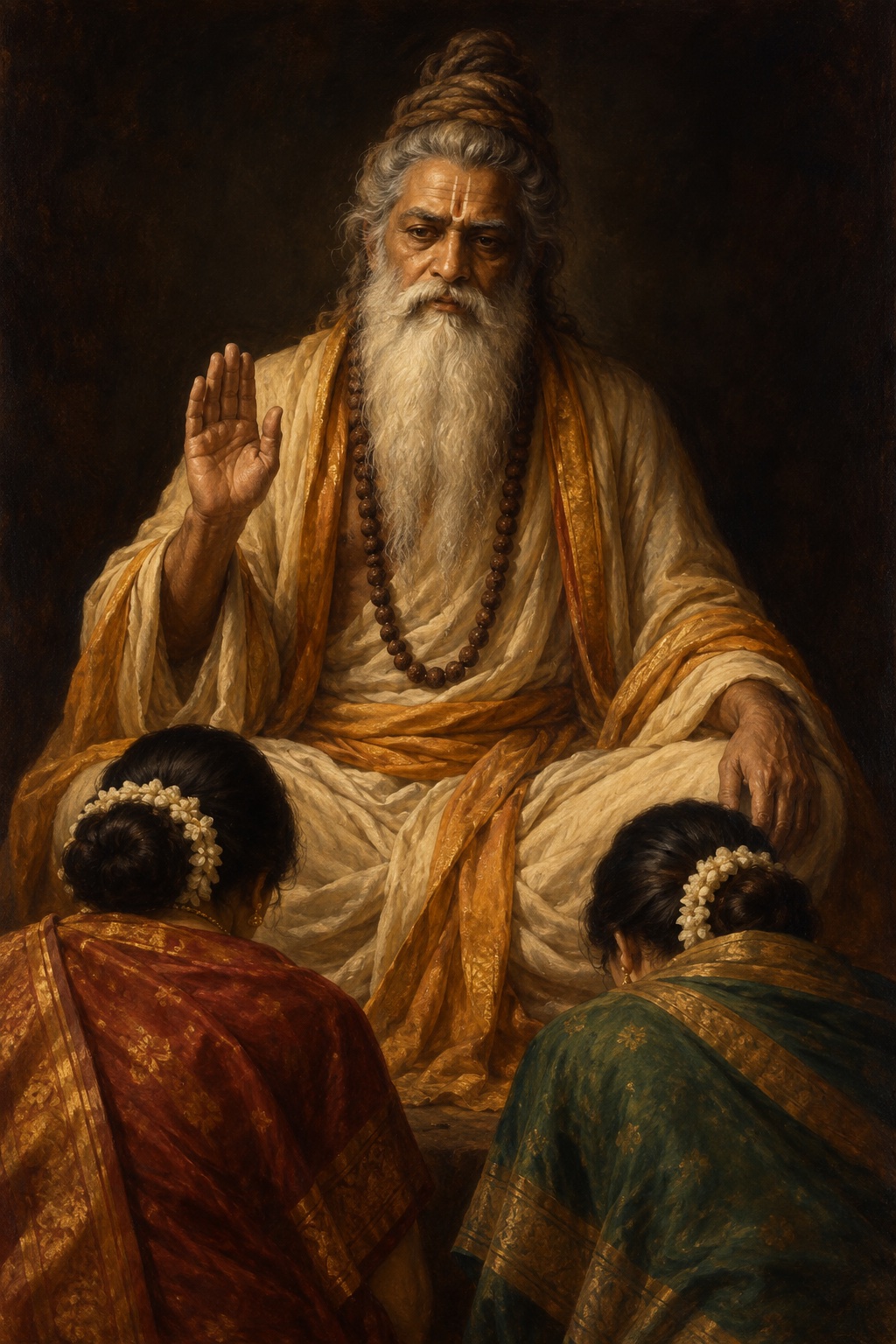
Two wives, and the children each of them named
Most of what the epic says about him is a list. He is the son through whom the creatures descend, the husband of thirteen daughters of Daksha, the father of gods and Asuras alike — all of it stated, none of it shown. The Astika sub-parva of the Adi Parva is the one place where the universal progenitor is put on stage and made to act, and what he does there takes four verses. Two of the daughters of Daksha are his wives. He is pleased with them, and he offers each of them a boon of her own choosing.
ते भार्ये कश्यपस्यास्तां कद्रूश्च विनता च ह। प्रादात्ताभ्यां वरं प्रीतः प्रजापतिसमः पतिः।। कश्यपो धर्मपत्नीभ्यां मुदा परमया युतः। वरातिसर्गं श्रुत्वैवं कश्यपादुत्तमं च ते।। हर्षादप्रतिमां प्रीतिं प्रापतुः स्म वरस्त्रियौ। वव्रे कद्रूः सुतान्नागान्सहस्रं तुल्यवर्चसः।। द्वौ पुत्रौ विनता वव्रे कद्रूपुत्राधिकौ बले। तेजसा वपुषा चैव विक्रमेणाधिकौ च तौ
“in the Krita (golden) age Prajapati had two fair and virtuous daughters named Kadru and Vinata. The sisters were the wives of Kasyapa. Highly gratified with his virtuous wives, Kasyapa, resembling Prajapati himself, was desirous of conferring on each of them a boon. The ladies were all joy because their lord was willing to confer on them choice blessings. Kadru said, ‘I would be mother of a thousand snakes of equal vigor.’ And Vinata wished to bring forth two sons surpassing the thousand offspring of Kadru in strength, energy, size of body, and bravery.” — Mahabharata 1.16.6–9 (Adi Parva Section XVI, Astika Parva), tr. K. M. Ganguli
The Sanskrit measures him in one phrase: प्रजापतिसमः पतिः, a husband who is the equal of a Prajapati, a lord of creatures. That is a comparison, not a title, and the passage earns it by what he then declines to do. He does not decide what they will bear. He lets each wife name it herself, and the two names are opposites. Kadru asks for number — a thousand snakes, all of equal vigour, a brood with no ranking inside it. Vinata asks for rank — two sons only, defined entirely by exceeding Kadru’s thousand in strength, energy, size of body and bravery. The rivalry that drives the rest of the Astika parva, the wager, Vinata’s servitude and the snake sacrifice that frames the whole first book, is already fully specified in those two requests, and he grants both without comment.
Two things in the English are Ganguli’s and not the epic’s, and both matter to a reader following the names. The Prajapati whose daughters these are is Daksha, the lord of creatures who gave thirteen of them to Kashyapa. And the Krita or golden age is Ganguli’s gloss on a Sanskrit word that says only the former age of the gods. One verse sits between this passage and the next, and it is the verse where translator and original disagree outright about who is speaking: the Sanskrit gives the assent to Vinata, Ganguli gives it to Kashyapa. Both quoted spans skip it, so nothing here rests on it. He grants what is asked — that much the two sides agree on.
The instruction he leaves behind
He says one more thing, and then he is gone.
यथावत्प्रार्थितं लब्ध्वा वरं तुष्टाभवत्तदा। कृतकृत्या तु विनता लब्ध्वा वीर्याधिकौ सुतौ।। कद्रूश्च लब्ध्वा पुत्राणां सहस्रं तुल्यवर्चसाम्। धार्यौ प्रयत्नतो गर्भावित्युक्त्वा स महातपाः।। ते भार्ये वरसंतुष्टे कश्यपो वनमाविशत्
“And having obtained her prayer, she rejoiced greatly. And having obtained two sons of splendid prowess, she regarded her boon fulfilled. And Kadru also obtained her thousand sons of equal vigor. ‘Bear your children carefully’ said Kasyapa and went to the forest, leaving his two wives gratified with his blessings.” — Mahabharata 1.16.11–13a (Adi Parva Section XVI, Astika Parva), tr. K. M. Ganguli
Four verbs are his whole part in the episode: he is pleased, he offers, he grants, he goes. The carrying he assigns to them — धार्यौ प्रयत्नतो, they are to be borne with effort — and that instruction is the last of him the section contains. What follows it is the story of the instruction being disobeyed. After a long time Kadru lays a thousand eggs and Vinata two, and the eggs are set aside in warm vessels. Five hundred years later Kadru’s thousand burst and her brood comes out; Vinata’s two do not. She breaks one of hers and finds inside it an embryo developed above and undeveloped below, and the child in the egg curses her for the impatience: she will be a slave until his brother frees her. Every disaster in the Astika parva runs down from that one act, and the father who told her to carry carefully is by then in the forest and does not reappear in the episode at all.
वनमाविशत्, he entered the forest. It is the closing verb of the scene and it is characteristic. Where other progenitors in this literature preside over what they beget, he issues a specification, hands it over, and withdraws from the consequences before they begin.
The father on Gandhamadana
Fourteen sections later he is on stage again, and this time he is not a progenitor at all. He is somebody’s father, dealing with a problem his son has brought him.
Garuda, on his way to fetch the amrita, has taken an elephant and a tortoise in his claws and settled on a branch to eat them, and the branch has broken. Hanging head-down from it are the Valakhilyas, thumb-sized ascetics whose anger would burn him to nothing. Carrying the branch rather than drop them, he searches the regions below and finds no spot anywhere he can safely sit, and comes at last to the foremost of mountains, called Gandhamadana, where he sees his father engaged in ascetic devotions. Kashyapa’s first words to his son are a warning against doing anything rash. Then he does the thing that actually solves it.
ततः प्रसादयामास कश्यपः पुत्रकारणात्। वालखिल्यान्महाभागांस्तपसा हतकल्मषान्।। कश्यप उवाच। प्रजाहितार्थमारम्भो गरुडस्य तपोधनाः। चिकीर्षति महत्कर्म तदनुज्ञातुमर्हथ
“And Kasyapa then propitiated, for the sake of his son, the Valakhilyas of exceeding good fortune and whose sins had been destroyed by ascetic penances. And Kasyapa said, ‘Ye whose wealth is asceticism, the essay of Gadura is for the good of all creatures. The task is great that he is striving to accomplish. It behoveth ye to accord him your permission.’” — Mahabharata 1.30.16–17 (Adi Parva Section XXX), tr. K. M. Ganguli
The plea is short and it is not addressed to Garuda. He turns to the people who hold the obstacle and argues his son’s case to them, on the ground that the errand is for the good of all creatures, and then asks their permission instead of assuming it. The sages release the branch and go, and Garuda goes on. Gadura is how this printing spells the name across Sections XXIX and XXX; the quotation keeps it and the rest of this entry does not.
The procedure is the same as in the boon scene, transposed. He is approached, he consents, he obtains from a third party the permission the petitioner needs, and he leaves the outcome to whoever wanted it. He is powerful in both scenes and initiates nothing in either.
Two genealogies that do not meet
The genealogy his name usually carries comes from two sections much later in the same book, and it has to be kept apart from the Vedic material that this wiki’s Aditi and Daksha entries are built on, because the two do not describe the same world.
Adi Parva LXV lays out the epic line. Brahma has six mind-born sons, of whom Marichi is one; Marichi’s son is Kashyapa; and from Kashyapa the creatures spring. The thirteen daughters of Daksha — Aditi, Diti, Danu, Vinata, Kadru and the rest — are Kashyapa’s wives, and from Aditi come the twelve Adityas. Section LXVI states the consequence in a single line: his offspring are the gods and the Asuras both, and therefore he is the Father of the worlds. That is the one epithet this entry carries, and it is a claim about reach rather than rank. He is nowhere the highest god in these chapters. He is the single point through which two permanently hostile populations both descend, which is a harder thing to be and a much stranger one.
Indra, Varuna, Mitra and Vivasvat are all named among the twelve in LXV, and Indra heads the list in LXVI. That fatherhood is an epic claim and only an epic claim. The Rigveda’s own creation hymn, 10.72, has no Kashyapa in it anywhere: there Aditi is born of Daksha and Daksha of Aditi, each of them the other’s parent, and the gods arrive after her. Nothing in the hymn makes Kashyapa anyone’s father, and nothing in the epic sections makes Aditi her own father’s mother. These are two layers of one tradition that reuse three names, not two versions of one story, and this entry keeps them in that order — the hymn where the wiki’s Aditi and Daksha live, and the epic where Aditi’s husband and Daksha’s son-in-law does.
One name in the epic list is deliberately left out of this entry’s relations. LXVI ends its twelve Adityas with Vishnu, called the youngest of them and the one the worlds depend on — a placement that the Vishnu of later devotion does not make about himself, and that this entry records rather than asserts. The four sons named above are the safe set, and they are the ones the corpus already agrees on.
On the epic’s own count he is third — Brahma, then Marichi, then him — which is why this entry files him as a god rather than as a primordial. He belongs to no first generation. What he is, in every passage that shows him doing anything at all, is the place a generation passes through: a man sitting still in a forest or on a mountain, granting what is asked of him, and leaving the consequences to the person who asked.