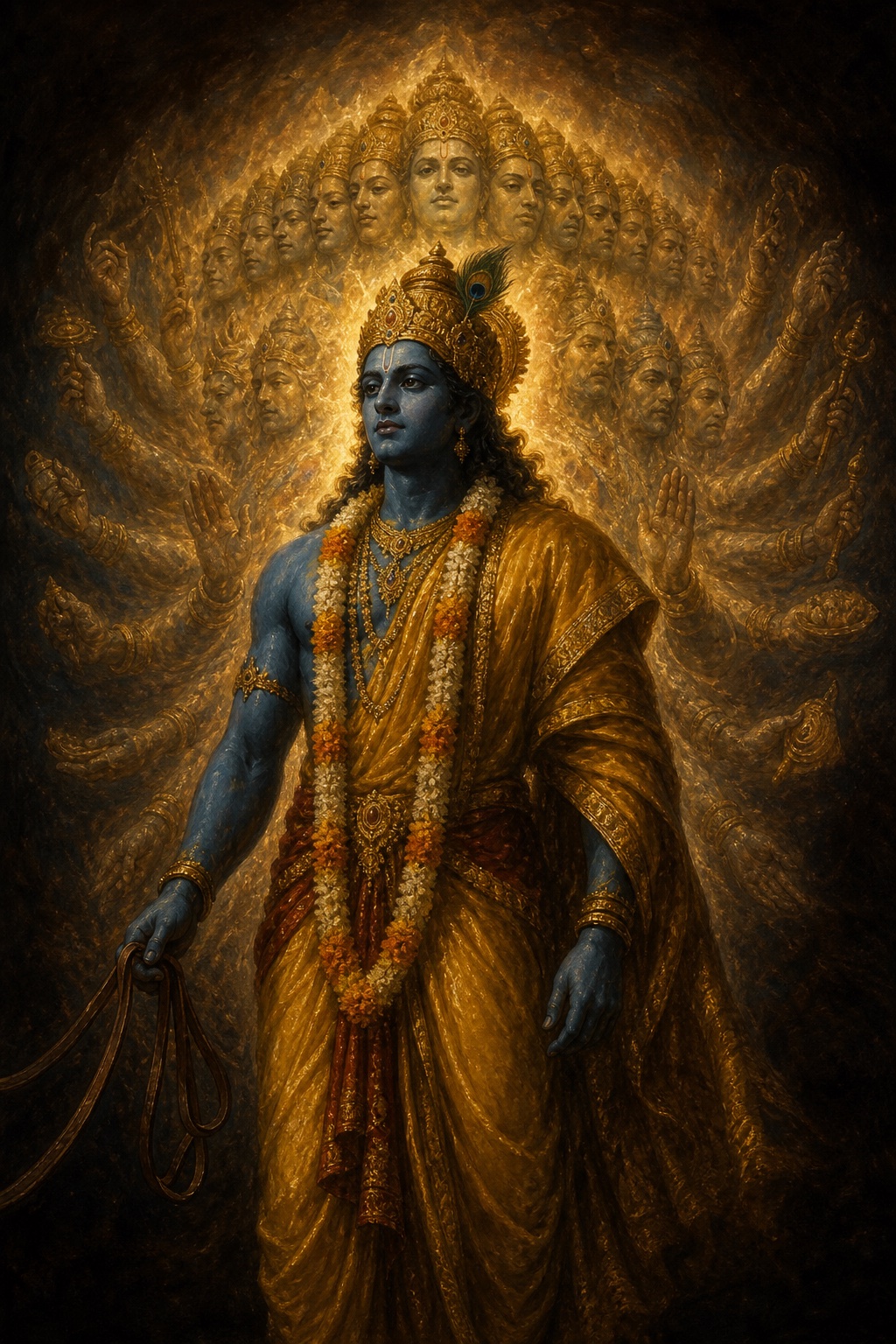
The vision on the battlefield
On the field of Kurukshetra, moments before the Mahabharata’s great war begins, Arjuna falters — he cannot bring himself to fight kinsmen and teachers arrayed on the other side. Krishna, serving as his charioteer, answers with the teaching that becomes the Bhagavad Gita, and near its climax grants Arjuna a vision of his true, universal form: every god, every world, every being folded into one blazing body. Terrified, Arjuna asks what he is looking at, and Krishna answers.
कालोऽस्मि लोकक्षयकृत्प्रवृद्धो लोकान्समाहर्तुमिह प्रवृत्तः । ऋतेऽपि त्वां न भविष्यन्ति सर्वे येऽवस्थिताः प्रत्यनीकेषु योधाः ॥११- ३२॥
“Time am I, laying desolate the world, Made manifest on earth to slay mankind! Not one of all these warriors ranged for strife Escapeth death; thou shalt alone survive.” — Bhagavad Gita 11.32, tr. Besant
The line is the poem’s most quoted, and, once compressed by a very different reader for a very different occasion, its most famous: J. Robert Oppenheimer’s recollection of it, recalling the first atomic test decades later, renders Krishna’s words as a starker line about becoming Death itself. What Krishna actually says here is narrower and stranger: not that he brings death, but that he is Time, and the deaths already gathering on the field ahead will happen whether or not Arjuna raises his bow.
Charioteer, counselor, teacher
Krishna takes up no weapon in the war himself. By the terms he sets before the armies engage, he serves one side only as counsel, driving Arjuna’s chariot rather than fighting from it — the entire Bhagavad Gita is delivered in the pause between the armies’ advance and the first arrow, a doctrine of right action offered to a warrior who would rather not act at all. His own clan, the Yadavas, takes no side in the war; his allegiance to Arjuna and the Pandava brothers is personal rather than tribal, chosen rather than owed.
Cowherd of Vrindavana, king of Dwaraka
The counselor at Kurukshetra is, by the time of the war, already old in story. He is born to Vasudeva and Devaki in a prison cell at Mathura, under a prophecy that marks him for the death of his uncle Kamsa, the city’s king; smuggled out the night of his birth, he is raised instead by the cowherd Nanda and his wife Yashoda in Vrindavana, alongside his elder brother Balarama. The childhood the tradition keeps retelling is a pastoral one — a butter-thief, a flute-player, the god who lifts a hill on a single finger to shelter the cowherds from a storm of rain — before the return to Mathura and the killing of Kamsa the prophecy demanded. He later rules as king from Dwaraka, a city built on land reclaimed from the sea, and marries Rukmini, princess of Vidarbha, after she writes to him asking to be rescued from a match arranged against her will — the same Rukmini whom Lakshmi’s own tradition names as her incarnation for this life, just as she is Sita for Rama’s. The gopis of Vrindavana, and in the later devotional tradition Radha above all of them, remain his other great romantic memory, one the Puranas keep carefully apart from the queen he marries.
Avatar, or the god himself
Vishnu’s own tradition counts Krishna as the eighth of the ten avatars, the Dashavatara, coming after Rama and before Buddha — one incarnation among many, called down whenever the world’s order needs restoring. Rama, the Dashavatara’s seventh, is filed in this wiki as a hero rather than a god, on the strength of his own defining passage: a portrait of virtue, not a claim to divinity. Krishna’s defining verse asks the same question of him and answers it differently.
Later, the story ends almost carelessly: a hunter named Jara, mistaking his foot for a deer’s, puts an arrow through the one weak point on Krishna’s body, and the god who could not be killed by gods or demons dies of an ordinary hunting accident in a forest.