Budge writes Khepera
This entry’s name is not the source’s name. Budge, whose account of Heliopolis is the fullest one available in English, never writes “Khepri” — not once in either volume. He writes Khepera, and it is the same god: the self-created power at the root of the Heliopolitan creation story, the sun as it stands at the one hour it has not yet fully risen. (His raw text does contain the string “Khepri” exactly once, but it names an unrelated serpent of the underworld — a different figure that happens to share the same root the two names come from.)
The fullest statement of that self-creation survives in the Book of Knowing the Evolutions of Ra, a text Budge dates to about 312 BC, copied out for a priest of Panopolis named Nes-Amsu. In it the creator-god Neb-er-tcher, a form of Ra, speaks in the first person about his own beginning.
I am he who came into being in the form of the god Khepera — The Book of Knowing the Evolutions of Ra, in E. A. Wallis Budge, The Gods of the Egyptians (1904), vol. 1
Nothing comes before that clause. Neb-er-tcher does not take on an existing form; he becomes the form, and everything that follows in the speech works outward from that single fact.
I was the creator of that which came into being, that is to say, I was the creator of everything which came into being — The Book of Knowing the Evolutions of Ra, in E. A. Wallis Budge, The Gods of the Egyptians (1904), vol. 1
What he made, in this account, he did not make with his hands. Egyptian theology tells the making of the world more than once and locates it in more than one god: at Memphis, in the text this atlas already gives under Ptah, Thoth speaks the creative command and Ptah and Khnemu carry it out at the bench and the potter’s wheel — one god’s word, two gods’ labour. Neb-er-tcher’s Heliopolitan account needs no second party:
when I had come into being myself, the things which I created and which came forth from out of my mouth were very many — The Book of Knowing the Evolutions of Ra, in E. A. Wallis Budge, The Gods of the Egyptians (1904), vol. 1
Speaker, act, and creator are one figure here, and no other.
Ra at dawn, Atum at dusk
The power that speaks in that text does not keep one name for a whole day. In the Myth of Ra and Isis, Ra names his own succession of forms to Isis directly: Khepera when morning comes, Ra himself at noon, and Temu — the Atum this atlas already tracks under his own entry — once evening falls. Ra’s own entry here has, since it was written, aged through the day the same way: a scarab-child at dawn, a falcon-headed noon, a ram-headed dusk. Khepri was always the missing third of a set this corpus already knew it had.
That leaves him no parentage of his own to add. The Evolutions speech that opens this entry is a Ra-Tem text under a third name, and the same creator this atlas already credits — as Atum — with producing Shu and Tefnut is the one declaring itself Khepera here. The theology was not built to settle which of the day’s three names owns that act, and this entry does not settle it either.
The forerunner of the rising sun
Budge’s account of the Twelfth Hour of the Tuat, the last hour of the sun’s nightly crossing before daybreak, describes the solar barque changing its furniture for that final stretch. The disk that rides at its prow through every other hour of the night is gone, and something else has taken its place.
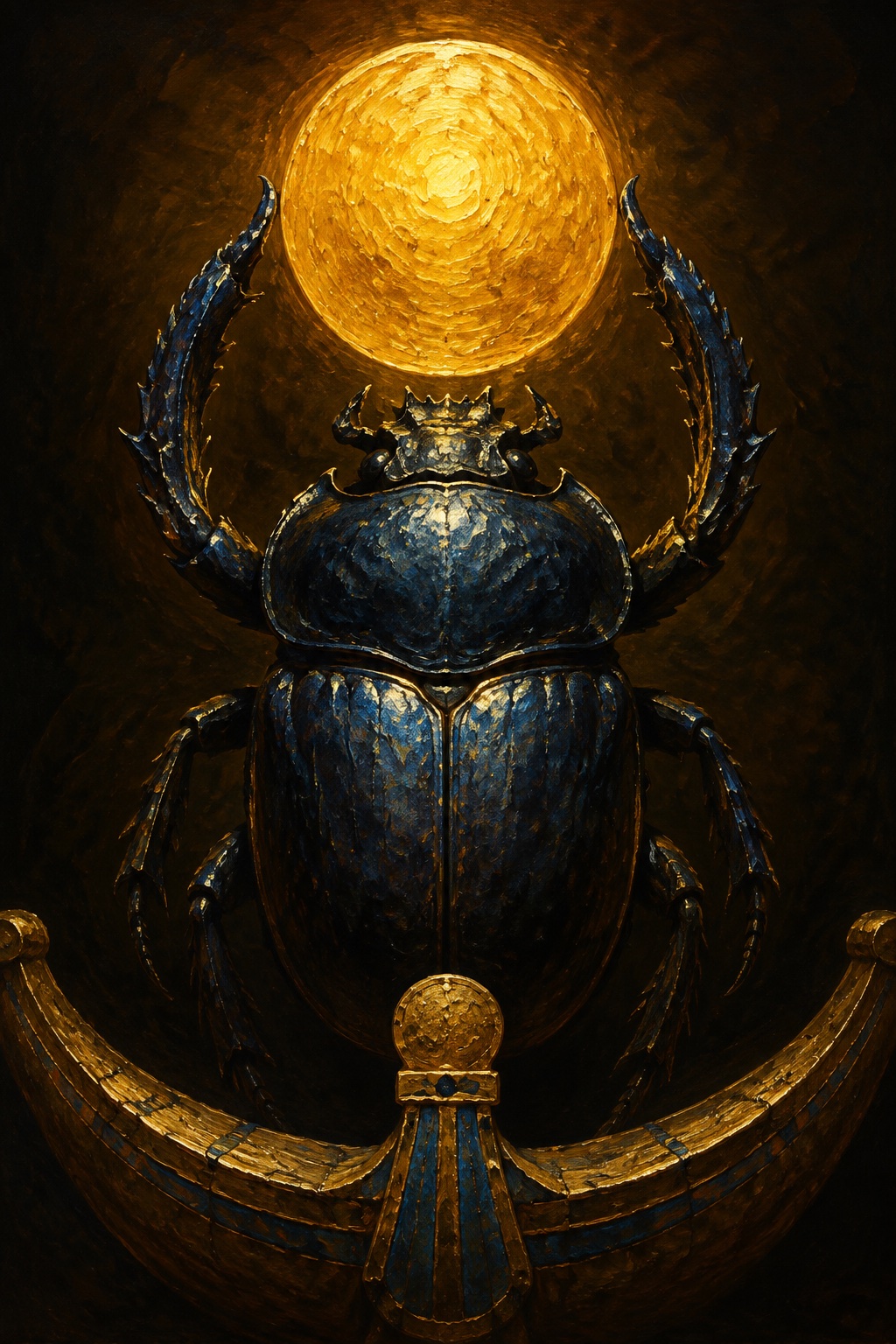
its place is occupied by the beetle of Khepera, the forerunner of the rising sun — E. A. Wallis Budge, The Gods of the Egyptians (1904), vol. 1
That is the whole of Khepri’s iconography in one image: not an animal added to a god who already had a shape, but a body standing in for the sun’s own disk at the single hour when the sun is no longer merely dark but not yet risen either. Budge elsewhere explains the logic behind the substitution — the Egyptians watched a scarab roll a ball of dung into a sphere and push it along the ground, and reasoned from that to the sun’s disk, pushed the same way across the sky by the same kind of creature. The dung ball is not a second emblem beside the disk; it is the reason the disk was ever given to this insect in the first place.
Becoming, and being born again
Budge’s account of that same Twelfth Hour gives the crossing one more property besides the beetle at the prow: passing through it is what returns the sun each morning not merely alive but young again, ready for a full day exactly as if the previous one had not happened. Khepri does not have a birth story separate from this. He has no father, no mother, nothing that happened to him before he happened.
The Evolutions speech that opens this entry is not a genealogy missing one generation. It is the whole of his own account of himself, repeated once for every sunrise there has ever been — becoming, not as one of his attributes, but as the entire content of what he is.