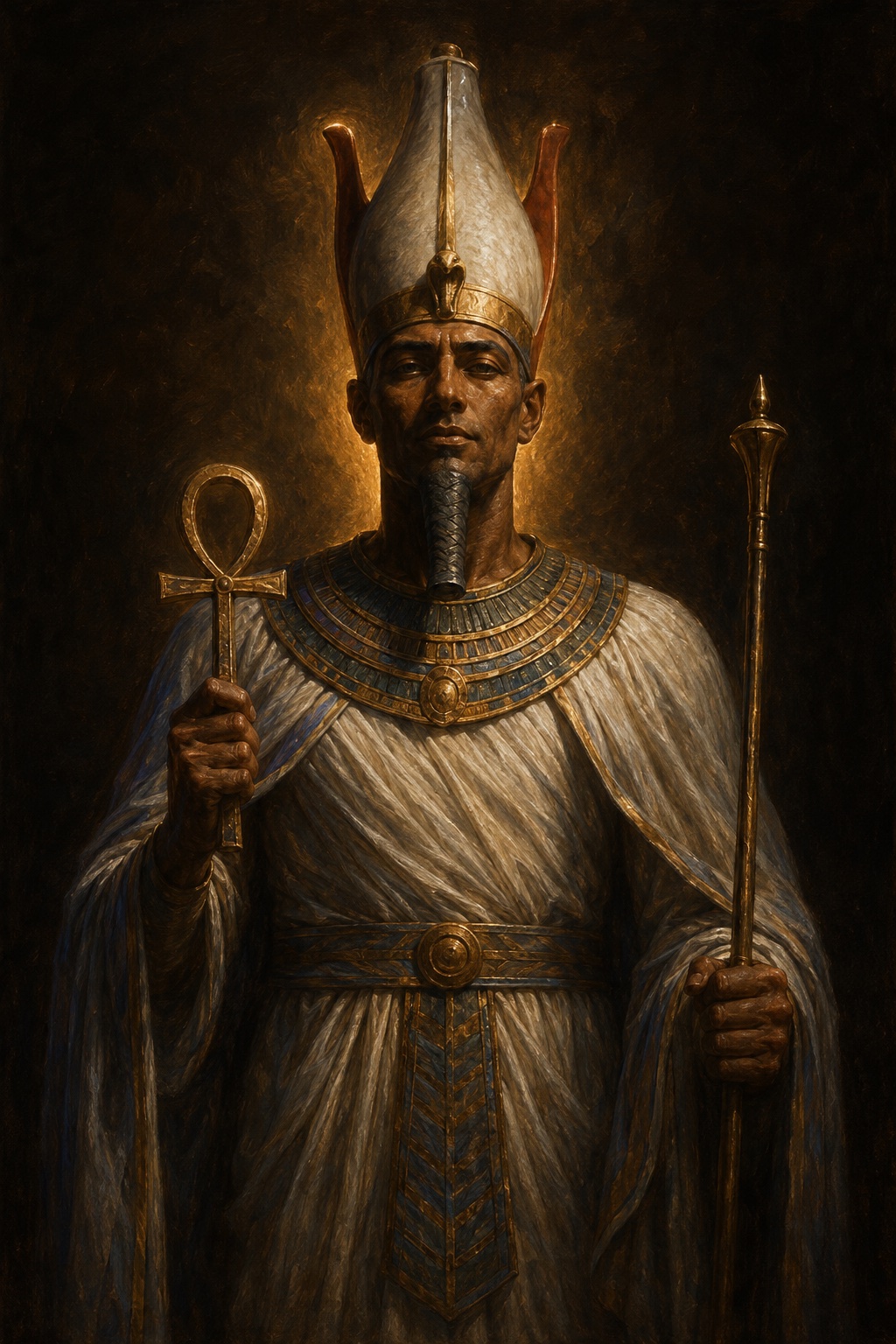
Budge calls him Tem
The name this entry carries is not the name in its source. Budge, writing the fullest English account of the Heliopolitan gods available in the public domain, never writes “Atum” — not once in either volume. He writes Tem, and Temu, and occasionally Atem, and it is the same god: the local deity of Annu, the city the Greeks called Heliopolis, whose priesthood put its theology on top of the whole country.
What he was there is easy to state and strange to sit with.
Tem was the first living man-god known to the Egyptians, just as Osiris was the first dead man-god, and as such was always represented in human form and with a human head — E. A. Wallis Budge, The Gods of the Egyptians (1904), vol. 1
Every other major god in this corpus has an animal somewhere. Ra takes the falcon’s head at noon and the ram’s at dusk; Thoth has the ibis, Anubis the jackal, Sekhmet the lioness, Horus the hawk. Atum has none, ever, and Budge treats that as a date rather than a preference — the point at which Egyptian religion stopped assigning animal forms to its gods and started working on the idea of a god who is simply, entirely, a person. He wears the crowns of the South and North, holds the ankh in his right hand and the sceptre in his left, and that is the whole of his equipment.
The two that issued from himself
The Heliopolitan creation runs through him, and it runs through his body. Alone on the primeval mound with nobody to couple with, he produces the first pair — air and moisture — out of himself. The Pyramid Texts describe the act in physical detail; Budge, summarising the doctrine his priests formulated, states it as a proposition.
the god Tem produced the two gods that issued from himself, i.e., Shu and Tefnut — E. A. Wallis Budge, The Gods of the Egyptians (1904), vol. 1
Everything else in the Ennead follows in the ordinary way. From Shu and Tefnut come Geb and Nut, earth and sky; from Geb and Nut come Osiris, Isis, Set and Nephthys. Three generations, and only the first one is impossible.
The corpus records that first generation from the children’s side, and it names a different father. Shu and Tefnut both name Ra as their father, which is not an error and not a disagreement: at Heliopolis the priests of Ra joined their god to the local god and addressed their hymns to Ra-Tem or Tem-Ra, a single compound deity. Whether the being on the mound is Ra or Tem is a question the theology was built specifically not to have to answer.
Ra when he rises, Temu when he sets
The one place the two do come apart is the time of day.
thou who art Ra when thou risest, and Temu when thou settest — Hymn to Ra, Papyrus of Hunefer, in E. A. Wallis Budge, The Gods of the Egyptians (1904), vol. 1
Ra is the sun in the sky; Atum is the sun going down. The doctrine attached to that is not merely descriptive. The Heliopolitan priesthood taught that souls leaving the world waited in Amentet until the Boat of the Setting Sun arrived, and those who were properly buried and properly equipped were taken aboard. Atum is the form of the sun that collects the dead, which is how a creator ends up being the god a Pyramid Text prays to for a place at the head of the gods.
It also puts the creation and the sunset in the same figure, which is not a contradiction in Egyptian terms but a completed circuit. He is what there was before anything, and he is what the day turns into.
God One
Budge’s most striking material on him is a run of epithets, applied to the compound Ra-Tem, which he quotes to argue that Egyptian religion was at bottom monotheistic.
lord of heaven, lord of earth, maker of beings celestial and of beings terrestrial, God One, who came into being in primeval time, maker of the world, creator of rational beings, maker of Nu — E. A. Wallis Budge, The Gods of the Egyptians (1904), vol. 1
Maker of Nu is the clause worth stopping on. Nu is the primeval abyss, the water that is there before creation and out of which the sun first rose — including, in the version this same corpus records under Ra, the water Ra himself rose from. Here the abyss is something the god made. The sequence has no first term that is not him.
Budge applies the same argument to Ta-tunen and to Osiris, both of whom get called “God One” too, and the accumulation is the point rather than a problem: an Egyptian priesthood asserting supremacy for its own god did not thereby demote anyone else’s. What survives in Atum’s case is a god defined by a completely self-contained beginning — self-produced, self-emptied to make his children, and, alone among them, wearing nobody else’s face.